

Written by students who passed Immediately available after payment Read online or as PDF Wrong document? Swap it for free 4.6 TrustPilot
logo-home
Document preview thumbnail
Preview 2 out of 15 pages
Exam (elaborations)

Nursing Theories and Nursing Practice Final Exam Questions and Approved Correct Answers 2025

Document preview thumbnail
Preview 2 out of 15 pages

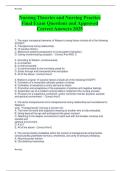
Nursing Theories and Nursing Practice Final Exam Questions and Approved Correct Answers 2025 1. The major conceptual elements of Watson's caring theory include all of the following EXCEPT: A. Transpersonal caring relationship. B. 10 carative factors. C. Behavioral systems perspective of nurse-patient interaction. D. Caring moment/caring occasion. - Correct Ans-ANS: C 2. According to Watson, consciousness: A. Is contained. B. Is interconnected. C. Is communicated to the one being cared for. D. Exists through and transcends time and space. E. All of the above - Correct Ans-E 3. Watson's original 10 carative factors include all of the following EXCEPT: A. Formation of a humanistic-altruistic system of values. B. Cultivation of sensitivity to one's self and to others C. Promotion and acceptance of the expression of positive and negative feelings D. Systematic use of a problem-solving skills to implement the nursing process. E. Provision for a supportive, protective, and/or corrective mental, physical, societal, and spiritual environment. - Correct Ans-D 4. The terms transpersonal and a transpersonal caring relationship are foundational to Watson's work. "Transpersonal" conveys a concern for: A. The inner life world and subjective meaning of another who is fully embodied. B. Going beyond the ego self and beyond the given moment. C. Reaching to the deeper connections to spirit and with the broader universe and societal and spiritual environment. D. A & C E. All of the above - Correct Ans-E 5. The caring-healing modalities within the context of transpersonal caring/caritas consciousness potentiate harmony, wholeness, and unity of being by releasing: A. Neuromuscular tension. B. Old childhood memories. Nursing Nursing C. Some of the disharmony, the blocked energy that interferes with the natural healing processes. D. A & B - Correct Ans-C 6. A caring occasion occurs whenever: A. The nurse has a feeling of compassion toward the patient. B. The nurse and the patient know and like one another. C. The nurse and another come together with their unique life histories and phenomenal fields in a human-to-human transaction. D. The nurse has advanced intuitive skills. - Correct Ans-C 7. The dynamic of transpersonal caring (healing) within a caring moment is manifest in: A. A full intention. B. A field of consciousness. C. A field of dreams. D. An interpersonal transaction. - Correct Ans-B 8. In her discussion of the application of Watson's theory, Woodward proposes that collaboration and co-creation are key elements in the endeavors to translate Caring Theory into practice. She suggests that they: A. Reveal the nonlinear process and relational aspect of caring praxis. B. Demonstrate the power of a team approach. C. Provide a creative element to the endeavor. D. Reveal the true nature of those involved in the enterprise. - Correct Ans-A 9. When a nurse and another come together with their unique life histories in a human to-human transaction, this is considered a: A. Caring occasion. B. Caring moment. C. Caring consciousness. D. Caring relationship. - Correct Ans-A 10. The action and choice by the nurse and other to be in the moment is considered a: A. Caring moment. B. Caring consciousness. C. Caring relationship. D. Caring occasion. - Correct Ans-A 1. Watson proposes that: The nurse's moral commitment, intentionality, and caritas consciousness is to protect, enhance, promote, and potentiate human dignity, wholeness, and healing, wherein a person creates or co-creates his or her own meaning for existence, healing, wholeness, and living and dying. TRUE OR FALSE - Correct Ans-T Nursing Nursing 2. Woodward suggests there is a new emphasis on a change of consciousness, a focused intentionality toward caring and healing relationships and modalities, a shift toward a spiritualization of health as opposed to a limited medicalized view. TRUE OR FALSE - Correct Ans-T 1. The assumptions of the humanbecoming school of thought are written on the ___________ level of discourse: A. Ontological B. Epistemological C. Philosophical D. Theoretical - Correct Ans-C 2. In the Humanbecoming school of thought, paradoxes are: A. Opposites of the same concept. B. Problems to be solved. C. Roadblocks to becoming. D. How humans live their chosen meanings. - Correct Ans-D 3. The goal of nursing from the humanbecoming perspective is: A. Patient wellness. B. Quality of life. C. Overcoming disease. D. Patient-centered care. - Correct Ans-B 4. According to Parse, true presence is a _____________ connection A. Human-universe B. Medical-spiritual C. Nurse-patient D. Patient-wellness - Correct Ans-A 5. From a humanbecoming perspective, data are extracted from nurse-person dialogs by using: A. Empirical induction. B. Dialectical Construction. C. Conversational structuring. D. Heuristic Interpretation. - Correct Ans-D 6. The assumptions, values, and meanings expressed and shared in the language patterns of a group of people are defined by Parse as: A. A culture of care. B. Humanbecoming nursing. C. Interactive dialoging. D. Heuristic interpretation. - Correct Ans-A 7. In Parse's view, nurses should focus on: A. Patient health. Nursing Nursing B. Medical process. C. Special knowing. D. Knowing participation. - Correct Ans-D 8. According to Parse, a basic human science that has co-created human experiences as its central focus is called: A. Humanbecoming. B. Being and becoming. C. Human co-creation. D. None of the above. - Correct Ans-A 9. Parse's school of thought leads to which of the following three major themes? A. Imaging, Revealing-concealing and Transforming B. Meaning, Rhythmicity, and Transcendence C. Languaging, Connecting-separating, and Powering D. Valuing, Enabling-limiting and Originating - Correct Ans-B 10. The Parse research method extracts information from: A. Participant's medical records. B. A participant's health journal. C. Participants' dialogues. D. Hospital records. - Correct Ans-C 11. In this paradigm, nursing practice is more closely aligned with a medical model of care: A. Simultaneity paradigm. B. Totality paradigm. C. Structured paradigm. D. Humanbecoming paradigm. - Correct Ans-B 1. Newman's basic philosophy is ______________________ rather than ___________________ the patient. A. Being with, doing for B. Hearing, calling C. Being with, ignoring D. Healing, doing for - Correct Ans-A 2. Newman's focus is on: A. Healing the patient. B. Doing research. C. Partnering with the patient. D. Partnering with the doctor to fix the patient. - Correct Ans-C 3. For Newman, ________________ describes information that depicts the whole of a person's relationship with the environment and gives an understanding of the meaning of the relationships all at once. Nursing Nursing A. Holistic B. Pattern C. Process D. Mutuality - Correct Ans-B 4. Patients faced with life-threatening events or terminal illness often reflect on their lives and find ways to change their priorities. This process is termed by Newman as: A. Insight. B. Retrenching. C. Lifestyle change. D. Self-healing. - Correct Ans-A 5. The nurse, through attention and partnership, should try to facilitate: A. Healing. B. Medical procedures. C. Patient transformation. D. Patient relaxation. - Correct Ans-C 6. In Newman's system, the decisions a patient makes as his or her consciousness expands are made at: A. Turning points. B. The point of no return. C. Price points. D. Choice points. - Correct Ans-D 7. The information that provides the patient's system the capacity to interact with the environment is called: A. Consciousness. B. Subconsciousness. C. Caution. D. Intuition. - Correct Ans-A 8. To understand the patient better, Newman suggests the nurse should use a series of: A. Biometric tests. B. Clarifying questions C. Surveys. D. None of the above - Correct Ans-B 9. In Newman's view, health is composed of: A. Mental well-being. B. Both disease and wellness. C. Medical cure of disease. D. A positive mental attitude. - Correct Ans-B 10. According to Newman, being in the present with a family and not being chained by linear time is an example of: Nursing Nursing A. Resonating with the whole. B. Attention to pattern and meaning. C. Process of expanding consciousness. D. Choice points for action potential. - Correct Ans-C 1. According to Newman, during illness, both the patient and the caregiver encounter alterations in movement, space, time, and consciousness. T or F - Correct Ans-TRUE 1. Which of the following theorists influenced Kolcaba's development of comfort theory? A. Orlando, Nightingale, and Henderson B. Orlando, Orem, and Nightingale C. Orlando, Henderson, and Watson D. Orlando, Henderson, and Paterson and Zderad - Correct Ans-D 2. For Kolcaba, the outcome of comfort is the immediate experience of being strengthened when needs for ______, _______ and ______ are met. A. Relief, ease, and food B. Relief, ease, and transcendence C. Ease, transcendence, and rest D. Ease, rest, and relief - Correct Ans-B 3. Kolcaba created a __________ to present the nursing meaning of comfort as a patient outcome. A. Theory diagram B. Taxonomic structure C. Research study D. Umbrella picture - Correct Ans-B 4. Being complete, whole, sound, upright, appealing, ethical, and sincere are defined by Kolcaba as qualities of: A. Health-seeking institutions. B. Magnet institutions. C. Institutional integrity. D. The U.S. health care system. - Correct Ans-C 5. Kolcaba defines interventions that produce the best possible patient and family outcomes, based on empirical evidence, as: A. Best policies. B. Best practices. C. Best measures. D. Best interventions. - Correct Ans-B 6. Interventions specified by other disciplines or by nursing protocols that include medication, treatments, monitoring schedules, insertion of lines, etc. are defined as ______ interventions by Kolcaba. A. Technical Nursing Nursing B. Coaching C. Comfort food for the soul D. All of the above - Correct Ans-A 7. Those extra special, holistic, and more time-consuming nursing interventions such as back or hand message, guided imagery, or music or art therapy are defined as ______ interventions by Kolcaba. A. Technical B. Coaching C. Comfort food for the soul D. All of the above - Correct Ans-C 1. Kolcaba asserts comfort is experienced by patients in physical, psychospiritual, sociocultural, and environmental contexts. T or F - Correct Ans-T 2. The intuitive parts of Kolcaba's Comfort Theory cannot be applied separately; they must be applied as a whole. T or F - Correct Ans-F 3. Kolcaba believes nurses already know how to practice comforting care. T or F - Correct Ans-T 1. The practice of knowing persons as whole with the use of varying technologies is called: A. Authentic intention. B. Technological competency as caring in nursing. C. Nursing technologies. D. Machine technologies. - Correct Ans-B 2. Entering the world of the other requires: A. Rapport. B. Trust. C. Commitment. D. All of the above - Correct Ans-D 3. The idealization of persons as complete human beings "in the moment" is expressed by Locsin as: A. Vulnerability. B. Substantiation. C. Wholeness. D. All of the above - Correct Ans-C 4. A shared lived experience between the nurse and nursed is called a: A. Nursing situation. B. Call for nursing. C. Nursing response. D. Nursing relationship. - Correct Ans-A Nursing Nursing 5. The primary nursing process in the theory of technological competency as caring in nursing is: A. Designing participation in caring. B. Knowing. C. Implementation. D. Evaluation. - Correct Ans-B 6. Illuminations of the person's hopes, dreams, and aspirations are referred to by Locsin as: A. Technological competency. B. Nursing responses. C. Nursing process. D. Calls for nursing. - Correct Ans-D 7. A process that regards human beings as "stuff" to care about rather than knowledgeable participants of care is: A. Continuous knowing. B. Objectification. C. Substantiation. D. Participation. - Correct Ans-B 8. Mechanisms that persons use that allow the nurse to respond with the authentic intention to know them fully as persons in the moment are: A. Caring technologies B. Esthetic expressions C. Calls for nursing D. All of the above - Correct Ans-C 9. According to Locsin, coming to know a person deters: A. Subjectivity. B. Objectification. C. Compassion fatigue. D. Use of technology. - Correct Ans-B 10. The continuous, circular, and recursive process of knowing persons demonstrates the ever-changing, and the dynamic nature of fundamental ways of knowing in nursing describes Locsin's process of _____________ in the theory of technological competence as caring in nursing? A. Knowing B. Participative engaging C. Furthering knowing D. Designing - Correct Ans-C 11. A simultaneous practice of conjoined activities that are crucial to knowing persons i

Content preview

Nursing


Nursing Theories and Nursing Practice
Final Exam Questions and Approved
Correct Answers 2025

1. The major conceptual elements of Watson's caring theory include all of the following
EXCEPT:
A. Transpersonal caring relationship.
B. 10 carative factors.
C. Behavioral systems perspective of nurse-patient interaction.
D. Caring moment/caring occasion. - Correct Ans-ANS: C

2. According to Watson, consciousness:
A. Is contained.
B. Is interconnected.
C. Is communicated to the one being cared for.
D. Exists through and transcends time and space.
E. All of the above - Correct Ans-E

3. Watson's original 10 carative factors include all of the following EXCEPT:
A. Formation of a humanistic-altruistic system of values.
B. Cultivation of sensitivity to one's self and to others
C. Promotion and acceptance of the expression of positive and negative feelings
D. Systematic use of a problem-solving skills to implement the nursing process.
E. Provision for a supportive, protective, and/or corrective mental, physical, societal,
and spiritual environment. - Correct Ans-D

4. The terms transpersonal and a transpersonal caring relationship are foundational to
Watson's
work. "Transpersonal" conveys a concern for:
A. The inner life world and subjective meaning of another who is fully embodied.
B. Going beyond the ego self and beyond the given moment.
C. Reaching to the deeper connections to spirit and with the broader universe and
societal and
spiritual environment.
D. A & C
E. All of the above - Correct Ans-E

5. The caring-healing modalities within the context of transpersonal caring/caritas
consciousness potentiate harmony, wholeness, and unity of being by releasing:
A. Neuromuscular tension.
B. Old childhood memories.


Nursing

, Nursing


C. Some of the disharmony, the blocked energy that interferes with the natural healing
processes.
D. A & B - Correct Ans-C

6. A caring occasion occurs whenever:
A. The nurse has a feeling of compassion toward the patient.
B. The nurse and the patient know and like one another.
C. The nurse and another come together with their unique life histories and phenomenal
fields in a human-to-human transaction.
D. The nurse has advanced intuitive skills. - Correct Ans-C

7. The dynamic of transpersonal caring (healing) within a caring moment is manifest in:
A. A full intention.
B. A field of consciousness.
C. A field of dreams.
D. An interpersonal transaction. - Correct Ans-B

8. In her discussion of the application of Watson's theory, Woodward proposes that
collaboration and co-creation are key elements in the endeavors to translate Caring
Theory into practice. She suggests that they:
A. Reveal the nonlinear process and relational aspect of caring praxis.
B. Demonstrate the power of a team approach.
C. Provide a creative element to the endeavor.
D. Reveal the true nature of those involved in the enterprise. - Correct Ans-A

9. When a nurse and another come together with their unique life histories in a human-
to-human transaction, this is considered a:
A. Caring occasion.
B. Caring moment.
C. Caring consciousness.
D. Caring relationship. - Correct Ans-A

10. The action and choice by the nurse and other to be in the moment is considered a:

A. Caring moment.
B. Caring consciousness.
C. Caring relationship.
D. Caring occasion. - Correct Ans-A

1. Watson proposes that: The nurse's moral commitment, intentionality, and caritas
consciousness is to protect, enhance, promote, and potentiate human dignity,
wholeness, and healing, wherein a person creates or co-creates his or her own
meaning for existence, healing, wholeness, and living and dying. TRUE OR FALSE -
Correct Ans-T


Nursing

Document information

Uploaded on
September 23, 2025
Number of pages
15
Written in
2025/2026
Type
Exam (elaborations)
Contains
Questions & answers
$20.99

Wrong document? Swap it for free Within 14 days of purchase and before downloading, you can choose a different document. You can simply spend the amount again.
Written by students who passed
Immediately available after payment
Read online or as PDF

Seller avatar
Reputation scores are based on the amount of documents a seller has sold for a fee and the reviews they have received for those documents. There are three levels: Bronze, Silver and Gold. The better the reputation, the more your can rely on the quality of the sellers work.
AlexScorer
2.5
(2)
Sold
11
Followers
0
Items
1800
Last sold
2 weeks ago


Why students choose Stuvia

Created by fellow students, verified by reviews

Quality you can trust: written by students who passed their tests and reviewed by others who've used these notes.

Didn't get what you expected? Choose another document

No worries! You can instantly pick a different document that better fits what you're looking for.

Pay as you like, start learning right away

No subscription, no commitments. Pay the way you're used to via credit card and download your PDF document instantly.

Student with book image

“Bought, downloaded, and aced it. It really can be that simple.”

Alisha Student

Working on your references?

Create accurate citations in APA, MLA and Harvard with our free citation generator.

Working on your references?

Frequently asked questions
