
Preliminary Legal Studies Studt Guide Complete
Questions And Verified Answers
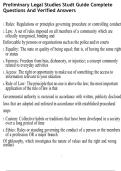
1. Rules: Regulations or principles governing procedure or controlling conduct
2. Law: A set of rules imposed on all members of a community which are
oflcially recognised, binding and
Enforceable by persons or organisations such as the police and/or courts
3. Equality: The state or quality of being equal; that is, of having the same right
or status
4. Fairness: Freedom from bias, dishonesty, or injustice; a concept commonly
related to everyday activities
5. Access: The right or opportunity to make use of something; the access to
information relevant to your situation
6. Rule of Law: The principle that no one is above the law; the most important
application of the rule of law is that
Governmental authority is exercised in accordance with written, publicity disclosed
laws that are adopted and enforced in accordance with established procedural
steps
7. Custom: Collective habits or traditions that have been developed in a society
over a long period of time
8. Ethics: Rules or standing governing the conduct of a person or the members
of a profession OR a major branch
Of philosophy, which investigates the nature of values and the right and wrong
conduct
1/
16
,9. Natural Justice: The body of principles used to ensure the fairness and
justice of the decision-making procedures of courts; in Australia it generally
refers to the right to know the case against you and to present your case, the right
to freedom of bias by decision makers, and the right to a decision based on
relevant evidence
10. Tyranny: Rule by a single leader holding absolute power in a state
11. Anarchy: A state that has an absence of laws and governments
12. Adversary System: A system of revolving legal conflicts, used in commo
law countries such as England
And Australia, which relies on the skill of representatives for each side (e.g.
Defence and prosecution lawyers) who represent their case to an impartial
decision-maker
13. Inquisitorial System: A legal system where the court or part of the court (e.g
The judge) is actively involved
In conducting the trial and determining what question to ask; used in some
countries with civil legal systems as opposed to common law systems
14.Development of Common Law: William the Conquer came to England
and introduced a system that
Involved the equal treatment of criminal ottences (same punishment for the same
crime)
15. Precedent: A judgement that is authority for a legal principle, and that serves
2/
16
, to provide guidance for deciding cases that have similar facts
16.Binding Precedent: When the lower courts are bound to follow the
decisions made by superior courts, regardless of whatever the judge believes
the decision of the higher court is correct or not
Persuasive Precedent: When the superior courts do not have to follow
17.
decisions made in a lower courts. The higher courts may however use the
decisions of the lower court to help make them a decision.
3/
16
Questions And Verified Answers
1. Rules: Regulations or principles governing procedure or controlling conduct
2. Law: A set of rules imposed on all members of a community which are
oflcially recognised, binding and
Enforceable by persons or organisations such as the police and/or courts
3. Equality: The state or quality of being equal; that is, of having the same right
or status
4. Fairness: Freedom from bias, dishonesty, or injustice; a concept commonly
related to everyday activities
5. Access: The right or opportunity to make use of something; the access to
information relevant to your situation
6. Rule of Law: The principle that no one is above the law; the most important
application of the rule of law is that
Governmental authority is exercised in accordance with written, publicity disclosed
laws that are adopted and enforced in accordance with established procedural
steps
7. Custom: Collective habits or traditions that have been developed in a society
over a long period of time
8. Ethics: Rules or standing governing the conduct of a person or the members
of a profession OR a major branch
Of philosophy, which investigates the nature of values and the right and wrong
conduct
1/
16
,9. Natural Justice: The body of principles used to ensure the fairness and
justice of the decision-making procedures of courts; in Australia it generally
refers to the right to know the case against you and to present your case, the right
to freedom of bias by decision makers, and the right to a decision based on
relevant evidence
10. Tyranny: Rule by a single leader holding absolute power in a state
11. Anarchy: A state that has an absence of laws and governments
12. Adversary System: A system of revolving legal conflicts, used in commo
law countries such as England
And Australia, which relies on the skill of representatives for each side (e.g.
Defence and prosecution lawyers) who represent their case to an impartial
decision-maker
13. Inquisitorial System: A legal system where the court or part of the court (e.g
The judge) is actively involved
In conducting the trial and determining what question to ask; used in some
countries with civil legal systems as opposed to common law systems
14.Development of Common Law: William the Conquer came to England
and introduced a system that
Involved the equal treatment of criminal ottences (same punishment for the same
crime)
15. Precedent: A judgement that is authority for a legal principle, and that serves
2/
16
, to provide guidance for deciding cases that have similar facts
16.Binding Precedent: When the lower courts are bound to follow the
decisions made by superior courts, regardless of whatever the judge believes
the decision of the higher court is correct or not
Persuasive Precedent: When the superior courts do not have to follow
17.
decisions made in a lower courts. The higher courts may however use the
decisions of the lower court to help make them a decision.
3/
16


