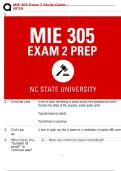
MIE 305 Exam 2 Study Guide –
NCSU.
1.
2. Criminal Law A form of public law seeking to protect society from prohibited acts which
threaten the safety of life, property, and/or public order.
Typically based on statute
Punishment is punitive;
3. Civil Law A form of public law that is based on a combination of statute AND comm
law
4. Who holds the 5. How are criminal cases remedied?
"burden of
proof" in
criminal law?
, MIE 305 Exam 2 Study Guide –
NCSU.
The prosecutor holds the
burden of proof "beyond a
reasonable doubt" against They are typically punitive; imprisonment, fine, etc
the defendant
Remedies are designed to punish, rather than compensate for losses
6. Felonies A serious criminal ottense punishable by a prison sentence of more than o
year
7. Misdemeanors A crime or ottense that is less serious than a felony; any minor misbehavi
or
misconduct
8. Who holds the plaintitt holds the "burden of proof" by a preponderance of the
the "burden
of proof" in evidence against the defendant
civil law?
9. Elements of a
Crime: Mens
Rea The "guilty mind"; not a crime to merely think about robbing a bank
*A crime requires both elements
10. The "guilty act"; not a crime to accidentally pick up a suitcase at the airport
that's identical to yours
, MIE 305 Exam 2 Study Guide –
NCSU.
Elements of a
Crime:
Actus Reus crime requires both elements
11. Elements of a
Crime: Conspira-
is a crime to plan or agree with another to carry out a crime
cy (Exception!)
*Even if the conspired crime does not occur, the actus reus is in the planning
and agreement
12. States of Mind 1) Purposefulness
2) Knowing
3) Recklessness
4) Negligence
13. States of Conscious object is to commit the act
Mind:
Purposefulnes
s Premeditation can be SOM that imposes a higher standard of
purposefulness
14. States of
Mind: Commission of the act with understanding that it is practically certain it will
Knowing result in a certain outcome
Awareness of cause-ettect
15. States of
Mind: Conscious disregard of a substantial and unjustifiable risk attendant to
Recklessness one's behavior
16. States of
Mind: Ignoring a reasonable perception of undue risk in an act that is a "gross
Negligence deviation from the standard of care" of a reasonable person in those
circumstances
17. Strict Liability Ottenses where "states of mind" are not required; the completion of the
act itself is enough to hold the perpetrator responsible
, MIE 305 Exam 2 Study Guide –
NCSU.
*Liability without fault, traditionally for inherently dangerous activities
(handling wild animals, blasting/building demo, etc)
NCSU.
1.
2. Criminal Law A form of public law seeking to protect society from prohibited acts which
threaten the safety of life, property, and/or public order.
Typically based on statute
Punishment is punitive;
3. Civil Law A form of public law that is based on a combination of statute AND comm
law
4. Who holds the 5. How are criminal cases remedied?
"burden of
proof" in
criminal law?
, MIE 305 Exam 2 Study Guide –
NCSU.
The prosecutor holds the
burden of proof "beyond a
reasonable doubt" against They are typically punitive; imprisonment, fine, etc
the defendant
Remedies are designed to punish, rather than compensate for losses
6. Felonies A serious criminal ottense punishable by a prison sentence of more than o
year
7. Misdemeanors A crime or ottense that is less serious than a felony; any minor misbehavi
or
misconduct
8. Who holds the plaintitt holds the "burden of proof" by a preponderance of the
the "burden
of proof" in evidence against the defendant
civil law?
9. Elements of a
Crime: Mens
Rea The "guilty mind"; not a crime to merely think about robbing a bank
*A crime requires both elements
10. The "guilty act"; not a crime to accidentally pick up a suitcase at the airport
that's identical to yours
, MIE 305 Exam 2 Study Guide –
NCSU.
Elements of a
Crime:
Actus Reus crime requires both elements
11. Elements of a
Crime: Conspira-
is a crime to plan or agree with another to carry out a crime
cy (Exception!)
*Even if the conspired crime does not occur, the actus reus is in the planning
and agreement
12. States of Mind 1) Purposefulness
2) Knowing
3) Recklessness
4) Negligence
13. States of Conscious object is to commit the act
Mind:
Purposefulnes
s Premeditation can be SOM that imposes a higher standard of
purposefulness
14. States of
Mind: Commission of the act with understanding that it is practically certain it will
Knowing result in a certain outcome
Awareness of cause-ettect
15. States of
Mind: Conscious disregard of a substantial and unjustifiable risk attendant to
Recklessness one's behavior
16. States of
Mind: Ignoring a reasonable perception of undue risk in an act that is a "gross
Negligence deviation from the standard of care" of a reasonable person in those
circumstances
17. Strict Liability Ottenses where "states of mind" are not required; the completion of the
act itself is enough to hold the perpetrator responsible
, MIE 305 Exam 2 Study Guide –
NCSU.
*Liability without fault, traditionally for inherently dangerous activities
(handling wild animals, blasting/building demo, etc)