Chapter 1
- Origin of Vertebrae immune cells TOPIC
-Principles of Innate Immunity
-Principles of Adaptive Immunity
I1
-Effective mechanisms of immunity
Chapter 2: Innate Immunity with Complement
Chapter 3: Innate Immune response
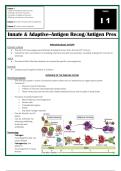
Innate & Adaptive--Antigen Recog/Antigen Pres
IMMUNOLOGICAL HISTORY
EDWARD JENNER
• The start of immunology was attributed to Edward Jenner from the late 18th century
• Coined the term vaccination b inoculating a farmers boy with cow pustules, inevitably making him immune to
small pox
KOCH
• Discovered that infectious diseases are caused by specific microorganisms
PASTEUR
• Created vaccine against cholera in chickens
OVERVIEW OF THE IMMUNE SYSTEM
The Immune System
– The immune system is more a functional system rather than an anatomical or organ based system
– Consists of:
o Diverse array of molecules
o Trillions of immune cells (especially lymphocytes)
o These molecules and immune cells inhabit lymphoid tissues and circulate in body fluids
– Functions to protect body from:
o Most infectious microorganisms
o Cancer cells
o Transplanted organs
o Grafts
o Any other foreign material
– Can act directly- by cell
attack
– Can act indirectly- by
releasing mobilizing
chemicals and
antibodies
Terminology
– Pathogen:
microorganism that can
cause disease
– Pathogenicity: the
ability of
microorganism to cause
disease
, – Virulence: degree of pathogenicity
– Opportunistic pathogens: bacteria that cause disease in compromised host
– Normal Flora: harmless bacteria associated with the host
– Infection: when organism with normal flora are breached
o Note: Infection doesn’t necessarily lead to disease; Depends on:
§ Route of entry
§ Number pathogens
§ Immune status of host
– Immune system: collection of tissues, molecules and organs that mediate a reaction
– Immune response: coordinated response of tissues and molecules against a pathogen or foreign body
– Immunity: resistance to pathogens
Whole Immune System in Summary
– Note there is an external barrier , an Innate immune response and Adaptive immune response
,
, ORIGINS OF VERTEBRATE IMMUNE CELLS
Major cellular components of the immune system consist of monocytes, macrophages, lymphocytes, and family
of granulocyte (Neutrophils, Basophils, Eosinophils and Mast cells) Derived from Hematopoetic Stem cell. Most cells arise
from bone marrow (some tissue resident macrophages come from yolk sac or fetal liver)
- Origin of Vertebrae immune cells TOPIC
-Principles of Innate Immunity
-Principles of Adaptive Immunity
I1
-Effective mechanisms of immunity
Chapter 2: Innate Immunity with Complement
Chapter 3: Innate Immune response
Innate & Adaptive--Antigen Recog/Antigen Pres
IMMUNOLOGICAL HISTORY
EDWARD JENNER
• The start of immunology was attributed to Edward Jenner from the late 18th century
• Coined the term vaccination b inoculating a farmers boy with cow pustules, inevitably making him immune to
small pox
KOCH
• Discovered that infectious diseases are caused by specific microorganisms
PASTEUR
• Created vaccine against cholera in chickens
OVERVIEW OF THE IMMUNE SYSTEM
The Immune System
– The immune system is more a functional system rather than an anatomical or organ based system
– Consists of:
o Diverse array of molecules
o Trillions of immune cells (especially lymphocytes)
o These molecules and immune cells inhabit lymphoid tissues and circulate in body fluids
– Functions to protect body from:
o Most infectious microorganisms
o Cancer cells
o Transplanted organs
o Grafts
o Any other foreign material
– Can act directly- by cell
attack
– Can act indirectly- by
releasing mobilizing
chemicals and
antibodies
Terminology
– Pathogen:
microorganism that can
cause disease
– Pathogenicity: the
ability of
microorganism to cause
disease
, – Virulence: degree of pathogenicity
– Opportunistic pathogens: bacteria that cause disease in compromised host
– Normal Flora: harmless bacteria associated with the host
– Infection: when organism with normal flora are breached
o Note: Infection doesn’t necessarily lead to disease; Depends on:
§ Route of entry
§ Number pathogens
§ Immune status of host
– Immune system: collection of tissues, molecules and organs that mediate a reaction
– Immune response: coordinated response of tissues and molecules against a pathogen or foreign body
– Immunity: resistance to pathogens
Whole Immune System in Summary
– Note there is an external barrier , an Innate immune response and Adaptive immune response
,
, ORIGINS OF VERTEBRATE IMMUNE CELLS
Major cellular components of the immune system consist of monocytes, macrophages, lymphocytes, and family
of granulocyte (Neutrophils, Basophils, Eosinophils and Mast cells) Derived from Hematopoetic Stem cell. Most cells arise
from bone marrow (some tissue resident macrophages come from yolk sac or fetal liver)