

NUR 315 Exam #2 UPDATED ACTUAL Questions and CORRECT
Answers
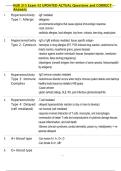
1. Hypersensitivity -IgE mediated
Type 1: Allergic -allegerns
-environmental antigens that cause atypical immunologic response
-most common
-antibiotic allergies, food allergies, hay fever, urticaria, bee sting, anaphylaxis
2. Hypersensitivity -IgG or IgM antibody mediated, tissue specific antigen
Type 2: Cytotoxic -hemolysis in drug allergies (HIT, PCN induced drug reaction, autoimmune he-
molytic anemia, myasthenia gravis, graves disease)
-reaction against another individual's tissues (transplant rejection, transfusion
reactions, fetus during pregnancy)
-alloantigens (nonself antigens from members of same species, histocompatibil-
ity antigens)
3. Hypersensitivity -IgG immune complex mediated
Type 3: Immune -Autoimmune disorder occurs when body's immune system attacks and destroys
Complex healthy body tissue by mistake (>80 types)
-Cause unkown
-gluten (wheat) allergy, SLE, RA, post infectious glomerulonephritis
4. Hypersensitivity -T-cell mediated
Type 4: Delayed -delayed hypersensitivity reaction (a day or more to develop)
(cell mediated) -not humoral (cell mediated)
-response involved interaction of T cells, monocytes, and macrophages
-overreaction of helper T cells and overproduction of cytokines damage tissues,
cause inflammation, and cell death
-Stevens Johnson syndrome, contact dermatitis, poison ivy, metal/jewelry -> re-
sponse delayed
5. A+ blood type -Can receive A+, A-, O+, O-
-Can donate to A+, AB+
6. O+ blood type
, NUR 315 Exam #2 UPDATED ACTUAL Questions and CORRECT
Answers
-Can receive O+, O-
-Can donate to O+, A+, B+, AB+
7. B+ blood type -Can receive B+, B-, O+, O-
-Can donate to B+, AB+
8. AB+ blood type -Can receive from everyone
-Can donate to AB+
9. A- blood type -Can receive from A-, O-
-Can donate to A+, A-, AB+, AB-
10. O- blood type -Can receive from O-
-Can donate to everyone
11. B- blood type -Can receive from B-, O-
-Can donate to B+, B-, AB+, AB-
12. AB- blood type -Can receive from AB-, A-, B-, O-
-Can donate to AB+, AB-
13. systemic lu- -most common chronic autoimmune disease
pus erythemato- -auto antibodies against: nucleic acids, histones, ribonucleoproteins, other nu-
sus (SLE) clear materials
-deposition of circulating immune complexes containing antibody against host
DNA
-manifestations include: arthritis, vasculitis and rash, renal disease, hematologic
(blood) changes, cardiovascular disease
14. rheumatoid - chronic inflammatory disorder that effects the joints and may have systemic
arthritis (RA) effects
-0.5 to 1% of population, 2-3x more common in women
-genetics, environmental, hormonal, immunological, and infectious factors may
play a role (genetic factors count for 50% of risk)
, NUR 315 Exam #2 UPDATED ACTUAL Questions and CORRECT
Answers
-decreased incidence in women taking oral contraceptives
-immune system attacks synovial tissues stimulating inflammatory process result-
ing in destruction of cartilage, bones, tendons, and ligaments (deformities caused
by that)
15. transplant rejec- major histocompatibility complex's (human leukocyte antigen) are major target
tion
16. Immune Defi- -failure of immune mechanisms to function normally
ciencies *increased susceptibility to infections
17. Primary (congen- result of single gene effect
ital) immunodefi-
ciency
18. Secondary (ac- -Caused by another illness
quired) immun- -More common
odeficiency
19. immune defi- - development of unusually or recurrent, severe, infection
ciency (clinical - T-cell deficiencies (viral, fungal, yeast, and atypical microorganism)
presentation) - B-cell and phagocyte deficiencies (microorganisms requiring opsonization)
20. secondary im- - malignancy, immunosuppressive treatments, AIDS
mune deficien-
cies
21. Malignancy -complicated by immunosuppression
-late stage malignancies result in generalized deficiency of immune response
many people with malignancies will die from infection rather than tumor
- cancer
22. immunosuppres- corticosteroids, chemotherapeutic agents, irradiation, antirejection drugs
sive treatments
Answers
1. Hypersensitivity -IgE mediated
Type 1: Allergic -allegerns
-environmental antigens that cause atypical immunologic response
-most common
-antibiotic allergies, food allergies, hay fever, urticaria, bee sting, anaphylaxis
2. Hypersensitivity -IgG or IgM antibody mediated, tissue specific antigen
Type 2: Cytotoxic -hemolysis in drug allergies (HIT, PCN induced drug reaction, autoimmune he-
molytic anemia, myasthenia gravis, graves disease)
-reaction against another individual's tissues (transplant rejection, transfusion
reactions, fetus during pregnancy)
-alloantigens (nonself antigens from members of same species, histocompatibil-
ity antigens)
3. Hypersensitivity -IgG immune complex mediated
Type 3: Immune -Autoimmune disorder occurs when body's immune system attacks and destroys
Complex healthy body tissue by mistake (>80 types)
-Cause unkown
-gluten (wheat) allergy, SLE, RA, post infectious glomerulonephritis
4. Hypersensitivity -T-cell mediated
Type 4: Delayed -delayed hypersensitivity reaction (a day or more to develop)
(cell mediated) -not humoral (cell mediated)
-response involved interaction of T cells, monocytes, and macrophages
-overreaction of helper T cells and overproduction of cytokines damage tissues,
cause inflammation, and cell death
-Stevens Johnson syndrome, contact dermatitis, poison ivy, metal/jewelry -> re-
sponse delayed
5. A+ blood type -Can receive A+, A-, O+, O-
-Can donate to A+, AB+
6. O+ blood type
, NUR 315 Exam #2 UPDATED ACTUAL Questions and CORRECT
Answers
-Can receive O+, O-
-Can donate to O+, A+, B+, AB+
7. B+ blood type -Can receive B+, B-, O+, O-
-Can donate to B+, AB+
8. AB+ blood type -Can receive from everyone
-Can donate to AB+
9. A- blood type -Can receive from A-, O-
-Can donate to A+, A-, AB+, AB-
10. O- blood type -Can receive from O-
-Can donate to everyone
11. B- blood type -Can receive from B-, O-
-Can donate to B+, B-, AB+, AB-
12. AB- blood type -Can receive from AB-, A-, B-, O-
-Can donate to AB+, AB-
13. systemic lu- -most common chronic autoimmune disease
pus erythemato- -auto antibodies against: nucleic acids, histones, ribonucleoproteins, other nu-
sus (SLE) clear materials
-deposition of circulating immune complexes containing antibody against host
DNA
-manifestations include: arthritis, vasculitis and rash, renal disease, hematologic
(blood) changes, cardiovascular disease
14. rheumatoid - chronic inflammatory disorder that effects the joints and may have systemic
arthritis (RA) effects
-0.5 to 1% of population, 2-3x more common in women
-genetics, environmental, hormonal, immunological, and infectious factors may
play a role (genetic factors count for 50% of risk)
, NUR 315 Exam #2 UPDATED ACTUAL Questions and CORRECT
Answers
-decreased incidence in women taking oral contraceptives
-immune system attacks synovial tissues stimulating inflammatory process result-
ing in destruction of cartilage, bones, tendons, and ligaments (deformities caused
by that)
15. transplant rejec- major histocompatibility complex's (human leukocyte antigen) are major target
tion
16. Immune Defi- -failure of immune mechanisms to function normally
ciencies *increased susceptibility to infections
17. Primary (congen- result of single gene effect
ital) immunodefi-
ciency
18. Secondary (ac- -Caused by another illness
quired) immun- -More common
odeficiency
19. immune defi- - development of unusually or recurrent, severe, infection
ciency (clinical - T-cell deficiencies (viral, fungal, yeast, and atypical microorganism)
presentation) - B-cell and phagocyte deficiencies (microorganisms requiring opsonization)
20. secondary im- - malignancy, immunosuppressive treatments, AIDS
mune deficien-
cies
21. Malignancy -complicated by immunosuppression
-late stage malignancies result in generalized deficiency of immune response
many people with malignancies will die from infection rather than tumor
- cancer
22. immunosuppres- corticosteroids, chemotherapeutic agents, irradiation, antirejection drugs
sive treatments


