

COM 312: Midterm UPDATED ACTUAL Questions and
CORRECT Answers
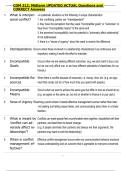
1. What is interper- -A systematic situations w/ the following 4 unique characteristics
sonal conflict? 1. the conflicting parties are *interdependent*
2. they have the perception that they seek *incompatible goals* or *outcomes* or
they favor *incompatible means* to the same end
3. the perceived incompatibility has the potential to *adversely affect relationship*
if not addressed
4. there is a *sense of urgency* about the need to resolve the difference.
2. Interdependence Occurs when those involved in a relationship characterize it as continuous and
important, making it worth the effort to maintain.
3. Incompatible Occurs when we are seeking different outcomes. (e.g. we each want to buy a car,
Goals but we can only afford one. or we have different standards of cleanliness for our
house.)
4. Incompatible Re- When there is conflict because of resources; i.e. money, time, etc. (e.g. an argu-
sources ment that comes out b/c of how much time you spend with people.)
5. Incompatible Occurs when we want to achieve the same goal but differ in how we should do so;
Means (e.g. we agree on the same car, but not on whether to finance it or pay cash.)
6. Sense of Urgency Reaching a point where it needs effective management sooner rather than later.
-not waiting and letting issues fester, and communicating about them in a timely
fashion.
7. What is meant by Conflicts can make people feel uncomfortable when together, dissatisfied with their
'conflict can ad- partners, and lead them to desire change.
versely affect re- (e.g. if people dominate their partners and always win their arguments, the
lationships'? partners may want to exit the relationship)
8. When is conflict Effective conflict management occurs when our communication behavior produces
management ef- mutual understanding and an outcome that is agreeable to everyone concerned.
fective?
1/9
, COM 312: Midterm UPDATED ACTUAL Questions and
CORRECT Answers
9. Conflict manage- the communication behavior a person employs based on his or her analysis of a
ment conflict situation.
10. Linear Model of -includes sender, receivers, channels, noise, feedback.
Conflict -Mainly focuses on the end result of communication (convincing, persuading,
controlling, or dominating the other.)
11. Transaction Mod- -Focused on managing and coordinating.
el of Conflict -the thought of two people working together, sharing messages, reading nonver-
bals, all at the same time in order to both solve the conflict together.
12. What is the con- -*Prelude to conflict*: variables that make conflict possible between those involved.
flict cycle and (participants in the conflict, their relationship, other interested parties, and physical
what occurs in and social environments)
each part of the -*Triggering*: conflict stimulus is a behavior that the parties in conflict point to as
cycle? the issue, problem or focal point of the conflict.
-*Initiation phase*: response occurs when the problem becomes overt and known
-*Differentiation phase*: ongoing interaction patterns occurs when the partici-
pants use constructive or destructive strategies.
-*Resolution phase*: outcome occurs when those involved accept some outcome
to the conflict.
13. Process View of -Process: something that is evolving and not static.
Communication -conflict situations are always changing and occurring within the broader context
of prior interaction.
The implication of this is that something like conflict when viewed as a process can
be viewed in different stages.
14. Intangible Con- -center on gut feelings like love, respect, and self-esteem as well as other topics like
flict Issues power, cooperation, and other beneficial behaviors such as attention and caring.
15. 1. *Personality issue*: conflict focused on a whole constellation of behaviors such
as being dominating, introverted, selfish, or achievement oriented. (e.g. "I wish
2/9
CORRECT Answers
1. What is interper- -A systematic situations w/ the following 4 unique characteristics
sonal conflict? 1. the conflicting parties are *interdependent*
2. they have the perception that they seek *incompatible goals* or *outcomes* or
they favor *incompatible means* to the same end
3. the perceived incompatibility has the potential to *adversely affect relationship*
if not addressed
4. there is a *sense of urgency* about the need to resolve the difference.
2. Interdependence Occurs when those involved in a relationship characterize it as continuous and
important, making it worth the effort to maintain.
3. Incompatible Occurs when we are seeking different outcomes. (e.g. we each want to buy a car,
Goals but we can only afford one. or we have different standards of cleanliness for our
house.)
4. Incompatible Re- When there is conflict because of resources; i.e. money, time, etc. (e.g. an argu-
sources ment that comes out b/c of how much time you spend with people.)
5. Incompatible Occurs when we want to achieve the same goal but differ in how we should do so;
Means (e.g. we agree on the same car, but not on whether to finance it or pay cash.)
6. Sense of Urgency Reaching a point where it needs effective management sooner rather than later.
-not waiting and letting issues fester, and communicating about them in a timely
fashion.
7. What is meant by Conflicts can make people feel uncomfortable when together, dissatisfied with their
'conflict can ad- partners, and lead them to desire change.
versely affect re- (e.g. if people dominate their partners and always win their arguments, the
lationships'? partners may want to exit the relationship)
8. When is conflict Effective conflict management occurs when our communication behavior produces
management ef- mutual understanding and an outcome that is agreeable to everyone concerned.
fective?
1/9
, COM 312: Midterm UPDATED ACTUAL Questions and
CORRECT Answers
9. Conflict manage- the communication behavior a person employs based on his or her analysis of a
ment conflict situation.
10. Linear Model of -includes sender, receivers, channels, noise, feedback.
Conflict -Mainly focuses on the end result of communication (convincing, persuading,
controlling, or dominating the other.)
11. Transaction Mod- -Focused on managing and coordinating.
el of Conflict -the thought of two people working together, sharing messages, reading nonver-
bals, all at the same time in order to both solve the conflict together.
12. What is the con- -*Prelude to conflict*: variables that make conflict possible between those involved.
flict cycle and (participants in the conflict, their relationship, other interested parties, and physical
what occurs in and social environments)
each part of the -*Triggering*: conflict stimulus is a behavior that the parties in conflict point to as
cycle? the issue, problem or focal point of the conflict.
-*Initiation phase*: response occurs when the problem becomes overt and known
-*Differentiation phase*: ongoing interaction patterns occurs when the partici-
pants use constructive or destructive strategies.
-*Resolution phase*: outcome occurs when those involved accept some outcome
to the conflict.
13. Process View of -Process: something that is evolving and not static.
Communication -conflict situations are always changing and occurring within the broader context
of prior interaction.
The implication of this is that something like conflict when viewed as a process can
be viewed in different stages.
14. Intangible Con- -center on gut feelings like love, respect, and self-esteem as well as other topics like
flict Issues power, cooperation, and other beneficial behaviors such as attention and caring.
15. 1. *Personality issue*: conflict focused on a whole constellation of behaviors such
as being dominating, introverted, selfish, or achievement oriented. (e.g. "I wish
2/9


