

COM 312 Final Exam Study Guide UPDATED ACTUAL Questions and
CORRECT Answers
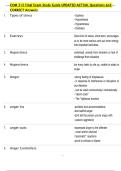
1. Types of stress - Eustress
- Hypostress
- Hyperstress
- Distress
2. Eustress Good kind of stress, short-term, encourages
us to be more serious and put more energy
into important activities.
3. Hypostress underload, anxiety from boredom or lack of
challenge from situation
4. Hyperstress too many tasks to pile up, unable to adapt or
cope
5. Anger -strong feeling of displeasure
- in response to interference or disruption of
our desires
- can be used constructively/ motivationally
- "alarm clock"
- The "righteous emotion
6. anger ins -avoiders and accommodations
-dont admit anger
-dont tell the person you're angry with
- passive aggressive
7. anger outs -expressed anger to the offender
- vocal and/or physical
-"automatic" reactions
-quick to criticize or blame
8. Anger Controllers
1/8
, COM 312 Final Exam Study Guide UPDATED ACTUAL Questions and
CORRECT Answers
Those who practice S-TLC, the confrontation-
al ritual, including assertiveness and i-state-
ments, compromise/collaboration.
9. Responding to others anger -Listening diffuses anger
-Acknowledge source of anger
-Sometimes it's what you did/didn't do, how
you told/didn't, or how you did/didn't let
them respond
10. Relational transgressions -very problematic situation
The core values of relationship are broken
-leaving high emotional residues
11. Core Relational Rules -Define expectations for behavior for how we
should behave towards others
-Differs based on the relationships
-"Sacred" rules broken
12. Forgiveness -Cognitive process that consists of letting go
of feelings of revenge and desire to retaliate
-Healthy but cant be rushed
13. Reconciliation -A behavioral process in which we take actions
to restore a relationship or create a new one,
after "forgiveness"
14. 5 steps of forgiveness Step 1: The account and apology
Step 2: Acceptance of an account & an apology
or its absence.
Step 3: Forgiveness may or may not be com-
municated
Step 4: Transforming the relationship, if de-
2/8
CORRECT Answers
1. Types of stress - Eustress
- Hypostress
- Hyperstress
- Distress
2. Eustress Good kind of stress, short-term, encourages
us to be more serious and put more energy
into important activities.
3. Hypostress underload, anxiety from boredom or lack of
challenge from situation
4. Hyperstress too many tasks to pile up, unable to adapt or
cope
5. Anger -strong feeling of displeasure
- in response to interference or disruption of
our desires
- can be used constructively/ motivationally
- "alarm clock"
- The "righteous emotion
6. anger ins -avoiders and accommodations
-dont admit anger
-dont tell the person you're angry with
- passive aggressive
7. anger outs -expressed anger to the offender
- vocal and/or physical
-"automatic" reactions
-quick to criticize or blame
8. Anger Controllers
1/8
, COM 312 Final Exam Study Guide UPDATED ACTUAL Questions and
CORRECT Answers
Those who practice S-TLC, the confrontation-
al ritual, including assertiveness and i-state-
ments, compromise/collaboration.
9. Responding to others anger -Listening diffuses anger
-Acknowledge source of anger
-Sometimes it's what you did/didn't do, how
you told/didn't, or how you did/didn't let
them respond
10. Relational transgressions -very problematic situation
The core values of relationship are broken
-leaving high emotional residues
11. Core Relational Rules -Define expectations for behavior for how we
should behave towards others
-Differs based on the relationships
-"Sacred" rules broken
12. Forgiveness -Cognitive process that consists of letting go
of feelings of revenge and desire to retaliate
-Healthy but cant be rushed
13. Reconciliation -A behavioral process in which we take actions
to restore a relationship or create a new one,
after "forgiveness"
14. 5 steps of forgiveness Step 1: The account and apology
Step 2: Acceptance of an account & an apology
or its absence.
Step 3: Forgiveness may or may not be com-
municated
Step 4: Transforming the relationship, if de-
2/8


