

COM 312 ASU Final UPDATED ACTUAL Questions and CORRECT
Answers
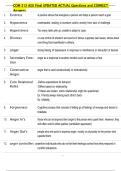
1. Eustress A positive stress that energizes a person and helps a person reach a goal
2. Hypostress underloaded, leading to boredom and/or anxiety from lack of challenge.
3. Hyperstress Too many tasks pile up; unable to adapt or cope.
4. Distress o Lose control of situation and source of stress; suppress real issues; stress about
one thing that manifests in others.
5. anger strong feeling of displeasure in response to interference or disruption of desires
6. Secondary Emo- anger as a response to another emotion such as sadness or fear
tion
7. Constructive anger that is used constructivally or motivationally
Anger
8. Core Relational -Define expectations for behavior.
Rules -Differs based on relationship
-If these are broken, entire relationship might be questioned.
Ex. Friends always having each other's back
Ex. Infidelity
9. Forgiveness Cognitive process that consists of letting go of feelings of revenge and desire to
retaliate.
10. Anger In's those who do not express their anger to the person who upset them. However, they
will often vent to other parties (ventilation approach)
11. Anger Out's people who are quick to express anger, vocally or physically to the person who
upsets them
12. anger controllers assertive individuals who do not let their feelings control how they respond in
conflict situations
1/6
, COM 312 ASU Final UPDATED ACTUAL Questions and CORRECT
Answers
13. Responses to - Listening diffuses anger.
others Anger - Acknowledge source of anger
- Avoidance may be appropriate.
- Exit situation if not safe.
14. Relational Trans- when one partner violates the explicit or implicit terms of the relationship, letting
gressions the other one down in some important way.
Relationships core values violated
15. 5 steps to forgive- 1. Account and Apology
ness 2. Acceptance of Account and its Apology (or its absence)
3. Forgiveness ( that may or may not be communicated)
4. Transforming Relationship ( if desired)
5. Actions Confirm forgiveness and reconciliation.
16. Reconciliation "Beneficial process to take actions to restore a relationship... after forgiveness"
17. Tangible Conflict Scarce resources, often all or nothing (money, people, space, objects)
Issues
18. Negotiation A form of communication between opposing sides in a conflict in which offers and
counteroffers are made and a solution occurs only when both parties agree
19. Minimax Princi- principle describing the tendency to maximize the benefits and minimize the costs
ple
20. Aspiration Point what you hope for in a given situation; it is your preferred result.
Best possible outcome (if the stars align)
21. Bargaining the range you are willing to bargain in; in between your resistance and aspiration
Range points.
22. Resistance Point lowest acceptable outcome; Walk away point
2/6
Answers
1. Eustress A positive stress that energizes a person and helps a person reach a goal
2. Hypostress underloaded, leading to boredom and/or anxiety from lack of challenge.
3. Hyperstress Too many tasks pile up; unable to adapt or cope.
4. Distress o Lose control of situation and source of stress; suppress real issues; stress about
one thing that manifests in others.
5. anger strong feeling of displeasure in response to interference or disruption of desires
6. Secondary Emo- anger as a response to another emotion such as sadness or fear
tion
7. Constructive anger that is used constructivally or motivationally
Anger
8. Core Relational -Define expectations for behavior.
Rules -Differs based on relationship
-If these are broken, entire relationship might be questioned.
Ex. Friends always having each other's back
Ex. Infidelity
9. Forgiveness Cognitive process that consists of letting go of feelings of revenge and desire to
retaliate.
10. Anger In's those who do not express their anger to the person who upset them. However, they
will often vent to other parties (ventilation approach)
11. Anger Out's people who are quick to express anger, vocally or physically to the person who
upsets them
12. anger controllers assertive individuals who do not let their feelings control how they respond in
conflict situations
1/6
, COM 312 ASU Final UPDATED ACTUAL Questions and CORRECT
Answers
13. Responses to - Listening diffuses anger.
others Anger - Acknowledge source of anger
- Avoidance may be appropriate.
- Exit situation if not safe.
14. Relational Trans- when one partner violates the explicit or implicit terms of the relationship, letting
gressions the other one down in some important way.
Relationships core values violated
15. 5 steps to forgive- 1. Account and Apology
ness 2. Acceptance of Account and its Apology (or its absence)
3. Forgiveness ( that may or may not be communicated)
4. Transforming Relationship ( if desired)
5. Actions Confirm forgiveness and reconciliation.
16. Reconciliation "Beneficial process to take actions to restore a relationship... after forgiveness"
17. Tangible Conflict Scarce resources, often all or nothing (money, people, space, objects)
Issues
18. Negotiation A form of communication between opposing sides in a conflict in which offers and
counteroffers are made and a solution occurs only when both parties agree
19. Minimax Princi- principle describing the tendency to maximize the benefits and minimize the costs
ple
20. Aspiration Point what you hope for in a given situation; it is your preferred result.
Best possible outcome (if the stars align)
21. Bargaining the range you are willing to bargain in; in between your resistance and aspiration
Range points.
22. Resistance Point lowest acceptable outcome; Walk away point
2/6


