

CNS exam UPDATED ACTUAL Questions and CORRECT Answers
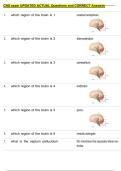
1. which region of the brain is 1 cerebral hemispheres
2. which region of the brain is 2 diencephalon
3. which region of the brain is 3 cerebellum
4. which region of the brain is 4 midbrain
5. which region of the brain is 5 pons
6. which region of the brain is 6 medulla oblongata
7. what is the septum pellucidum thin membrane that separates lateral ven-
tricles
, 8. the central canal is lined by ependymal cells
9. the central canal of the spine containa CSF
10. CSF travels from each lateral ventricle into interventricular foramen
the 3rd ventricle by
11. 3rd ventricle is located within diencephalon
12. the cerebral aqueduct connects the 3rd ventricle and dien-
cephalon to 4th ventricle
13. 4th ventricle is located between pons and cerebellum
14. Starting with a drop of CSF in a lateral ven- Lateral ventricle > interventricular foramen
tricle that exits fourth ventricle by entering > third ventricle > cerebral aqueduct >
subarachnoid space around brain fourth ventricle > median aperture or later-
al apertures of 4th ventricle > subarachnoid
space around brain > arachnoid villi > dural
venous sinus
15. Starting with a drop of CSF in a lateral ven- Lateral ventricle > interventricular foramen
tricle that leaves fourth ventricle and en- > third ventricle > cerebral aqueduct >
ters central canal of spinal cord fourth ventricle > central canal of spinal
cord > subarachnoid space around spinal
cord > subarachnoid space around brain >
arachnoid villi > dural venous sinus
16. function of CSF -helps to regulate chemical composition of
extracellular fluid within the brain of the
spinal cord
-protective
17. structures that produce CSF choroid plexuses
1. which region of the brain is 1 cerebral hemispheres
2. which region of the brain is 2 diencephalon
3. which region of the brain is 3 cerebellum
4. which region of the brain is 4 midbrain
5. which region of the brain is 5 pons
6. which region of the brain is 6 medulla oblongata
7. what is the septum pellucidum thin membrane that separates lateral ven-
tricles
, 8. the central canal is lined by ependymal cells
9. the central canal of the spine containa CSF
10. CSF travels from each lateral ventricle into interventricular foramen
the 3rd ventricle by
11. 3rd ventricle is located within diencephalon
12. the cerebral aqueduct connects the 3rd ventricle and dien-
cephalon to 4th ventricle
13. 4th ventricle is located between pons and cerebellum
14. Starting with a drop of CSF in a lateral ven- Lateral ventricle > interventricular foramen
tricle that exits fourth ventricle by entering > third ventricle > cerebral aqueduct >
subarachnoid space around brain fourth ventricle > median aperture or later-
al apertures of 4th ventricle > subarachnoid
space around brain > arachnoid villi > dural
venous sinus
15. Starting with a drop of CSF in a lateral ven- Lateral ventricle > interventricular foramen
tricle that leaves fourth ventricle and en- > third ventricle > cerebral aqueduct >
ters central canal of spinal cord fourth ventricle > central canal of spinal
cord > subarachnoid space around spinal
cord > subarachnoid space around brain >
arachnoid villi > dural venous sinus
16. function of CSF -helps to regulate chemical composition of
extracellular fluid within the brain of the
spinal cord
-protective
17. structures that produce CSF choroid plexuses


