

Written by students who passed Immediately available after payment Read online or as PDF Wrong document? Swap it for free 4.6 TrustPilot
logo-home
Document preview thumbnail
Preview 2 out of 6 pages
Exam (elaborations)

BUSML 3250 Exam 2025

Document preview thumbnail
Preview 2 out of 6 pages

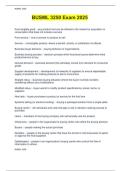
BUSML 3250 Exam 2025 Pure tangible good - -any product that can be offered to the market for acquisition or consumption that does not include a service Pure service - -only a service no product to sell Service - -nontangible product, where a benefit, activity, or safisfaction is offered Business buyer behavior - -buying behavior of organizations Business buying process - -decision process which business buyers determine what product/service to buy Derived demand - -business demand that ultimately comes from demand for consumer goods Supplier development - -development of networks of suppliers to ensure dependable supply of products for making products to sell to consumers Straight rebuy - -business buying stituation where the buyer routinely reorders something without any modifications Modified rebuy - -buyer wants to modify product specifications, prices, terms, or suppliers New task - -buyer purchases a product or service for the first time Systems selling (or solutions selling) - -buying a packaged solution from a single seller Buying center - -all individuals and units that play a role in decision making process of purchase Users - -members of the buying company who will actually use the product Influencers - -people in the organization's buying center who affect the buying decision Buyers - -people making the actual purchase Deciders - -people in the buying center that have the formal or informal power to select or approve the final suppliers Gatekeepers - -people in an organization's buying center who control the flow of information to others BUSML 3250 BUSML 3250 Problem recognition - -stage in business buying process which a company recognizes a problem that needs to be met by acquiring a good or service General need description - -stage is BBP which a buyer describes the characteristics and quantity of what is needed Product specification - -stage of BBP which buying organization decides on and specifies the best technical product characteristic for a needed item Supplier search - -stage of BBP which the buyer tries to find the best vendors Proposal solicitation - -stage of BBP which buyer invites qualified suppliers to submit proposals Supplier selection - -Stage of business buying process which the buyer reviews proposals and selects a supplier Order-routine specification - -stage of BBP which buyer writes final order to supplier Performance review - -stage of BBP which buyer assess the performance of the supplier and decides to continue, modify, or drop the arrangement E-procurement - -purchasing through electronic connections, gives buyers access to new suppliers, lower costs, and sped up processing and delivering Institutional market - -schools, hospitals, nursing homes, prison, and other institutions, provide services to people in their care Government market - -government units that purchase/rent goods or services for carrying out main functions of government Market segmentation - -dividing a marketing into smaller segments of buyers with distinct needs, characteristics, or behaviors Market targeting - -evaluating each market segment's attractiveness and selecting one or more segment to enter Differentiation - -differentiating the market offering to create superior customer value Positioning - -arranging for a market offering to occupy a clear, distinctive, and desirable place relative to competing products in the minds of target consumers Geographic segmentation - -dividing the market into different geographical units BUSML 3250 BUSML 3250 Demographic segmentation - -dividing market into segments based on variables such as age, life-cycle stage, gender, income, occupation, education, religion, etc. Age and life-cycle segmentation - -dividing a market into different age and life-cycle groups Gender segmentation - -different segments based on gender Income segmentation - -market into different income segments Psychographic segmentation - -dividing a market into different segments based on social class, lifestyle, or personally characteristics Behavioral segmentation - -market into segments based on consumer knowledge, attitudes, uses, or responses to a product Occasion segmentation - -dividing the market into segments according to occasions when buyers get the idea to buy, actually make their purchase or use the purchased item Benefit segmentation - -dividing market into segments according to the different benefits that consumers seek from the product Intermarket segmentation - -forming segments of consumers who have similar needs and buying behaviors even though they are located in different countries Target market - -set of buyers sharing common meeds that company decides to serve Undifferentiated (mass) marketing - -a market coverage strategy in which a firm decides to ignore market segment difference and go after whole market with one offer Differentiated (segmented) marketing - -marketing coverage strategy in which a firm decides to target several market segments and designs separate offers for each Concentrated (niche) marketing - -marketing-coverage strategy in which a firm goes a large share of one or a few segments or niches Micromarketing - -tailoring products and marketing programs to the needs and wants of specific individuals and local customer segments; includes lock and individual marketing Local marketing - -marketing to the needs and wants of local customer segments Individual marketing - -marketing programs to the needs and preferences of individual customers BUSML 3250 BUSML 3250 Product position - -how a product is defined by consumers on important attributes- the place the product occupies in consumers' minds relatives to competing products Competitive advantage - -advantage over competitors gained by offering greater customer value Value proposition - -the full mix of benefits on which it is positioned Positioning statement - -summarizes company or brand positioning using this form: to (target segment and need) our (brand) is (concept) that (point of difference) Consumer product - -product bought by final consumers for personal consumption Convenience product - -consumer product that customers usually buy frequently, immediately, and with minimal comparison and buying effort; generally the lowest price Shopping product - -consumer product that the customer usually compares on such attributes such as sustainability, quality, price, style Specialty product - -consumer product with unique characteristics or brand identification for which a significant group of buyers is willing to make a special purchase effort Unsought product - -consumer product that the consumer either does not know about or knows about but does not normally consider buying Industrial product - -product bought by individuals and organizations for further processing or for use in conducting a business Social marketing - -use of commercial marketing concepts and tools in programs designed to influence individuals' behavior to improve their well-being and that of society Product quality - -characteristics of a product or service that bear on its ability to satsfy stated or implied customer needs Product line - -group of products that are closely related because they function in a similar manner, are sold to the same customer groups, are marketed through the same types of outlets or fall within given price ranges Product Mix - -set of all product lines and items that a particular seller offers for sale Service intangibility - -service cannot be seen, tasted, felt, heard, or smelled before they are bought Service inseparability - -services are produced and consumed at the same time and cannot be separated from their providers BUSML 3250 BUSML 3250 Service variability - -quality of services may vary greatly depending on who provides them and when. Where, and how they are provided Service perishability - -services cannot be stored for later sale or use Service profit chain - -chain that links service firm profits with employee and customer satisfaction Internal marketing - -orienting and motivating customer - contact employees and supporting service employees to work as a team to provide customer satisfaction Interactive marketing - -training service employees in the fine art of interacting with customers to satisfy their needs Brand equity - -differential effect that knowing the brand name has on customer response to the product or its marketing Line extensions - -extending an existing brand name to new forms, colors, sizes, ingredients, or flavors of an existing product category Brand extension - -extending an existing brand name to new product categories Consumer buyer behavior - -buying behavior of final consumers - individuals and households that buy goods and services for personal consumption Consumer market - -all the individuals and households that buy or acquire goods and services for personal consumptions Culture - -set of basic, values, perceptions, wants, and behaviors learned by a member of society from family and other important institutions Subculture - -group of people with shared value systems based on common life experiences and situations Social class - -relatively permanent and ordered division in a society whose members share similar values and behaviors Group - -two or more people who interact to accomplish individual and mutual goals Word-of-mouth influence - -impact of personal words and recommendations of trusted friends, associates and other consumers on buying behavior Opinion leader - -person within reference group who, because of special skills, knowledge, personality, or other characteristics,

Content preview

BUSML 3250


BUSML 3250 Exam 2025

Pure tangible good - -any product that can be offered to the market for acquisition or
consumption that does not include a service

Pure service - -only a service no product to sell

Service - -nontangible product, where a benefit, activity, or safisfaction is offered

Business buyer behavior - -buying behavior of organizations

Business buying process - -decision process which business buyers determine what
product/service to buy

Derived demand - -business demand that ultimately comes from demand for consumer
goods

Supplier development - -development of networks of suppliers to ensure dependable
supply of products for making products to sell to consumers

Straight rebuy - -business buying stituation where the buyer routinely reorders
something without any modifications

Modified rebuy - -buyer wants to modify product specifications, prices, terms, or
suppliers

New task - -buyer purchases a product or service for the first time

Systems selling (or solutions selling) - -buying a packaged solution from a single seller

Buying center - -all individuals and units that play a role in decision making process of
purchase

Users - -members of the buying company who will actually use the product

Influencers - -people in the organization's buying center who affect the buying decision

Buyers - -people making the actual purchase

Deciders - -people in the buying center that have the formal or informal power to select
or approve the final suppliers

Gatekeepers - -people in an organization's buying center who control the flow of
information to others

BUSML 3250

, BUSML 3250


Problem recognition - -stage in business buying process which a company recognizes a
problem that needs to be met by acquiring a good or service

General need description - -stage is BBP which a buyer describes the characteristics
and quantity of what is needed

Product specification - -stage of BBP which buying organization decides on and
specifies the best technical product characteristic for a needed item

Supplier search - -stage of BBP which the buyer tries to find the best vendors

Proposal solicitation - -stage of BBP which buyer invites qualified suppliers to submit
proposals

Supplier selection - -Stage of business buying process which the buyer reviews
proposals and selects a supplier

Order-routine specification - -stage of BBP which buyer writes final order to supplier

Performance review - -stage of BBP which buyer assess the performance of the
supplier and decides to continue, modify, or drop the arrangement

E-procurement - -purchasing through electronic connections, gives buyers access to
new suppliers, lower costs, and sped up processing and delivering

Institutional market - -schools, hospitals, nursing homes, prison, and other institutions,
provide services to people in their care

Government market - -government units that purchase/rent goods or services for
carrying out main functions of government

Market segmentation - -dividing a marketing into smaller segments of buyers with
distinct needs, characteristics, or behaviors

Market targeting - -evaluating each market segment's attractiveness and selecting one
or more segment to enter

Differentiation - -differentiating the market offering to create superior customer value

Positioning - -arranging for a market offering to occupy a clear, distinctive, and desirable
place relative to competing products in the minds of target consumers

Geographic segmentation - -dividing the market into different geographical units


BUSML 3250

Document information

Uploaded on
September 20, 2025
Number of pages
6
Written in
2025/2026
Type
Exam (elaborations)
Contains
Questions & answers
$11.99

Wrong document? Swap it for free Within 14 days of purchase and before downloading, you can choose a different document. You can simply spend the amount again.
Written by students who passed
Immediately available after payment
Read online or as PDF

Seller avatar
Reputation scores are based on the amount of documents a seller has sold for a fee and the reviews they have received for those documents. There are three levels: Bronze, Silver and Gold. The better the reputation, the more your can rely on the quality of the sellers work.
AlexScorer
2.5
(2)
Sold
11
Followers
0
Items
1800
Last sold
2 weeks ago


Why students choose Stuvia

Created by fellow students, verified by reviews

Quality you can trust: written by students who passed their tests and reviewed by others who've used these notes.

Didn't get what you expected? Choose another document

No worries! You can instantly pick a different document that better fits what you're looking for.

Pay as you like, start learning right away

No subscription, no commitments. Pay the way you're used to via credit card and download your PDF document instantly.

Student with book image

“Bought, downloaded, and aced it. It really can be that simple.”

Alisha Student

Working on your references?

Create accurate citations in APA, MLA and Harvard with our free citation generator.

Working on your references?

Frequently asked questions
