
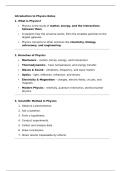
Introduction to Physics Notes
1. What is Physics?
Physics is the study of matter, energy, and the interactions
between them.
It explains how the universe works, from the smallest particles to the
largest galaxies.
Physics connects to other sciences like chemistry, biology,
astronomy, and engineering.
2. Branches of Physics
Mechanics – motion, forces, energy, and momentum.
Thermodynamics – heat, temperature, and energy transfer.
Waves & Sound – vibrations, frequency, and wave motion.
Optics – light, reflection, refraction, and lenses.
Electricity & Magnetism – charges, electric fields, circuits, and
magnets.
Modern Physics – relativity, quantum mechanics, atomic/nuclear
physics.
3. Scientific Method in Physics
1. Observe a phenomenon.
2. Ask a question.
3. Form a hypothesis.
4. Conduct experiments.
5. Collect and analyze data.
6. Draw conclusions.
7. Share results (repeatable by others).
, 4. Units and Measurements
Physics uses SI Units (International System of Units):
o Length → meter (m)
o Mass → kilogram (kg)
o Time → second (s)
o Temperature → kelvin (K)
o Electric current → ampere (A)
o Amount of substance → mole (mol)
o Luminous intensity → candela (cd)
Derived Units:
o Speed = meters/second (m/s)
o Force = newton (N) = kg·m/s²
o Energy = joule (J) = N·m
5. Motion (Basics of Mechanics)
Scalar = has magnitude only (speed, distance).
Vector = has magnitude and direction (velocity, displacement, force).
Speed vs. Velocity:
o Speed = distance/time.
o Velocity = displacement/time (includes direction).
Acceleration = change in velocity / time.
Example equation:
v=v0+atv = v_0 + atv=v0+at
6. Forces
A force is a push or pull that changes motion.
Measured in newtons (N).


