

NURS 3550 (PHARMACOLOGY) EXAM
QUESTIONS WITH 100% CORRECT
ANSWERS | LATEST VERSION 2025/2026.
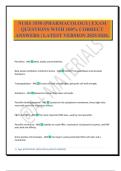
Penicillins - ANS Ideal, widely used antibiotics.
Beta-lactam antibiotics method of action - ANS Inhibits Transpeptidases and activates
Autolysins.
Transpeptidases - ANS Create cell wall cross bridges, giving the cell wall strength.
Autolysins - ANS Bacterial enzymes that cleave cell walls.
Penicillin-binding proteins - ANS Located on the cytoplasmic membrane, these eight sites
react with penicillin to produce effects.
PBP1 and PBP3 - ANS The most important PBP sites, used by most penicillin.
Penicillin resistance - ANS Inability to reach PBPs, inactivation via bacterial enzymes, and PBP
sites with low affinity.
Gram positive cell envelope - ANS Two layers: easily penetrated thick cell wall, and a
membrane.
1 | Page @COPYRIGHT 2025/2026 ALLRIGHTS RESERVED
,Gram negative cell envelope - ANS Three layers: inner membrane, a thin cell wall, and a
outer membrane that is difficult to penetrate.
Beta-lactamases - ANS Enzymes that cleave the beta-lactam ring, deactivating penicillin.
Some act on many drugs, some are very specific.
Methicillin - ANS Penicillin that was resistant to Staph beta-lactamases (now obsolete).
MRSA method of immunity - ANS Production of very low affinity PBP sites, as well as
standard Staph beta-lactamases, resulting in a very hardy infection.
Common dermal Staph symptoms - ANS Boils, rashes (cellulitis), blisters (impetigo).
Two types of MRSA - ANS HCA-MRSA (healthcare associated) and CA-MRSA (community
associated).
More serious MRSA type - ANS Healthcare associated MRSA.
Preferred HCA-MRSA treatment. - ANS Highly individualized, often uses IV vancomycin,
linezolid, daptomycin, telavancin, clindamycin, and cefazoline.
Best MRSA treatment drug - ANS Vancomycin.
Are HCA-MRSA and CA-MRSA the same? - ANS No, they are distinct species.
Should drugs be used for CA-MRSA? - ANS Unless serious, no. Reduction of acquired
immunities is paramount.
Penicillin G - ANS The first prototype penicillin, it is more effective against gram-positive
bacteria than gram-negative. Despite it's age, it is still used to this date.
2 | Page @COPYRIGHT 2025/2026 ALLRIGHTS RESERVED
, Penicillin G spectrum - ANS Narrow spectrum, being mostly efficient against gram-positive
bacteria. Gram-negative bacteria it can affect are N. Meningitidis and N. gonorrhoeae.
Admission routes of penicillin G - ANS IM (Potassium and sodium based P.G is rapid while
procaine and benzathine are slower).
IV (Only use potassium or sodium salts)
Repository preparations - ANS Slow acting drug administration.
Penicillin half life - ANS Average of 30 minutes.
Penicillin excretion - ANS Kidneys.
Penicillin allergy process - ANS Allergens are by-products of penicillin metabolism, not the
drug itself.
Penicillin V (VK) - ANS Acid stable penicillin G, used for oral administration.
Antistaphylococcal Penicillins - ANS Nafcillin, oxacillin, dicloxacillin. Narrow range, used for
Staph infections.
Ampicillin, amoxicillin - ANS Broad spectrum penicillins.
Difference in broad spectrum penicillin - ANS Amoxicillin is more stable for oral
administration, less side effects when administered orally.
Piper-acillin - ANS Only extended release penicillin. Strongly indicated for P. aeruginosa
infections.
3 | Page @COPYRIGHT 2025/2026 ALLRIGHTS RESERVED
QUESTIONS WITH 100% CORRECT
ANSWERS | LATEST VERSION 2025/2026.
Penicillins - ANS Ideal, widely used antibiotics.
Beta-lactam antibiotics method of action - ANS Inhibits Transpeptidases and activates
Autolysins.
Transpeptidases - ANS Create cell wall cross bridges, giving the cell wall strength.
Autolysins - ANS Bacterial enzymes that cleave cell walls.
Penicillin-binding proteins - ANS Located on the cytoplasmic membrane, these eight sites
react with penicillin to produce effects.
PBP1 and PBP3 - ANS The most important PBP sites, used by most penicillin.
Penicillin resistance - ANS Inability to reach PBPs, inactivation via bacterial enzymes, and PBP
sites with low affinity.
Gram positive cell envelope - ANS Two layers: easily penetrated thick cell wall, and a
membrane.
1 | Page @COPYRIGHT 2025/2026 ALLRIGHTS RESERVED
,Gram negative cell envelope - ANS Three layers: inner membrane, a thin cell wall, and a
outer membrane that is difficult to penetrate.
Beta-lactamases - ANS Enzymes that cleave the beta-lactam ring, deactivating penicillin.
Some act on many drugs, some are very specific.
Methicillin - ANS Penicillin that was resistant to Staph beta-lactamases (now obsolete).
MRSA method of immunity - ANS Production of very low affinity PBP sites, as well as
standard Staph beta-lactamases, resulting in a very hardy infection.
Common dermal Staph symptoms - ANS Boils, rashes (cellulitis), blisters (impetigo).
Two types of MRSA - ANS HCA-MRSA (healthcare associated) and CA-MRSA (community
associated).
More serious MRSA type - ANS Healthcare associated MRSA.
Preferred HCA-MRSA treatment. - ANS Highly individualized, often uses IV vancomycin,
linezolid, daptomycin, telavancin, clindamycin, and cefazoline.
Best MRSA treatment drug - ANS Vancomycin.
Are HCA-MRSA and CA-MRSA the same? - ANS No, they are distinct species.
Should drugs be used for CA-MRSA? - ANS Unless serious, no. Reduction of acquired
immunities is paramount.
Penicillin G - ANS The first prototype penicillin, it is more effective against gram-positive
bacteria than gram-negative. Despite it's age, it is still used to this date.
2 | Page @COPYRIGHT 2025/2026 ALLRIGHTS RESERVED
, Penicillin G spectrum - ANS Narrow spectrum, being mostly efficient against gram-positive
bacteria. Gram-negative bacteria it can affect are N. Meningitidis and N. gonorrhoeae.
Admission routes of penicillin G - ANS IM (Potassium and sodium based P.G is rapid while
procaine and benzathine are slower).
IV (Only use potassium or sodium salts)
Repository preparations - ANS Slow acting drug administration.
Penicillin half life - ANS Average of 30 minutes.
Penicillin excretion - ANS Kidneys.
Penicillin allergy process - ANS Allergens are by-products of penicillin metabolism, not the
drug itself.
Penicillin V (VK) - ANS Acid stable penicillin G, used for oral administration.
Antistaphylococcal Penicillins - ANS Nafcillin, oxacillin, dicloxacillin. Narrow range, used for
Staph infections.
Ampicillin, amoxicillin - ANS Broad spectrum penicillins.
Difference in broad spectrum penicillin - ANS Amoxicillin is more stable for oral
administration, less side effects when administered orally.
Piper-acillin - ANS Only extended release penicillin. Strongly indicated for P. aeruginosa
infections.
3 | Page @COPYRIGHT 2025/2026 ALLRIGHTS RESERVED


