Building Blocks of English 1 – Period 1
Lecture 1a – Background to Pronunciation
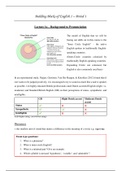
The model of English that we will be
basing our skills on in this course is the
“Inner Circle English” – the native
English spoken in traditionally English-
speaking countries.
(Outer-Circle: countries colonised by
traditionally English-speaking countries.
Expanding Circle: not colonised, but
English is also commonly used here)
In an experimental study, Nejjari, Gerritsen, Van Der Haagen, & Korzilius (2012) found that if
one wants to be judged positively, it is encouraged to try to sound as much like a native speaker
as possible. 144 highly educated British professionals rated Dutch-accented English (slight -vs-
moderate) and Standard British English (GB) on their perceptions of status, sympathetic, and
intelligible:
GB Slight Dutch accent Moderate Dutch
accent
Status ✔ ✕ ✕
Sympathetic ✔ ✔ ✕
Intelligible ✔ ✕ ✕
(tick=higher rating, cross=lower rating)
Phonemes
= the smallest unit of sound that makes a difference in the meaning of a word, e.g. rope/robe.
Exam type questions:
1. What is a phoneme?
2. What is inner-circle English?
3. What is a minimal pair? Give an example.
4. Which syllable is stressed ‘hypothesis’, ‘variable’, and ‘admirable’?
, Lecture 1b – The Speech Tract
The speech tract is where sounds are made
Two types of sounds: consonants and vowels
➢ Consonants: air obstructed or stopped
1. Place of articulation
2. Manner (how they are produced)
3. Voice
Place of articulation
For example, when saying /p/, the air is obstructed completely, for /f/ is it obstructed partly,
and for /h/ it is obstructed very little.
When saying ‘th’, the tip of the tongue is placed behind the upper front teeth. This means that
the tongue is the articulator, and the upper front teeth is the place of articulation.
The 5 Manners of Articulation
= the kind of obstruction in the mouth
Complete blockage and release: plosive (e.g. /p/ ‘pan’)
Very narrow opening with friction: fricative (e.g. /θ/ ‘thin’)
Narrowing of opening, but no friction: approximant (e.g. /r/ ‘rubbish’, /y/ ‘you’)
Complete closure followed by very affricative (plosive + fricative) (e.g. dʒ ‘jam’)
narrow opening with friction:
Complete closure of the mouth and nasal (e.g. /n/ ‘man’)
air escapes through the nose:
, Voice
= whether or not the vocal cords vibrate
In phonology, minimal pairs are pairs of words or phrases that differ in only one
phonological element in the same position of the word and have distinct meanings.
Voiced Voiceless
van fan
prove proof
bin pin
lab lap
dense tense
bid bit
game came
bag back
➢ Vowels: air passed through the speech tract relatively freely and relatively
unobstructed. The vocal cords vibrate.
1. Length
2. Single pure sound or combination of sounds (monophthongs / diphthongs)
3. Where in the speech tract are they produced (front / middle / back)
4. How far is the tongue from the roof of the mouth (palate)
Length
Short Long (indicated by length mark ‘:’)
/ɪ/ ‘hit’ /i:/ ‘heat’
/ʊ/ ‘look’ /u:/ ‘Luke’
Monophthongs and Diphthongs
Monophthongs (single pure sound) Diphthongs (combination of sounds)
/ɔː/ ‘walk’ /əʊ/ ‘woke’
/e/ ‘shed’ /eɪ/ ‘shade’
/æ/ ‘back’ /aɪ/ ‘bike’
Lecture 1a – Background to Pronunciation
The model of English that we will be
basing our skills on in this course is the
“Inner Circle English” – the native
English spoken in traditionally English-
speaking countries.
(Outer-Circle: countries colonised by
traditionally English-speaking countries.
Expanding Circle: not colonised, but
English is also commonly used here)
In an experimental study, Nejjari, Gerritsen, Van Der Haagen, & Korzilius (2012) found that if
one wants to be judged positively, it is encouraged to try to sound as much like a native speaker
as possible. 144 highly educated British professionals rated Dutch-accented English (slight -vs-
moderate) and Standard British English (GB) on their perceptions of status, sympathetic, and
intelligible:
GB Slight Dutch accent Moderate Dutch
accent
Status ✔ ✕ ✕
Sympathetic ✔ ✔ ✕
Intelligible ✔ ✕ ✕
(tick=higher rating, cross=lower rating)
Phonemes
= the smallest unit of sound that makes a difference in the meaning of a word, e.g. rope/robe.
Exam type questions:
1. What is a phoneme?
2. What is inner-circle English?
3. What is a minimal pair? Give an example.
4. Which syllable is stressed ‘hypothesis’, ‘variable’, and ‘admirable’?
, Lecture 1b – The Speech Tract
The speech tract is where sounds are made
Two types of sounds: consonants and vowels
➢ Consonants: air obstructed or stopped
1. Place of articulation
2. Manner (how they are produced)
3. Voice
Place of articulation
For example, when saying /p/, the air is obstructed completely, for /f/ is it obstructed partly,
and for /h/ it is obstructed very little.
When saying ‘th’, the tip of the tongue is placed behind the upper front teeth. This means that
the tongue is the articulator, and the upper front teeth is the place of articulation.
The 5 Manners of Articulation
= the kind of obstruction in the mouth
Complete blockage and release: plosive (e.g. /p/ ‘pan’)
Very narrow opening with friction: fricative (e.g. /θ/ ‘thin’)
Narrowing of opening, but no friction: approximant (e.g. /r/ ‘rubbish’, /y/ ‘you’)
Complete closure followed by very affricative (plosive + fricative) (e.g. dʒ ‘jam’)
narrow opening with friction:
Complete closure of the mouth and nasal (e.g. /n/ ‘man’)
air escapes through the nose:
, Voice
= whether or not the vocal cords vibrate
In phonology, minimal pairs are pairs of words or phrases that differ in only one
phonological element in the same position of the word and have distinct meanings.
Voiced Voiceless
van fan
prove proof
bin pin
lab lap
dense tense
bid bit
game came
bag back
➢ Vowels: air passed through the speech tract relatively freely and relatively
unobstructed. The vocal cords vibrate.
1. Length
2. Single pure sound or combination of sounds (monophthongs / diphthongs)
3. Where in the speech tract are they produced (front / middle / back)
4. How far is the tongue from the roof of the mouth (palate)
Length
Short Long (indicated by length mark ‘:’)
/ɪ/ ‘hit’ /i:/ ‘heat’
/ʊ/ ‘look’ /u:/ ‘Luke’
Monophthongs and Diphthongs
Monophthongs (single pure sound) Diphthongs (combination of sounds)
/ɔː/ ‘walk’ /əʊ/ ‘woke’
/e/ ‘shed’ /eɪ/ ‘shade’
/æ/ ‘back’ /aɪ/ ‘bike’