
9/17/25, 12:55 PM Rio Bio 156 Exam 1 Questions & Answers | Latest Already Graded A+ UPDATE 2025|2026 !! Flashcards | Quizlet
Rio Bio 156 Exam 1 Questions & Answers | Latest
Already Graded A+ UPDATE 2025|2026 !!
Save
Practice questions for this set
Learn 1 /7 Study with Learn
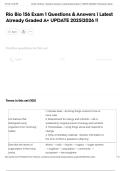
Terms in this set (105)
1. Cellular basis - All living things consist of one or
more cells
List features that 2. Requirement for energy and nutrients - Life is
distinguish living sustained by ongoing inputs of energy and nutrients
organisms from nonliving 3. Homeostasis - Living things sense and respond to
matter. change
4. DNA is hereditary material - Genetic information in
the form of DNA is passed to offspring
Describe the levels of Atoms → cells → tissues → organs → organ systems
organization in the living → organism → population → community →
world. ecosystem → the biosphere
https://quizlet.com/1077924407/rio-bio-156-exam-1-questions-answers-latest-already-graded-a-update-20252026-flash-cards/ 1/14
, 9/17/25, 12:55 PM Rio Bio 156 Exam 1 Questions & Answers | Latest Already Graded A+ UPDATE 2025|2026 !! Flashcards | Quizlet
Prokaryotes are bacteria and archaea.
List the three domains of Domain Bacteria: unicellular no nucleus
life and distinguish Domain Archaea: unicellular no nucleus but closer to
between each domain. eukarya
Domain Eukarya: have nucleus
1. Fungi can be single or multicellular but digest food
outside their body.
List four kingdoms within 2. Plants are multicellular and are photosynthetic.
the domain Eukarya and 3. Animals are multicellular and eat other organisms
distinguish between them. for nutrients.
4. Protists are the unicellular organisms that have a
nucleus but do not fit any other category.
List and describe the steps observation
involved in solving a hypothesis
problem using hypothesis- experimental
based science conclusion
Describe the concept "an organism is part of a more complex organization.
organism is more than the These emergent properties go beyond itself.
sum of its parts."
1. Population: multiple organisms in a single spot
By definition, distinguish 2. community: is made up of populations of different
between a population, a organisms
community, and an 3. ecosystem: is the interactions between the
ecosystem. community and the non-living environment that
surrounds it
producer:photosynthetic organisms that trap light and
convert that light energy into chemical bond energy.
Distinguish between a such as some bacteria, protists, and all plants
producer, a consumer and consumer: organisms that feed on already-stored
a decomposer. food
decomposer: bacteria and fungi recycle the dead
molecules throughout the bioshpere.
https://quizlet.com/1077924407/rio-bio-156-exam-1-questions-answers-latest-already-graded-a-update-20252026-flash-cards/ 2/14
Rio Bio 156 Exam 1 Questions & Answers | Latest
Already Graded A+ UPDATE 2025|2026 !!
Save
Practice questions for this set
Learn 1 /7 Study with Learn
Terms in this set (105)
1. Cellular basis - All living things consist of one or
more cells
List features that 2. Requirement for energy and nutrients - Life is
distinguish living sustained by ongoing inputs of energy and nutrients
organisms from nonliving 3. Homeostasis - Living things sense and respond to
matter. change
4. DNA is hereditary material - Genetic information in
the form of DNA is passed to offspring
Describe the levels of Atoms → cells → tissues → organs → organ systems
organization in the living → organism → population → community →
world. ecosystem → the biosphere
https://quizlet.com/1077924407/rio-bio-156-exam-1-questions-answers-latest-already-graded-a-update-20252026-flash-cards/ 1/14
, 9/17/25, 12:55 PM Rio Bio 156 Exam 1 Questions & Answers | Latest Already Graded A+ UPDATE 2025|2026 !! Flashcards | Quizlet
Prokaryotes are bacteria and archaea.
List the three domains of Domain Bacteria: unicellular no nucleus
life and distinguish Domain Archaea: unicellular no nucleus but closer to
between each domain. eukarya
Domain Eukarya: have nucleus
1. Fungi can be single or multicellular but digest food
outside their body.
List four kingdoms within 2. Plants are multicellular and are photosynthetic.
the domain Eukarya and 3. Animals are multicellular and eat other organisms
distinguish between them. for nutrients.
4. Protists are the unicellular organisms that have a
nucleus but do not fit any other category.
List and describe the steps observation
involved in solving a hypothesis
problem using hypothesis- experimental
based science conclusion
Describe the concept "an organism is part of a more complex organization.
organism is more than the These emergent properties go beyond itself.
sum of its parts."
1. Population: multiple organisms in a single spot
By definition, distinguish 2. community: is made up of populations of different
between a population, a organisms
community, and an 3. ecosystem: is the interactions between the
ecosystem. community and the non-living environment that
surrounds it
producer:photosynthetic organisms that trap light and
convert that light energy into chemical bond energy.
Distinguish between a such as some bacteria, protists, and all plants
producer, a consumer and consumer: organisms that feed on already-stored
a decomposer. food
decomposer: bacteria and fungi recycle the dead
molecules throughout the bioshpere.
https://quizlet.com/1077924407/rio-bio-156-exam-1-questions-answers-latest-already-graded-a-update-20252026-flash-cards/ 2/14


