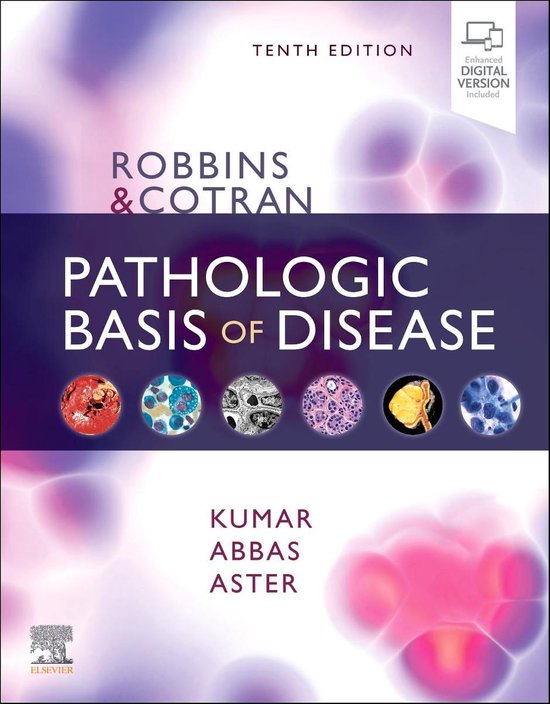
Robbins & Cotran 10th Ed. Pathology Test Bank | Chapter-
by-Chapter Questions & Verified Solutions
Robbins & Cotran Pathologic Basis of Disease
10th Edition
• Author(s)Vinay Kumar; Abul K. Abbas; Jon C. Aster
1. Chapter Reference – Chapter 1: The Cell as a Unit of
Health and Disease — The Genome
Stem: A newborn screening test shows absent activity of an
enzyme required to synthesize a mitochondrial protein;
sequencing reveals a single-nucleotide change in a nuclear
gene encoding a mitochondrial import receptor. Which
mechanism best explains how this mutation causes disease?
A. Defective splicing of mitochondrial mRNA
B. Impaired import of nuclear-encoded proteins into
mitochondria
C. Loss of mitochondrial DNA replication due to mtDNA
deletion
D. Failure of ribosomes to translate mitochondrial rRNA
Correct Answer: B
Rationale — Correct option: B. Nuclear-encoded proteins
require cytosolic translation and mitochondrial import; a
,mutation in an import receptor prevents essential proteins
reaching mitochondria, impairing function.
Incorrect options:
A. Mitochondrial mRNA splicing is largely driven by
mitochondrial-encoded factors; the mutation is nuclear and in an
import receptor, not a splicing factor.
C. A nuclear gene encoding an import receptor does not directly
cause mtDNA deletion or loss of mtDNA replication.
D. Mitochondrial rRNA is translated within the mitochondrion;
a nuclear import receptor defect does not directly block
mitochondrial ribosome translation.
Teaching Point: Nuclear genes encode many mitochondrial
proteins that must be imported for normal function.
2. Chapter Reference – Chapter 1 — Cellular Housekeeping
Stem: A patient with progressive neurodegeneration is
found to accumulate ubiquitin-positive cytoplasmic
inclusions. Which cellular process is most likely impaired?
A. Proteasomal degradation of misfolded proteins
B. Lysosomal degradation via autophagy
C. Endoplasmic reticulum export of properly folded
proteins
D. Mitochondrial oxidative phosphorylation
Correct Answer: A
Rationale — Correct option: A. Ubiquitin tags direct
misfolded proteins to the proteasome for degradation; ubiquitin-
positive inclusions indicate failure of the ubiquitin-proteasome
,system.
Incorrect options:
B. Autophagy also degrades proteins and organelles, but
ubiquitin-positive cytosolic inclusions classically reflect
proteasomal pathway failure.
C. ER export problems cause ER stress and unfolded protein
response, not typically ubiquitin-positive cytoplasmic
inclusions.
D. Oxidative phosphorylation defects cause energy failure, not
ubiquitin-tagged inclusion accumulation.
Teaching Point: The ubiquitin-proteasome system clears
misfolded proteins and prevents cytoplasmic inclusions.
3. Chapter Reference – Chapter 1 — Cellular Metabolism
and Mitochondrial Function
Stem: A muscle biopsy from a patient with exercise
intolerance shows ragged-red fibers and subsarcolemmal
mitochondrial proliferation. Which explanation best
accounts for these findings?
A. Increased mitochondrial biogenesis to compensate for
defective oxidative phosphorylation
B. Upregulation of glycolysis with decreased mitochondrial
number
C. Enhanced mitochondrial fusion leading to fewer, larger
mitochondria
D. Loss of mitochondrial DNA causing immediate cell
necrosis
Correct Answer: A
, Rationale — Correct option: A. Defects in oxidative
phosphorylation often trigger compensatory mitochondrial
biogenesis, producing subsarcolemmal mitochondrial
proliferation and ragged-red fibers on histology.
Incorrect options:
B. Upregulated glycolysis would not produce subsarcolemmal
mitochondrial proliferation seen as ragged-red fibers.
C. Enhanced fusion changes morphology but does not typically
cause the classic ragged-red subsarcolemmal accumulation.
D. mtDNA loss causes dysfunction but not necessarily
immediate necrosis; histology suggests compensation rather than
acute loss.
Teaching Point: Mitochondrial dysfunction often induces
compensatory mitochondrial proliferation visible in muscle.
4. Chapter Reference – Chapter 1 — Cellular Activation
Stem: Following lipopolysaccharide (LPS) exposure,
macrophages markedly increase TNF-α and IL-1
production. Which intracellular receptor family directly
senses LPS to initiate this response?
A. NOD-like receptors (NLRs)
B. Toll-like receptors (TLRs)
C. RIG-I–like receptors (RLRs)
D. C-type lectin receptors (CLRs)
Correct Answer: B
Rationale — Correct option: B. TLR4 on macrophages
recognizes bacterial LPS and triggers NF-κB–mediated cytokine
by-Chapter Questions & Verified Solutions
Robbins & Cotran Pathologic Basis of Disease
10th Edition
• Author(s)Vinay Kumar; Abul K. Abbas; Jon C. Aster
1. Chapter Reference – Chapter 1: The Cell as a Unit of
Health and Disease — The Genome
Stem: A newborn screening test shows absent activity of an
enzyme required to synthesize a mitochondrial protein;
sequencing reveals a single-nucleotide change in a nuclear
gene encoding a mitochondrial import receptor. Which
mechanism best explains how this mutation causes disease?
A. Defective splicing of mitochondrial mRNA
B. Impaired import of nuclear-encoded proteins into
mitochondria
C. Loss of mitochondrial DNA replication due to mtDNA
deletion
D. Failure of ribosomes to translate mitochondrial rRNA
Correct Answer: B
Rationale — Correct option: B. Nuclear-encoded proteins
require cytosolic translation and mitochondrial import; a
,mutation in an import receptor prevents essential proteins
reaching mitochondria, impairing function.
Incorrect options:
A. Mitochondrial mRNA splicing is largely driven by
mitochondrial-encoded factors; the mutation is nuclear and in an
import receptor, not a splicing factor.
C. A nuclear gene encoding an import receptor does not directly
cause mtDNA deletion or loss of mtDNA replication.
D. Mitochondrial rRNA is translated within the mitochondrion;
a nuclear import receptor defect does not directly block
mitochondrial ribosome translation.
Teaching Point: Nuclear genes encode many mitochondrial
proteins that must be imported for normal function.
2. Chapter Reference – Chapter 1 — Cellular Housekeeping
Stem: A patient with progressive neurodegeneration is
found to accumulate ubiquitin-positive cytoplasmic
inclusions. Which cellular process is most likely impaired?
A. Proteasomal degradation of misfolded proteins
B. Lysosomal degradation via autophagy
C. Endoplasmic reticulum export of properly folded
proteins
D. Mitochondrial oxidative phosphorylation
Correct Answer: A
Rationale — Correct option: A. Ubiquitin tags direct
misfolded proteins to the proteasome for degradation; ubiquitin-
positive inclusions indicate failure of the ubiquitin-proteasome
,system.
Incorrect options:
B. Autophagy also degrades proteins and organelles, but
ubiquitin-positive cytosolic inclusions classically reflect
proteasomal pathway failure.
C. ER export problems cause ER stress and unfolded protein
response, not typically ubiquitin-positive cytoplasmic
inclusions.
D. Oxidative phosphorylation defects cause energy failure, not
ubiquitin-tagged inclusion accumulation.
Teaching Point: The ubiquitin-proteasome system clears
misfolded proteins and prevents cytoplasmic inclusions.
3. Chapter Reference – Chapter 1 — Cellular Metabolism
and Mitochondrial Function
Stem: A muscle biopsy from a patient with exercise
intolerance shows ragged-red fibers and subsarcolemmal
mitochondrial proliferation. Which explanation best
accounts for these findings?
A. Increased mitochondrial biogenesis to compensate for
defective oxidative phosphorylation
B. Upregulation of glycolysis with decreased mitochondrial
number
C. Enhanced mitochondrial fusion leading to fewer, larger
mitochondria
D. Loss of mitochondrial DNA causing immediate cell
necrosis
Correct Answer: A
, Rationale — Correct option: A. Defects in oxidative
phosphorylation often trigger compensatory mitochondrial
biogenesis, producing subsarcolemmal mitochondrial
proliferation and ragged-red fibers on histology.
Incorrect options:
B. Upregulated glycolysis would not produce subsarcolemmal
mitochondrial proliferation seen as ragged-red fibers.
C. Enhanced fusion changes morphology but does not typically
cause the classic ragged-red subsarcolemmal accumulation.
D. mtDNA loss causes dysfunction but not necessarily
immediate necrosis; histology suggests compensation rather than
acute loss.
Teaching Point: Mitochondrial dysfunction often induces
compensatory mitochondrial proliferation visible in muscle.
4. Chapter Reference – Chapter 1 — Cellular Activation
Stem: Following lipopolysaccharide (LPS) exposure,
macrophages markedly increase TNF-α and IL-1
production. Which intracellular receptor family directly
senses LPS to initiate this response?
A. NOD-like receptors (NLRs)
B. Toll-like receptors (TLRs)
C. RIG-I–like receptors (RLRs)
D. C-type lectin receptors (CLRs)
Correct Answer: B
Rationale — Correct option: B. TLR4 on macrophages
recognizes bacterial LPS and triggers NF-κB–mediated cytokine