

Chemistry Chemical Bonds
Chemistry
Chemical Bonds
10
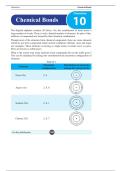
The English alphabet contains 26 letters. Yet, the combination of them forms a
large number of words. There is only a limited number of elements. In spite of that,
millions of compounds are formed by their chemical combination.
Though most of the elements form chemical compounds, there are some elements
which do not form compounds under normal conditions. Helium, neon and argon
are examples. These elements occurring as single atoms in nature exist as gases.
They are known as noble gases.
What is the reason why many elements form compounds but not the noble gases?
This can be explained by taking into consideration the electronic configuration of
elements.
Table10.1
Electronic Distribution of electrons
Element
configuration among the energy levels
Neon (Ne) 2, 8
Argon (Ar) 2, 8, 8
Sodium (Na) 2, 8, 1
Chorine (Cl) 2, 8, 7
For free distribution 168
,Chemistry Chemical Bonds
The outermost shell carrying electrons in an atom of an element is known
as its valence shell.The valence shell of the atoms of neon and argon has eight
electrons each. This electronic structure has been identified as a stable electronic
configuration. Because of this stable configuration their reactivity is very low, so
they are referred to as noble gases. But, the state of sodium and chlorine atoms is
different. In order to have the stable noble gas configuration, a sodium atom has to
either lose the electron in the last shell or gain seven electrons. Similarly a chlorine
atom can attain the stable electronic configuration by receiving a single electron or
by removing seven electrons. In the atoms of these element, electrons in the valence
shell reorganise to acquire the stable electronic configuration. That means, loss,
gain or sharing of electrons occurs.
The attractive forces or binding among the atoms or ions resulted by the
rearrangement of electrons in the valence shell for stabilising the atoms of
elements as described above are called chemical bonds.
According to the way the participating atoms behave when they chemically bind
together, the chemical bonds can be divided into two types.
1. Ionic bonds
2. Covalent bonds
10.1 Ionic Bonds
The electronic configuration of the sodium atom is 2, 8, 1. Sodium is an element
with low electronegativity. As the number of protons in a sodium atom is equal to
the number of electrons, an atom of sodium is electrically neutral (Fig. 10.1).
Number of electrons 11 (-11)
Number of protons 11 (+11)
Total charge 0
A sodium atom
Fig. 10.1
The atom after losing its electron in the outer energy level becomes a sodium ion
(Na+) with a charge of +1 (Fig.10.2). An atom after receiving a charge is known as
169 For free distribution
, Chemistry Chemical Bonds
an ion. Since this ion has a positive charge it is called a positive ion or a cation. The
chemical properties of an ion is different from that of an atom.
-e
Loss of an
electron
The Na atom The Na+ ion
Number of electrons 11(-11) Number of electrons 10(-10)
Electronic configuration 2, 8, 1 Electronic configuration 2, 8,
Number of protons 11(+11) Number of protons 11(+11)
Total charge 0 Total charge +1
Na Na+ + e
Atom Positive ion + e
Fig 10.2 Formation of a Na+ ion form a Na atom
The electronic configuration of the chlorine atom is 2, 8, 7.Chlorine is an element
with a high electronegativity value. Since the opposite charges are equal, a chlorine
atom is electrically neutral (Fig.10.3).
Chlorine atom
Number of electrons 17 (-17)
Electronic configuration 2, 8, 7
Number of protons 17 (+17)
Total charge 0
Fig. 10.3 A chlorine atom
Gaining one electron to the outermost energy level, a chlorine atom (Cl) forms the
chloride ion (Cl-) with a single negative charge (Fig. 10. 4). As this ion is negatively
charged it is called a negative ion or an anion.
For free distribution 170
Chemistry
Chemical Bonds
10
The English alphabet contains 26 letters. Yet, the combination of them forms a
large number of words. There is only a limited number of elements. In spite of that,
millions of compounds are formed by their chemical combination.
Though most of the elements form chemical compounds, there are some elements
which do not form compounds under normal conditions. Helium, neon and argon
are examples. These elements occurring as single atoms in nature exist as gases.
They are known as noble gases.
What is the reason why many elements form compounds but not the noble gases?
This can be explained by taking into consideration the electronic configuration of
elements.
Table10.1
Electronic Distribution of electrons
Element
configuration among the energy levels
Neon (Ne) 2, 8
Argon (Ar) 2, 8, 8
Sodium (Na) 2, 8, 1
Chorine (Cl) 2, 8, 7
For free distribution 168
,Chemistry Chemical Bonds
The outermost shell carrying electrons in an atom of an element is known
as its valence shell.The valence shell of the atoms of neon and argon has eight
electrons each. This electronic structure has been identified as a stable electronic
configuration. Because of this stable configuration their reactivity is very low, so
they are referred to as noble gases. But, the state of sodium and chlorine atoms is
different. In order to have the stable noble gas configuration, a sodium atom has to
either lose the electron in the last shell or gain seven electrons. Similarly a chlorine
atom can attain the stable electronic configuration by receiving a single electron or
by removing seven electrons. In the atoms of these element, electrons in the valence
shell reorganise to acquire the stable electronic configuration. That means, loss,
gain or sharing of electrons occurs.
The attractive forces or binding among the atoms or ions resulted by the
rearrangement of electrons in the valence shell for stabilising the atoms of
elements as described above are called chemical bonds.
According to the way the participating atoms behave when they chemically bind
together, the chemical bonds can be divided into two types.
1. Ionic bonds
2. Covalent bonds
10.1 Ionic Bonds
The electronic configuration of the sodium atom is 2, 8, 1. Sodium is an element
with low electronegativity. As the number of protons in a sodium atom is equal to
the number of electrons, an atom of sodium is electrically neutral (Fig. 10.1).
Number of electrons 11 (-11)
Number of protons 11 (+11)
Total charge 0
A sodium atom
Fig. 10.1
The atom after losing its electron in the outer energy level becomes a sodium ion
(Na+) with a charge of +1 (Fig.10.2). An atom after receiving a charge is known as
169 For free distribution
, Chemistry Chemical Bonds
an ion. Since this ion has a positive charge it is called a positive ion or a cation. The
chemical properties of an ion is different from that of an atom.
-e
Loss of an
electron
The Na atom The Na+ ion
Number of electrons 11(-11) Number of electrons 10(-10)
Electronic configuration 2, 8, 1 Electronic configuration 2, 8,
Number of protons 11(+11) Number of protons 11(+11)
Total charge 0 Total charge +1
Na Na+ + e
Atom Positive ion + e
Fig 10.2 Formation of a Na+ ion form a Na atom
The electronic configuration of the chlorine atom is 2, 8, 7.Chlorine is an element
with a high electronegativity value. Since the opposite charges are equal, a chlorine
atom is electrically neutral (Fig.10.3).
Chlorine atom
Number of electrons 17 (-17)
Electronic configuration 2, 8, 7
Number of protons 17 (+17)
Total charge 0
Fig. 10.3 A chlorine atom
Gaining one electron to the outermost energy level, a chlorine atom (Cl) forms the
chloride ion (Cl-) with a single negative charge (Fig. 10. 4). As this ion is negatively
charged it is called a negative ion or an anion.
For free distribution 170


