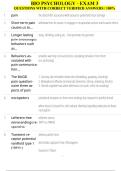
Bio Psychology - Exam 3 Questions With Correct Verified Answers | 100%
1. pain the discomfort associated with (actual or potential) tissue damage 2. Short term pain causes us to... withdraw from its source, to engage in recuperative actions and to warn others 3. Longer lasting pain encourages behaviors such as... sleep, drinking, eating, etc... that promote recuperation 4. Behaviors associated with pain communication... provides warning to kin and elicits caretaking behaviors from them (ex. grimacing) 5. The McGill pain questionnaire three aspects of pain 1. Sensory-discriminative dimension (throbbing, gnawing, shooting) 2. Motivational-affective (emotional) dimension (tiring, sickening, fearful) 3. Overall cognitive-evaluative dimension (no pain, mild, excruciating) 6. nocicpetors peripheral receptors on free nerve endings that respond to painful stimuli when tissue is injured the cells release chemical signaling molecules to these nociceptors 7. Different free nerve endings respond to different stimuli TRPV1 vs TRPM3 8. Transient receptor potential vanilloid type 1 (TRPV1) detects painful heat also binds capsaicin from chili peppers found on C fibers 1 / 32 9. Transient receptor potential type M3 (TRPM3) detects higher temperatures than TRPV1 does not respond to capsaicin found on A delta fibers 10. A delta fibers large myelinated axons that register pain quickly 11. C fibers thin, unmyelinated axons that conduct more slowly, producing lasting pain 12. Congenital insensitivity to pain (CIP) a genetic condition that prevents the feeling of pain particular sodium channel blocked - can't detect pain or odor 13. anterolateral/ spinothalamic system transmits the sensations of pain and temperature to the brain nerve fiber axons - dorsal horns of the spinal cord - synapse on spinal neurons - project across midline - ascend to thalamus - glutamate and a peptide, substance P are released in the spinal cord to boost pain signals 14. Steps of the anterolateral/ spinothalamic system 1. pain info is carried by rapidly conducting myelinated A delta fibers and slowly conducting unmyelinated C fibers 2. Axons of dorsal horn neurons cross the midline (at base) and ascend the spinal cord in the anterolateral quadrant 3. Pain info is provided to various brainstem sites, which control pain-related behavior such as vocalization 4. Pain info is distributed to many thalamic and cortical areas 5. Cingulate cortex is especially activated by pain information
Document information
- Uploaded on
- September 13, 2025
- Number of pages
- 32
- Written in
- 2025/2026
- Type
- Exam (elaborations)
- Contains
- Questions & answers