

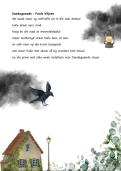
Sondagaande - Fanie Viljoen
die aand stuur sy roofvoë̈ ls uit in die taai donker
hulle draai eers rond
hoog bo die stad se woonsteldakke
maar mettertyd sirkel hulle laer, al laer
en sink neer op die krom lamppale
van waar hulle met skerp oë̈ by vensters kan intuur
na die prooi wat elke week sielalleen voor Sondagaande staan
, Sondagaande - The title “Sondagaande” sets the scene and mood, suggesting
routine, solitude, and quiet melancholy, which mirrors the
poem’s focus on the isolated prey and the looming threat
around them. This line conveys a dark and foreboding
die aand stuur sy - atmosphere. The phrase “die aand” sets the scene as night falls,
- a time often associated with mystery or danger. “Stuur sy
roofvoë̈ ls uit in die taai roofvoë̈ ls uit” personifies the evening or some unseen force as
donker - deliberately releasing predators, suggesting control and intent.
The description of the darkness as “taai” (thick or viscous)
intensifies the heaviness and oppressive quality of the night,
- giving the sense that the predators move through a dense,
almost tangible gloom. Overall, the line evokes a menacing
tension, establishing a mood of suspense and inevitability as the
hunter begins its hunt.
In the evening, it sends out its
- The line conveys a sense of cautious observation and
birds of prey into the thick anticipation.
darkness
hulle draai eers rond - The use of the verb “draai” suggests the predators are
surveying their environment, emphasizing patience and
- calculated intent before taking action.
The word “eers” implies a deliberate sequence, indicating that
this initial circling is a necessary step in their predatory
- process.
Symbolically, it may also reflect hesitation, reconnaissance, or
the ritualistic nature of hunting, creating tension as the
- reader senses the looming threat.
The simplicity of the line, paired with the visual image of
circling above the city, intensifies the eerie, watchful
They first circle around
- atmosphere of the poem.
on Sunday evenings
hoog bo die stad se - The line evokes a sense of distance and surveillance,
emphasizing the roof birds’ elevated, dominant position over
woonsteldakke
the urban landscape.
- It suggests detachment from the ordinary human world below,
High giving the birds a predatory and almost omniscient
above the perspective.
- The imagery contrasts the freedom and expansiveness of the
city’s
sky with the confined, structured human dwellings, highlighting
apartment
a theme of power, observation, and impending threat as the
roofs birds watch over their unsuspecting prey.
die aand stuur sy roofvoë̈ ls uit in die taai donker
hulle draai eers rond
hoog bo die stad se woonsteldakke
maar mettertyd sirkel hulle laer, al laer
en sink neer op die krom lamppale
van waar hulle met skerp oë̈ by vensters kan intuur
na die prooi wat elke week sielalleen voor Sondagaande staan
, Sondagaande - The title “Sondagaande” sets the scene and mood, suggesting
routine, solitude, and quiet melancholy, which mirrors the
poem’s focus on the isolated prey and the looming threat
around them. This line conveys a dark and foreboding
die aand stuur sy - atmosphere. The phrase “die aand” sets the scene as night falls,
- a time often associated with mystery or danger. “Stuur sy
roofvoë̈ ls uit in die taai roofvoë̈ ls uit” personifies the evening or some unseen force as
donker - deliberately releasing predators, suggesting control and intent.
The description of the darkness as “taai” (thick or viscous)
intensifies the heaviness and oppressive quality of the night,
- giving the sense that the predators move through a dense,
almost tangible gloom. Overall, the line evokes a menacing
tension, establishing a mood of suspense and inevitability as the
hunter begins its hunt.
In the evening, it sends out its
- The line conveys a sense of cautious observation and
birds of prey into the thick anticipation.
darkness
hulle draai eers rond - The use of the verb “draai” suggests the predators are
surveying their environment, emphasizing patience and
- calculated intent before taking action.
The word “eers” implies a deliberate sequence, indicating that
this initial circling is a necessary step in their predatory
- process.
Symbolically, it may also reflect hesitation, reconnaissance, or
the ritualistic nature of hunting, creating tension as the
- reader senses the looming threat.
The simplicity of the line, paired with the visual image of
circling above the city, intensifies the eerie, watchful
They first circle around
- atmosphere of the poem.
on Sunday evenings
hoog bo die stad se - The line evokes a sense of distance and surveillance,
emphasizing the roof birds’ elevated, dominant position over
woonsteldakke
the urban landscape.
- It suggests detachment from the ordinary human world below,
High giving the birds a predatory and almost omniscient
above the perspective.
- The imagery contrasts the freedom and expansiveness of the
city’s
sky with the confined, structured human dwellings, highlighting
apartment
a theme of power, observation, and impending threat as the
roofs birds watch over their unsuspecting prey.



