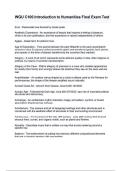
WGU C100 Introduction to Humanities Final Exam Test
Eros - Passionate love favored by Greek poets Aesthetic Experience - An experience of beauty that inspires a feeling of pleasure, which is its own justification, and this experience is valued independently of others. Agape - Greek term for platonic love. Age of Exploration - Time period between the early fifteenth to the early seventeenth centuries when Europeans sailed around the globe and transferred goods, food, plants, and people (in the form of slaves) transforming the countries they reached. Allegory - A work of art which represents some abstract quality or idea, often religious or political, by means of symbolic representation. Allegory of the Cave - Plato's allegory of prisoners in a cave who mistake appearance for reality (the Forms) and wrongly believe the shadows they see on the cave wall are real. Amphitheater - An outdoor venue shaped as a circle or ellipse used by the Romans for performances; the shape of the theater amplified sound naturally. Ancient Greek Art - Artwork from Greece, circa 8,000-146 BCE. Archaic Age - Followed the Dark Age, circa 800-479 BCE; saw rise of important political structures and democracy. Archetype - An emblematic mythic character, image, plot pattern, symbol, or buried assumption shared across cultures. Architecture - The science and art of designing buildings and other structures and is concerned with the aesthetic effect of structures in their surrounding environment. Art Nouveau - Art movement of the late 19th century - early 20th century that favored sinuous lines, curves, and organic motifs, such as plants and flowers. Atonality - Describes music that is written in a way that avoids centering around a specific key. Balance - The achievement of putting into harmony different compositional elements that are in dynamic tension with one another.
Document information
- Uploaded on
- September 11, 2025
- Number of pages
- 11
- Written in
- 2025/2026
- Type
- Exam (elaborations)
- Contains
- Questions & answers