

The Chemistry of Cells
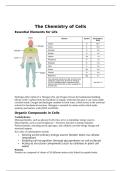
Essential Elements for Life
Hydrogen (H), Carbon (C), Nitrogen (N), and Oxygen (O) are the fundamental building
blocks of life. Carbon forms the backbone of organic molecules because it can create stable
covalent bonds. Oxygen and hydrogen combine to form water, which serves as the universal
solvent for biochemical reactions. Nitrogen is essential for amino acids (which make
proteins) and nucleic acids (DNA and RNA).
Organic Compounds in Cells
Carbohydrates
Monosaccharides, such as glucose (C₆H₁₂O₆), serve as immediate energy sources.
Disaccharides, such as sucrose (glucose + fructose), function in energy transport.
Polysaccharides, including starch, glycogen, and cellulose, provide energy storage and
structural support.
Key roles of carbohydrates include:
Serving as the primary energy source (broken down via cellular
respiration)
Enabling cell recognition (through glycoproteins on cell surfaces)
Acting as structural components (such as cellulose in plant cell
walls)
Proteins
Proteins are composed of chains of 20 different amino acids linked by peptide bonds.
,Their structural organization includes:
Primary: The linear amino acid sequence
Secondary: α-helices and β-pleated sheets formed by hydrogen
bonding
Tertiary: The three-dimensional folding determined by R-group
interactions
Quaternary: Multiple polypeptide subunits, as in hemoglobin
The biological functions of proteins include:
Catalyzing reactions (enzymes)
Providing structural support (cytoskeleton, collagen)
Facilitating molecular transport (hemoglobin, membrane channels)
Enabling cell signaling (hormones, receptors)
Lipids
Lipids are hydrophobic molecules composed mainly of hydrocarbons.
The major types include:
Triglycerides: Energy storage in adipose tissue
Phospholipids: The primary component of cell membranes, with an
amphipathic structure
Steroids: Including cholesterol (for membrane fluidity) and
hormones (such as estrogen and testosterone)
Functions of lipids include:
Long-term energy storage
Cell membrane structure
Acting as signaling molecules
Nucleic Acids
DNA is a double-stranded helix that contains genetic instructions and has a deoxyribose
sugar. RNA is single-stranded, contains ribose sugar, and is involved in protein synthesis.
A nucleotide consists of:
A phosphate group
A pentose sugar
A nitrogenous base (A, T, C, G for DNA; A, U, C, G for RNA)
Cell Membrane Structure and Function
The cell membrane is composed of a phospholipid bilayer with hydrophilic heads and
hydrophobic tails. It also contains embedded proteins (both integral and peripheral),
cholesterol for membrane stability, and glycolipids/glycoproteins for cell recognition.
Key properties of the membrane include:
Selective permeability
A fluid mosaic structure
Self-sealing capability
Its primary functions are to:
Maintain cellular integrity
Regulate the transport of materials
Facilitate cell communication
Provide attachment sites for the cytoskeleton and the extracellular
matrix
,Cellular Transport Mechanisms
Passive Transport
Simple Diffusion: The movement of small, nonpolar molecules
(such as O₂ and CO₂) down the concentration gradient
Facilitated Diffusion: Protein-assisted transport of larger or polar
molecules (such as glucose and ions)
Osmosis: The movement of water across semipermeable
membranes
Active Transport
Protein Pumps: ATP-driven movement of molecules against the
concentration gradient (e.g., Na⁺/K⁺ pump)
Bulk Transport:
o Endocytosis (cellular uptake)
o Exocytosis (cellular secretion)
Membrane-Assisted Processes
Receptor-Mediated Endocytosis: Selective uptake of specific
molecules
Pinocytosis: The cell “drinking” extracellular fluid
Phagocytosis: The cell “eating” large particles
Human Tissues
Epithelial Tissue
, Epithelial tissue performs several vital functions, including absorption, protection, secretion,
filtration, and sensory reception.
Types:
o Simple epithelium (single layer): Found in structures such as capillaries,
alveoli, and glomeruli, where diffusion occurs.
o Stratified epithelium (multiple layers): Provides protection in areas like the
skin, mouth, and esophagus.
o Glandular epithelium: Forms glands, including endocrine glands (which
produce hormones) and exocrine glands (which produce sweat and saliva).
Shapes: Epithelial cells can be squamous (flat), cuboidal (cube-like), or columnar
(tall).
Epithelial tissue regenerates quickly but requires nutrients from underlying tissues.
Connective Tissue
Connective tissue provides support, binding, insulation, and protection for the body.
Types:
1. Connective Tissue Proper
Loose connective tissue: Has fewer fibers (e.g., fat tissue).
Dense connective tissue: Rich in collagen, found in tendons and
ligaments.
2. Cartilage
Hyaline cartilage: Found in joints and ribs.
Elastic cartilage: Found in the ear and epiglottis.
Fibrocartilage: The strongest type, found in intervertebral discs.
3. Bone – A rigid and vascular tissue that supports the body and produces blood
cells.
4. Liquid Connective Tissue
Blood: Made of plasma and blood cells.
Lymph: Plays a key role in immune defense.
Membranes associated with connective tissue:
o Cutaneous membrane: The skin.
o Mucous membrane: Lines the digestive and respiratory tracts.
o Serous membrane: Lines body cavities.
o Synovial membrane: Provides lubrication for joints
Muscle Tissue
Muscle tissue enables movement and comes in three types:
Skeletal muscle: Striated and voluntary, responsible for movement and posture.
Essential Elements for Life
Hydrogen (H), Carbon (C), Nitrogen (N), and Oxygen (O) are the fundamental building
blocks of life. Carbon forms the backbone of organic molecules because it can create stable
covalent bonds. Oxygen and hydrogen combine to form water, which serves as the universal
solvent for biochemical reactions. Nitrogen is essential for amino acids (which make
proteins) and nucleic acids (DNA and RNA).
Organic Compounds in Cells
Carbohydrates
Monosaccharides, such as glucose (C₆H₁₂O₆), serve as immediate energy sources.
Disaccharides, such as sucrose (glucose + fructose), function in energy transport.
Polysaccharides, including starch, glycogen, and cellulose, provide energy storage and
structural support.
Key roles of carbohydrates include:
Serving as the primary energy source (broken down via cellular
respiration)
Enabling cell recognition (through glycoproteins on cell surfaces)
Acting as structural components (such as cellulose in plant cell
walls)
Proteins
Proteins are composed of chains of 20 different amino acids linked by peptide bonds.
,Their structural organization includes:
Primary: The linear amino acid sequence
Secondary: α-helices and β-pleated sheets formed by hydrogen
bonding
Tertiary: The three-dimensional folding determined by R-group
interactions
Quaternary: Multiple polypeptide subunits, as in hemoglobin
The biological functions of proteins include:
Catalyzing reactions (enzymes)
Providing structural support (cytoskeleton, collagen)
Facilitating molecular transport (hemoglobin, membrane channels)
Enabling cell signaling (hormones, receptors)
Lipids
Lipids are hydrophobic molecules composed mainly of hydrocarbons.
The major types include:
Triglycerides: Energy storage in adipose tissue
Phospholipids: The primary component of cell membranes, with an
amphipathic structure
Steroids: Including cholesterol (for membrane fluidity) and
hormones (such as estrogen and testosterone)
Functions of lipids include:
Long-term energy storage
Cell membrane structure
Acting as signaling molecules
Nucleic Acids
DNA is a double-stranded helix that contains genetic instructions and has a deoxyribose
sugar. RNA is single-stranded, contains ribose sugar, and is involved in protein synthesis.
A nucleotide consists of:
A phosphate group
A pentose sugar
A nitrogenous base (A, T, C, G for DNA; A, U, C, G for RNA)
Cell Membrane Structure and Function
The cell membrane is composed of a phospholipid bilayer with hydrophilic heads and
hydrophobic tails. It also contains embedded proteins (both integral and peripheral),
cholesterol for membrane stability, and glycolipids/glycoproteins for cell recognition.
Key properties of the membrane include:
Selective permeability
A fluid mosaic structure
Self-sealing capability
Its primary functions are to:
Maintain cellular integrity
Regulate the transport of materials
Facilitate cell communication
Provide attachment sites for the cytoskeleton and the extracellular
matrix
,Cellular Transport Mechanisms
Passive Transport
Simple Diffusion: The movement of small, nonpolar molecules
(such as O₂ and CO₂) down the concentration gradient
Facilitated Diffusion: Protein-assisted transport of larger or polar
molecules (such as glucose and ions)
Osmosis: The movement of water across semipermeable
membranes
Active Transport
Protein Pumps: ATP-driven movement of molecules against the
concentration gradient (e.g., Na⁺/K⁺ pump)
Bulk Transport:
o Endocytosis (cellular uptake)
o Exocytosis (cellular secretion)
Membrane-Assisted Processes
Receptor-Mediated Endocytosis: Selective uptake of specific
molecules
Pinocytosis: The cell “drinking” extracellular fluid
Phagocytosis: The cell “eating” large particles
Human Tissues
Epithelial Tissue
, Epithelial tissue performs several vital functions, including absorption, protection, secretion,
filtration, and sensory reception.
Types:
o Simple epithelium (single layer): Found in structures such as capillaries,
alveoli, and glomeruli, where diffusion occurs.
o Stratified epithelium (multiple layers): Provides protection in areas like the
skin, mouth, and esophagus.
o Glandular epithelium: Forms glands, including endocrine glands (which
produce hormones) and exocrine glands (which produce sweat and saliva).
Shapes: Epithelial cells can be squamous (flat), cuboidal (cube-like), or columnar
(tall).
Epithelial tissue regenerates quickly but requires nutrients from underlying tissues.
Connective Tissue
Connective tissue provides support, binding, insulation, and protection for the body.
Types:
1. Connective Tissue Proper
Loose connective tissue: Has fewer fibers (e.g., fat tissue).
Dense connective tissue: Rich in collagen, found in tendons and
ligaments.
2. Cartilage
Hyaline cartilage: Found in joints and ribs.
Elastic cartilage: Found in the ear and epiglottis.
Fibrocartilage: The strongest type, found in intervertebral discs.
3. Bone – A rigid and vascular tissue that supports the body and produces blood
cells.
4. Liquid Connective Tissue
Blood: Made of plasma and blood cells.
Lymph: Plays a key role in immune defense.
Membranes associated with connective tissue:
o Cutaneous membrane: The skin.
o Mucous membrane: Lines the digestive and respiratory tracts.
o Serous membrane: Lines body cavities.
o Synovial membrane: Provides lubrication for joints
Muscle Tissue
Muscle tissue enables movement and comes in three types:
Skeletal muscle: Striated and voluntary, responsible for movement and posture.


