

25 Angles of a Polygon
By studying this lesson you will be able to;
² solve geometrical problems related to the interior angles of a polygon,
² solve geometrical problems related to the exterior angles of a polygon,
² solve problems related to regular polygons.
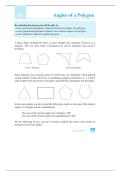
A plane figure bounded by three or more straight line segments is known as a
polygon. The two main types of polygons are convex polygons and concave
polygons.
Convex Polygons Concave Polygons
Some polygons have special names by which they are identified, which depend
on the number of sides they have. Accordingly, polygons which have 3, 4, 5 and 6
sides respectively are known as triangles, quadrilaterals, pentagons and hexagons.
In previous grades you have learnt the following results on the sum of the interior
angles of a triangle and of a quadrilateral.
The sum of the interior angles of a triangle is 180o.
The sum of the interior angles of a quadrilateral is 360o.
Do the following review exercise to further establish the above facts learnt on
polygons in previous grades.
51
For free distribution.
, Review Exercise
1. From the given figures, select all the convex polygons.
(i) (ii) (iii) (iv) (v)
2. From the statements given below, select the true statements.
a. A polygon with 7 sides is known as a heptagon.
b. In any polygon, the number of interior angles is equal to the number of
sides.
c. A polygon with all sides equal is known as a regular polygon.
d. At each vertex of a polygon, the sum of the interior angle and the exterior
angle is 180o.
e. There are 11 interior angles in a decagon.
f. The sum of the exterior angles of a quadrilateral is 180o.
3. Find the magnitude of each of the angles denoted by a lower case letter in each
of the following figures.
i. ii. iii. iv.
a
70x 2x 120x 110x
y
x
70x x 145
x
a a
v. vi. vii.
100x 3x a
a 2a
2a a
a 60x
2x
52
For free distribution.
By studying this lesson you will be able to;
² solve geometrical problems related to the interior angles of a polygon,
² solve geometrical problems related to the exterior angles of a polygon,
² solve problems related to regular polygons.
A plane figure bounded by three or more straight line segments is known as a
polygon. The two main types of polygons are convex polygons and concave
polygons.
Convex Polygons Concave Polygons
Some polygons have special names by which they are identified, which depend
on the number of sides they have. Accordingly, polygons which have 3, 4, 5 and 6
sides respectively are known as triangles, quadrilaterals, pentagons and hexagons.
In previous grades you have learnt the following results on the sum of the interior
angles of a triangle and of a quadrilateral.
The sum of the interior angles of a triangle is 180o.
The sum of the interior angles of a quadrilateral is 360o.
Do the following review exercise to further establish the above facts learnt on
polygons in previous grades.
51
For free distribution.
, Review Exercise
1. From the given figures, select all the convex polygons.
(i) (ii) (iii) (iv) (v)
2. From the statements given below, select the true statements.
a. A polygon with 7 sides is known as a heptagon.
b. In any polygon, the number of interior angles is equal to the number of
sides.
c. A polygon with all sides equal is known as a regular polygon.
d. At each vertex of a polygon, the sum of the interior angle and the exterior
angle is 180o.
e. There are 11 interior angles in a decagon.
f. The sum of the exterior angles of a quadrilateral is 180o.
3. Find the magnitude of each of the angles denoted by a lower case letter in each
of the following figures.
i. ii. iii. iv.
a
70x 2x 120x 110x
y
x
70x x 145
x
a a
v. vi. vii.
100x 3x a
a 2a
2a a
a 60x
2x
52
For free distribution.


