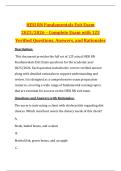
HESI RN Fundamentals Exit Exam
2025/2026 – Complete Exam with 125
Verified Questions, Answers, and Rationales
Description:
This document provides the full set of 125 actual HESI RN
Fundamentals Exit Exam questions for the academic year
2025/2026. Each question includes the correct verified answer
along with detailed rationales to support understanding and
review. It is designed as a comprehensive exam preparation
resource, covering a wide range of fundamental nursing topics
that are essential for success on the HESI RN exit exam.
Questions and Answers with Rationales:
The nurse is instructing a client with cholecystitis regarding diet
choices. Which meal best meets the dietary needs of this client?
A.
Steak, baked beans, and a salad
B.
Broiled fish, green beans, and an apple
C.
,Pork chops, macaroni and cheese, and grapes
D.
Avocado salad, milk, and angel food cake -Answer:-B
Rationale:-Clients with cholecystitis (inflammation of the
gallbladder) should follow a low-fat diet, such as option B. Option
A is a high-protein diet, and options C and D contain high-fat
foods, which are contraindicated for this client.
A 65-year-old client who attends an adult daycare program and is
wheelchair mobile has redness in the sacral area. Which
instruction is most important for the nurse to provide?
A.
"Take a vitamin supplement tablet once a day."
B.
"Change positions in the chair frequently"
C.
"Increase daily intake of water or other oral fluids."
D.
"Purchase a newer model wheelchair." -Answer:-B
Rationale:-The most important teaching is to change positions
frequently because pressure is the most significant factor related
,to the development of pressure ulcers. Increased vitamin and
fluid intake may also be beneficial and promote healing and
reduce further risk. Option D is an intervention of last resort
because this will be very expensive for the client.
Which nonverbal action should the nurse implement to
demonstrate active listening?
A.
Sit facing the client.
B.
Cross arms and legs.
C.
Avoid eye contact.
D.
Lean back in the chair. -Answer:-A
Rationale:-Active listening is conveyed using attentive verbal and
nonverbal communication techniques. To facilitate therapeutic
communication and attentiveness, the nurse should sit facing the
client, which lets the client know that the nurse is there to listen.
Active listening skills include postures that are open to the client,
such as keeping the arms open and relaxed, not option B, and
leaning toward the client, not option D. To communicate
, involvement and willingness to listen to the client, eye contact
should be established and maintained.
The nurse is assisting a client to the bathroom. When the client is
5 feet from the bathroom door, he states, "I feel faint." Before the
nurse can get the client to a chair, the client starts to fall. Which is
the priority action for the nurse to take?
A.
Check the client's carotid pulse.
B.
Encourage the client to get to the toilet.
C.
In a loud voice, call for help.
D.
Gently lower the client to the floor. -Answer:-D
Rationale:-Option D is the most prudent intervention and is the
priority nursing action to prevent injury to the client and the
nurse. Lowering the client to the floor should be done when the
client cannot support his own weight. The client should be placed
in a bed or chair only when sufficient help is available to prevent
injury. Option A is important but should be done after the client is
in a safe position. Because the client is not supporting himself,
2025/2026 – Complete Exam with 125
Verified Questions, Answers, and Rationales
Description:
This document provides the full set of 125 actual HESI RN
Fundamentals Exit Exam questions for the academic year
2025/2026. Each question includes the correct verified answer
along with detailed rationales to support understanding and
review. It is designed as a comprehensive exam preparation
resource, covering a wide range of fundamental nursing topics
that are essential for success on the HESI RN exit exam.
Questions and Answers with Rationales:
The nurse is instructing a client with cholecystitis regarding diet
choices. Which meal best meets the dietary needs of this client?
A.
Steak, baked beans, and a salad
B.
Broiled fish, green beans, and an apple
C.
,Pork chops, macaroni and cheese, and grapes
D.
Avocado salad, milk, and angel food cake -Answer:-B
Rationale:-Clients with cholecystitis (inflammation of the
gallbladder) should follow a low-fat diet, such as option B. Option
A is a high-protein diet, and options C and D contain high-fat
foods, which are contraindicated for this client.
A 65-year-old client who attends an adult daycare program and is
wheelchair mobile has redness in the sacral area. Which
instruction is most important for the nurse to provide?
A.
"Take a vitamin supplement tablet once a day."
B.
"Change positions in the chair frequently"
C.
"Increase daily intake of water or other oral fluids."
D.
"Purchase a newer model wheelchair." -Answer:-B
Rationale:-The most important teaching is to change positions
frequently because pressure is the most significant factor related
,to the development of pressure ulcers. Increased vitamin and
fluid intake may also be beneficial and promote healing and
reduce further risk. Option D is an intervention of last resort
because this will be very expensive for the client.
Which nonverbal action should the nurse implement to
demonstrate active listening?
A.
Sit facing the client.
B.
Cross arms and legs.
C.
Avoid eye contact.
D.
Lean back in the chair. -Answer:-A
Rationale:-Active listening is conveyed using attentive verbal and
nonverbal communication techniques. To facilitate therapeutic
communication and attentiveness, the nurse should sit facing the
client, which lets the client know that the nurse is there to listen.
Active listening skills include postures that are open to the client,
such as keeping the arms open and relaxed, not option B, and
leaning toward the client, not option D. To communicate
, involvement and willingness to listen to the client, eye contact
should be established and maintained.
The nurse is assisting a client to the bathroom. When the client is
5 feet from the bathroom door, he states, "I feel faint." Before the
nurse can get the client to a chair, the client starts to fall. Which is
the priority action for the nurse to take?
A.
Check the client's carotid pulse.
B.
Encourage the client to get to the toilet.
C.
In a loud voice, call for help.
D.
Gently lower the client to the floor. -Answer:-D
Rationale:-Option D is the most prudent intervention and is the
priority nursing action to prevent injury to the client and the
nurse. Lowering the client to the floor should be done when the
client cannot support his own weight. The client should be placed
in a bed or chair only when sufficient help is available to prevent
injury. Option A is important but should be done after the client is
in a safe position. Because the client is not supporting himself,