

Lectures genetics and public health
Lecture 1 – meet and greet: Mendel
Learning goals:
- Explain the principles of monogenetic (mendelian) inheritance and illustrate them
with examples
- Create a pedigree using information about a family and calculate the risks of
suffering from or passing on an inherited disorder, in the case of autosomal
dominant, autosomal recessive and X-linked recessive transmission
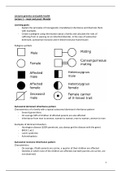
Pedigree symbols
Autosomal dominant inheritance pattern
Characteristics of a family with a typical autosomal dominant inheritance pattern
- Several generations
- On average 50% of children of affected parents are also affected
- Inheritance from man to woman, woman to woman, man to woman, woman to man
Examples of dominant disorders
- Huntington disease (100% penetrant, you always get the disease with the gene)
- BRCA 1 ad 2
- Lunch syndrome
- Achondroplasia
Autosomal recessive inheritance pattern
Characteristics
- On average, if both parents are carrier, a quarter of their children are affected
- (families in which none of the children are affected, but both parents are carrier, are
not observed)
1
, - Sometimes parents are consanguineous (you and your partner are related)
- Usually just 1 generation
Examples
- Cystic fibrosis
- Hemoglobinopathies (sickle cell anemia, thalassemia)
- Phenylketonuria (PKU)
Case examples
Peter and Danielle
Peter and Daniëlle have a relationship. A nephew
of Daniëlle has Duchenne Muscular Dystrophy
(DMD). Peter does not want to have children if his
children have a high risk to have DMD. However,
Daniëlle would very much like to have children.
Nephew Edward is Daniëlle’s brother’s son. X-
linked (sex-linked)
In general: no increased risk on X-linked disorder
if there is a healthy male in between.
Dannielle’s brother has a normal X-chromosome,
otherwise he would have had DMD as well.
Edward will have inherited the predisposition for DMD from his mother (or it is a ‘de novo’
(new) mutation). Danielle does not have an increased risk to pass on the disorder to her
children. Referral to a clinical genetics center is not necessary
Jasper and Lisa
Jasper and Lisa have a relationship. The cousin of Lisa, Tim, had DMD. Jasper does not want
to have children if they have I high risk to have DMD. However, Lisa would very much like to
have children. Tim is the son of Henk and Isabelle. Isabelle is the sister of Lisa’s mother.
In this pedigree there are only woman between Lisa and Tim. Because Isabelle is a carrier,
Lisa has a 25% chance to be a carrier as well.
2
,X-linked inheritance pattern
Characteristics
- Males are affected, females pass on the disorder but are (usually) not affected
(carrier)
- No inheritance from man to man
- Fathers (if fertile!) can have daughters who are carriers
- Sons are affected
Examples
- Duchenne muscular dystrophy
- Hemophilia A and B (impaired blood clotting)
- Color blindness
3
, Lecture 2 – Genes and diseases
Genetics is a science of genes, heredity and variation.
- Fast technological developments, increasingly multidisciplinary
- Can have high impact on individuals, families and populations
A gene is a functional unit that is regulated by transcription and encodes a product (a
protein of RNA). The human genome has 20-25.000 genes, which is less than we first
expected. The genes are located on our chromosomes which consists of 23 pairs.
Only 2% of our genome codes for the proteins, only the exons translate to proteins and
determine our hereditary trades.
Large parts (98%) are non-coding, it is still unexplained. We used to call it “junk DNA”. It is
recently discovered that this part of the genome had regulatory functions of distant gene,
to switch genes on and off.
On a phenotypic level there are a lot of differences between humans and other apes. But we
both have 20-25.000 genes in the genome. For example, puffer Fisch has 35.000. It is not just
the number of genes that determines who we are or determines the complexity of the
species, but it is probably that one gene codes for multiple proteins/protein complexes and
that determines the complexity of the species.
We differ and are unique because of human genetic variation. This can be distinguished in
different classes.
- The first class is the class of the single nucleotide variant (only one nucleotide
differences)
- Insertion-deletion variant (deletion of multiple nucleotides)
Genetic variation leads to phenotypic variation and increased the chance that some
individuals will survive. If the environment changes, some individuals will have a survival
benefit because of genetic variation. On average 2 individuals each differ 1 base in 1000
basepairs (used for forensic research and paternity testing). A change in DNA with a
frequency of >1% we call polymorphism. In our genome we have around 15.000.000 genetic
variants (polymorphisms, e.g. SNPs (single nucleotide polymorphisms)). Most
4
Lecture 1 – meet and greet: Mendel
Learning goals:
- Explain the principles of monogenetic (mendelian) inheritance and illustrate them
with examples
- Create a pedigree using information about a family and calculate the risks of
suffering from or passing on an inherited disorder, in the case of autosomal
dominant, autosomal recessive and X-linked recessive transmission
Pedigree symbols
Autosomal dominant inheritance pattern
Characteristics of a family with a typical autosomal dominant inheritance pattern
- Several generations
- On average 50% of children of affected parents are also affected
- Inheritance from man to woman, woman to woman, man to woman, woman to man
Examples of dominant disorders
- Huntington disease (100% penetrant, you always get the disease with the gene)
- BRCA 1 ad 2
- Lunch syndrome
- Achondroplasia
Autosomal recessive inheritance pattern
Characteristics
- On average, if both parents are carrier, a quarter of their children are affected
- (families in which none of the children are affected, but both parents are carrier, are
not observed)
1
, - Sometimes parents are consanguineous (you and your partner are related)
- Usually just 1 generation
Examples
- Cystic fibrosis
- Hemoglobinopathies (sickle cell anemia, thalassemia)
- Phenylketonuria (PKU)
Case examples
Peter and Danielle
Peter and Daniëlle have a relationship. A nephew
of Daniëlle has Duchenne Muscular Dystrophy
(DMD). Peter does not want to have children if his
children have a high risk to have DMD. However,
Daniëlle would very much like to have children.
Nephew Edward is Daniëlle’s brother’s son. X-
linked (sex-linked)
In general: no increased risk on X-linked disorder
if there is a healthy male in between.
Dannielle’s brother has a normal X-chromosome,
otherwise he would have had DMD as well.
Edward will have inherited the predisposition for DMD from his mother (or it is a ‘de novo’
(new) mutation). Danielle does not have an increased risk to pass on the disorder to her
children. Referral to a clinical genetics center is not necessary
Jasper and Lisa
Jasper and Lisa have a relationship. The cousin of Lisa, Tim, had DMD. Jasper does not want
to have children if they have I high risk to have DMD. However, Lisa would very much like to
have children. Tim is the son of Henk and Isabelle. Isabelle is the sister of Lisa’s mother.
In this pedigree there are only woman between Lisa and Tim. Because Isabelle is a carrier,
Lisa has a 25% chance to be a carrier as well.
2
,X-linked inheritance pattern
Characteristics
- Males are affected, females pass on the disorder but are (usually) not affected
(carrier)
- No inheritance from man to man
- Fathers (if fertile!) can have daughters who are carriers
- Sons are affected
Examples
- Duchenne muscular dystrophy
- Hemophilia A and B (impaired blood clotting)
- Color blindness
3
, Lecture 2 – Genes and diseases
Genetics is a science of genes, heredity and variation.
- Fast technological developments, increasingly multidisciplinary
- Can have high impact on individuals, families and populations
A gene is a functional unit that is regulated by transcription and encodes a product (a
protein of RNA). The human genome has 20-25.000 genes, which is less than we first
expected. The genes are located on our chromosomes which consists of 23 pairs.
Only 2% of our genome codes for the proteins, only the exons translate to proteins and
determine our hereditary trades.
Large parts (98%) are non-coding, it is still unexplained. We used to call it “junk DNA”. It is
recently discovered that this part of the genome had regulatory functions of distant gene,
to switch genes on and off.
On a phenotypic level there are a lot of differences between humans and other apes. But we
both have 20-25.000 genes in the genome. For example, puffer Fisch has 35.000. It is not just
the number of genes that determines who we are or determines the complexity of the
species, but it is probably that one gene codes for multiple proteins/protein complexes and
that determines the complexity of the species.
We differ and are unique because of human genetic variation. This can be distinguished in
different classes.
- The first class is the class of the single nucleotide variant (only one nucleotide
differences)
- Insertion-deletion variant (deletion of multiple nucleotides)
Genetic variation leads to phenotypic variation and increased the chance that some
individuals will survive. If the environment changes, some individuals will have a survival
benefit because of genetic variation. On average 2 individuals each differ 1 base in 1000
basepairs (used for forensic research and paternity testing). A change in DNA with a
frequency of >1% we call polymorphism. In our genome we have around 15.000.000 genetic
variants (polymorphisms, e.g. SNPs (single nucleotide polymorphisms)). Most
4


