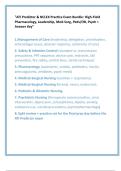
"ATI Predictor & NCLEX Practice Exam Bundle: High-Yield
Pharmacology, Leadership, Med-Surg, Peds/OB, Psych +
Answer Key"
1.Management of Care (leadership, delegation, prioritization,
ethical/legal issues, disaster response, continuity of care)
2. Safety & Infection Control (standard vs. transmission
precautions, PPE sequence, device care, restraints, fall
prevention, fire safety, central lines, sterile technique)
3. Pharmacology (autonomic, cardiac, antibiotics, insulin,
anticoagulants, antidotes, psych meds)
4. Medical-Surgical Nursing I (cardiac + respiratory).
5. Medical-Surgical Nursing II (renal, neuro, endocrine).
6. Pediatric & Obstetric Nursing.
7. Psychiatric Nursing (therapeutic communication, crisis
intervention, depression, schizophrenia, bipolar, anxiety,
substance use, suicide precautions, psychopharmacology)
8. light review + practice set for the final prep day before the
ATI Predictor exam
,1. Leadership / Delegation
A charge nurse is overseeing an acute care unit. The unit has an
RN, an LPN, and a UAP (unlicensed assistive personnel). Which
of the following tasks is appropriate to delegate to the UAP?
A. Providing a PRN analgesic to a 45-year-old patient reporting a
pain level of 6/10.
B. Performing a sterile dressing change on a 68-year-old post-
operative patient's surgical incision.
C. Assisting a 72-year-old patient with stable vital signs to
ambulate to the bathroom.
D. Inserting a urinary catheter for a 55-year-old male with a
recent post-void residual of 250 mL.
Topic/subtopic: Delegation — UAP tasks
NCLEX Client Needs Category & Subcategory: Management of
Care — Assignment/Delegation
Cognitive level (Bloom): Application
Difficulty (1–5): 2
Learning objective (one sentence): The student must
demonstrate the ability to assign appropriate tasks to
unlicensed assistive personnel (UAP) based on their scope of
practice.
,Answers & rationales:
Correct answer: C. Assisting a 72-year-old patient with stable
vital signs to ambulate to the bathroom.
Rationale: Assisting with ambulation is a routine task that falls
within the scope of practice for a UAP. The patient's stable vital
signs indicate that the task is safe and does not require complex
clinical judgment or assessment. The UAP is trained to perform
this supportive role.
Incorrect answers:
A. A UAP cannot administer medications, including PRN
analgesics, as this requires a license and clinical assessment.
B. Sterile procedures, like a sterile dressing change, are invasive
and require the licensed skill and knowledge of an LPN or RN.
D. Catheter insertion is an invasive procedure requiring a
licensed professional's skill and is outside the UAP's scope of
practice.
Test-taking tip: Remember the "5 Rights of Delegation" and
always consider the scope of practice for each team member.
2. Leadership / Delegation
A new charge nurse on a medical-surgical unit is orienting a new
RN. The charge nurse should intervene if which of the following
actions is observed?
, A. The new RN collaborates with the physical therapist to adjust
a patient's mobility goals.
B. The new RN assigns an LPN to administer a scheduled oral
antibiotic to a patient.
C. The new RN delegates the initial admission assessment of a
new patient to the LPN.
D. The new RN asks a UAP to obtain routine vital signs on a
stable patient.
Topic/subtopic: Delegation — RN to LPN
NCLEX Client Needs Category & Subcategory: Management of
Care — Assignment/Delegation
Cognitive level (Bloom): Evaluation
Difficulty (1–5): 3
Learning objective (one sentence): The student must evaluate a
new nurse's delegation decisions to ensure they align with
professional practice standards and scope of practice.
Answers & rationales:
Correct answer: C. The new RN delegates the initial admission
assessment of a new patient to the LPN.
Rationale: The initial admission assessment is a critical function
that requires the comprehensive knowledge and clinical
judgment of a registered nurse (RN). This assessment
Pharmacology, Leadership, Med-Surg, Peds/OB, Psych +
Answer Key"
1.Management of Care (leadership, delegation, prioritization,
ethical/legal issues, disaster response, continuity of care)
2. Safety & Infection Control (standard vs. transmission
precautions, PPE sequence, device care, restraints, fall
prevention, fire safety, central lines, sterile technique)
3. Pharmacology (autonomic, cardiac, antibiotics, insulin,
anticoagulants, antidotes, psych meds)
4. Medical-Surgical Nursing I (cardiac + respiratory).
5. Medical-Surgical Nursing II (renal, neuro, endocrine).
6. Pediatric & Obstetric Nursing.
7. Psychiatric Nursing (therapeutic communication, crisis
intervention, depression, schizophrenia, bipolar, anxiety,
substance use, suicide precautions, psychopharmacology)
8. light review + practice set for the final prep day before the
ATI Predictor exam
,1. Leadership / Delegation
A charge nurse is overseeing an acute care unit. The unit has an
RN, an LPN, and a UAP (unlicensed assistive personnel). Which
of the following tasks is appropriate to delegate to the UAP?
A. Providing a PRN analgesic to a 45-year-old patient reporting a
pain level of 6/10.
B. Performing a sterile dressing change on a 68-year-old post-
operative patient's surgical incision.
C. Assisting a 72-year-old patient with stable vital signs to
ambulate to the bathroom.
D. Inserting a urinary catheter for a 55-year-old male with a
recent post-void residual of 250 mL.
Topic/subtopic: Delegation — UAP tasks
NCLEX Client Needs Category & Subcategory: Management of
Care — Assignment/Delegation
Cognitive level (Bloom): Application
Difficulty (1–5): 2
Learning objective (one sentence): The student must
demonstrate the ability to assign appropriate tasks to
unlicensed assistive personnel (UAP) based on their scope of
practice.
,Answers & rationales:
Correct answer: C. Assisting a 72-year-old patient with stable
vital signs to ambulate to the bathroom.
Rationale: Assisting with ambulation is a routine task that falls
within the scope of practice for a UAP. The patient's stable vital
signs indicate that the task is safe and does not require complex
clinical judgment or assessment. The UAP is trained to perform
this supportive role.
Incorrect answers:
A. A UAP cannot administer medications, including PRN
analgesics, as this requires a license and clinical assessment.
B. Sterile procedures, like a sterile dressing change, are invasive
and require the licensed skill and knowledge of an LPN or RN.
D. Catheter insertion is an invasive procedure requiring a
licensed professional's skill and is outside the UAP's scope of
practice.
Test-taking tip: Remember the "5 Rights of Delegation" and
always consider the scope of practice for each team member.
2. Leadership / Delegation
A new charge nurse on a medical-surgical unit is orienting a new
RN. The charge nurse should intervene if which of the following
actions is observed?
, A. The new RN collaborates with the physical therapist to adjust
a patient's mobility goals.
B. The new RN assigns an LPN to administer a scheduled oral
antibiotic to a patient.
C. The new RN delegates the initial admission assessment of a
new patient to the LPN.
D. The new RN asks a UAP to obtain routine vital signs on a
stable patient.
Topic/subtopic: Delegation — RN to LPN
NCLEX Client Needs Category & Subcategory: Management of
Care — Assignment/Delegation
Cognitive level (Bloom): Evaluation
Difficulty (1–5): 3
Learning objective (one sentence): The student must evaluate a
new nurse's delegation decisions to ensure they align with
professional practice standards and scope of practice.
Answers & rationales:
Correct answer: C. The new RN delegates the initial admission
assessment of a new patient to the LPN.
Rationale: The initial admission assessment is a critical function
that requires the comprehensive knowledge and clinical
judgment of a registered nurse (RN). This assessment