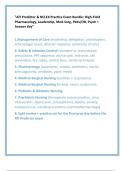
"ATI Predictor & NCLEX Practice Exam Bundle: High-Yield
Pharmacology, Leadership, Med-Surg, Peds/OB, Psych +
Answer Key"
1.Management of Care (leadership, delegation, prioritization,
ethical/legal issues, disaster response, continuity of care)
2. Safety & Infection Control (standard vs. transmission
precautions, PPE sequence, device care, restraints, fall
prevention, fire safety, central lines, sterile technique)
3. Pharmacology (autonomic, cardiac, antibiotics, insulin,
anticoagulants, antidotes, psych meds)
4. Medical-Surgical Nursing I (cardiac + respiratory).
5. Medical-Surgical Nursing II (renal, neuro, endocrine).
6. Pediatric & Obstetric Nursing.
7. Psychiatric Nursing (therapeutic communication, crisis
intervention, depression, schizophrenia, bipolar, anxiety,
substance use, suicide precautions, psychopharmacology)
8. light review + practice set for the final prep day before the
ATI Predictor exam
,NCLEX Practice – Management of Care
(14 Original Questions)
Question 1 – Delegation (MCQ)
A 45-year-old patient on a telemetry unit is 2 days post-PCI.
Vital signs are stable; the only IV is a heparin drip at 14 mL/hr.
The RN delegates morning care to an unlicensed assistive
personnel (UAP). Which task is appropriate for the UAP to
perform?
A. Measure pedal pulses and capillary refill
B. Adjust the heparin infusion per protocol
C. Explain the purpose of the sequential compression devices
D. Perform a focused cardiac assessment
Metadata
Topic/Subtopic: Delegation – Stable vs. Unstable Patient
NCLEX Category: Management of Care / Assignment, Delegation
and Supervision
Cognitive Level: Application
Difficulty: 2
Learning Objective: Determine what can safely be delegated to
a UAP when the patient is hemodynamically stable.
Answer & Rationale
Correct Answer: A
Rationale: Assessment of peripheral perfusion is within the
UAP’s scope because it is routine data collection for a stable
,patient. The other choices require licensed judgment or
teaching.
Distractor Analysis
B. Requires RN or pharmacist licensure; dosage changes are
never delegated.
C. Teaching/instruction is an RN responsibility.
D. Cardiac assessment requires interpretation and clinical
decision-making reserved for licensed staff.
Test-Taking Tip: Ask, “Does this involve assessment, teaching, or
judgment?” Any “yes” means the task stays with the RN.
Question 2 – Delegation (SATA)
The charge nurse is making assignments on a busy medical-
surgical floor at 0700. Which patients are appropriate to assign
to a licensed practical/vocational nurse (LPN/LVN)? Select all
that apply.
A. 72-year-old with new-onset atrial fibrillation receiving a
diltiazem bolus
B. 38-year-old 6 hours post-hemorrhoidectomy requesting pain
medication
C. 55-year-old with chronic hypertension who needs daily BP
monitoring
D. 29-year-old scheduled for discharge teaching on
anticoagulation
E. 64-year-old with stable CHF needing routine morning
medications
, Metadata
Topic/Subtopic: Delegation – Scope of LPN/LVN Practice
NCLEX Category: Management of Care / Assignment, Delegation
and Supervision
Cognitive Level: Analysis
Difficulty: 3
Learning Objective: Distinguish between stable, predictable care
and care requiring RN-level assessment or teaching.
Answer & Rationale
Correct Answers: B, C, E
Rationale: LPNs/LVNs can administer routine meds, monitor
stable conditions, and provide comfort measures. They cannot
titrate IV antiarrhythmics (A) or perform comprehensive
discharge teaching (D).
Distractor Analysis
A. IV antiarrhythmic titration exceeds LPN scope.
D. Discharge teaching requires RN-level education and
evaluation.
Test-Taking Tip: If the task involves titration, initial teaching, or
unstable pathophysiology, keep it with the RN.
Question 3 – Delegation (MCQ)
A 16-year-old post-appendectomy is receiving morphine via
patient-controlled analgesia (PCA). The RN is supervising a new
graduate nurse. Which statement by the new graduate indicates
a need for immediate follow-up?
Pharmacology, Leadership, Med-Surg, Peds/OB, Psych +
Answer Key"
1.Management of Care (leadership, delegation, prioritization,
ethical/legal issues, disaster response, continuity of care)
2. Safety & Infection Control (standard vs. transmission
precautions, PPE sequence, device care, restraints, fall
prevention, fire safety, central lines, sterile technique)
3. Pharmacology (autonomic, cardiac, antibiotics, insulin,
anticoagulants, antidotes, psych meds)
4. Medical-Surgical Nursing I (cardiac + respiratory).
5. Medical-Surgical Nursing II (renal, neuro, endocrine).
6. Pediatric & Obstetric Nursing.
7. Psychiatric Nursing (therapeutic communication, crisis
intervention, depression, schizophrenia, bipolar, anxiety,
substance use, suicide precautions, psychopharmacology)
8. light review + practice set for the final prep day before the
ATI Predictor exam
,NCLEX Practice – Management of Care
(14 Original Questions)
Question 1 – Delegation (MCQ)
A 45-year-old patient on a telemetry unit is 2 days post-PCI.
Vital signs are stable; the only IV is a heparin drip at 14 mL/hr.
The RN delegates morning care to an unlicensed assistive
personnel (UAP). Which task is appropriate for the UAP to
perform?
A. Measure pedal pulses and capillary refill
B. Adjust the heparin infusion per protocol
C. Explain the purpose of the sequential compression devices
D. Perform a focused cardiac assessment
Metadata
Topic/Subtopic: Delegation – Stable vs. Unstable Patient
NCLEX Category: Management of Care / Assignment, Delegation
and Supervision
Cognitive Level: Application
Difficulty: 2
Learning Objective: Determine what can safely be delegated to
a UAP when the patient is hemodynamically stable.
Answer & Rationale
Correct Answer: A
Rationale: Assessment of peripheral perfusion is within the
UAP’s scope because it is routine data collection for a stable
,patient. The other choices require licensed judgment or
teaching.
Distractor Analysis
B. Requires RN or pharmacist licensure; dosage changes are
never delegated.
C. Teaching/instruction is an RN responsibility.
D. Cardiac assessment requires interpretation and clinical
decision-making reserved for licensed staff.
Test-Taking Tip: Ask, “Does this involve assessment, teaching, or
judgment?” Any “yes” means the task stays with the RN.
Question 2 – Delegation (SATA)
The charge nurse is making assignments on a busy medical-
surgical floor at 0700. Which patients are appropriate to assign
to a licensed practical/vocational nurse (LPN/LVN)? Select all
that apply.
A. 72-year-old with new-onset atrial fibrillation receiving a
diltiazem bolus
B. 38-year-old 6 hours post-hemorrhoidectomy requesting pain
medication
C. 55-year-old with chronic hypertension who needs daily BP
monitoring
D. 29-year-old scheduled for discharge teaching on
anticoagulation
E. 64-year-old with stable CHF needing routine morning
medications
, Metadata
Topic/Subtopic: Delegation – Scope of LPN/LVN Practice
NCLEX Category: Management of Care / Assignment, Delegation
and Supervision
Cognitive Level: Analysis
Difficulty: 3
Learning Objective: Distinguish between stable, predictable care
and care requiring RN-level assessment or teaching.
Answer & Rationale
Correct Answers: B, C, E
Rationale: LPNs/LVNs can administer routine meds, monitor
stable conditions, and provide comfort measures. They cannot
titrate IV antiarrhythmics (A) or perform comprehensive
discharge teaching (D).
Distractor Analysis
A. IV antiarrhythmic titration exceeds LPN scope.
D. Discharge teaching requires RN-level education and
evaluation.
Test-Taking Tip: If the task involves titration, initial teaching, or
unstable pathophysiology, keep it with the RN.
Question 3 – Delegation (MCQ)
A 16-year-old post-appendectomy is receiving morphine via
patient-controlled analgesia (PCA). The RN is supervising a new
graduate nurse. Which statement by the new graduate indicates
a need for immediate follow-up?