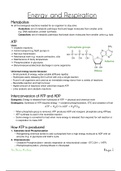
Energy and Respiration
Metabolism
↬ all the biological reactions needed for an organism to stay alive
Anabolism: set of metabolic pathways that build larger molecules from smaller units
e.g. DNA replication, protein synthesis
Catabolism: set of metabolic pathways that break down molecules from smaller units e.g. lysis
ATP
Uses:
⇾ Anabolic reactions 3 phosphate groups
⇾ Active transport e.g Na/K pumps in
⇾ Nervous transmission
⇾ Mechanical work e.g. muscle contraction, cilia
⇾ Maintenance of body temperature Adenine
⇾ Phosphorylation in glycolysis
⇾ Bioluminescence/electrical discharge in some organisms
Universal energy source because: Ribose
• Small packets of energy, water-soluble (diffuses rapidly)
• Hydrolyses easily releasing 30.5 kJ/mol with only a single reaction
• Found in all organisms and used as an immediate energy donor from a variety of reactions
• Reversible reaction and high turnover
• Higher amount of reactions which yield than require ATP
• Links anabolic and catabolic reactions
Interconversion of ATP and ADP
Exergonic: Energy is released from hydrolysis of ATP → physical and chemical work
Endergonic: Synthesis of ATP requires energy → oxidative phosphorylation, ETC and oxidation of fuel
ATP + H2O ⇋ ADP + H3PO4
- When phosphate group is removed, ATP produces ADP and inorganic phosphate using ATPase.
- ATP synthase is used in the reversible reaction
- Some energy is converted to heat when more energy is released than required for cell reaction or
in respiration to make ATP
How ATP is produced
1. Substrate-level Phosphorylation
• Reorganising chemical bonds to add a phosphate from a high energy molecule to ADP with an
enzyme. E.g. in glycolysis and kreb’s cycle
2. Chemiosmosis
• Oxidative Phosphorylation- aerobic respiration at mitochondrial cristae - ETC (3H+ = 1ATP)
• Photophosphorylation- photosynthesis in chloroplast
SxTeri Notes Page 3
, Respiration
↬ The enzymatic release of energy from complex organic
molecules and the transfer to ATP in living cells. Cellular
respiration occurs as a series of linked, enzyme catalysed
reactions
C6H12O6 + 6O2 → 6CO2 + 6H2O
Co-Enzymes
↬ Act like enzymes (reusable, lower activation energy) but are not proteins
Nicotinamide Adenine Dinucleotide (NAD) and Flavin Adenine Dinucleotide (FAD): carrier molecules
taking hydrogens and their high energy electrons to another reaction e.g. ETC
Coenzyme A: acts as a carrier of acetyl groups (2C) transferring them from LR to KC
Glycolysis
In cell cytoplasm
• Reaction is lysis of 6C glucose into 2
molecules of 3C pyruvate
• Energy from ATP is needed to make glucose
more reactive by lowering activation energy.
This creates 6C fructose diphosphate which Phosphorylation
splits into 2 3C triose phosphate. This is then
oxidised to pyruvate
• Addition of inorganic phosphate group from
ATP is called phosphorylation
• Overall net gain of 2 ATP molecules per Glycolysis
glucose
• 2 NADH (red. NAD) also produced
• 4 ATP produced by fructose 1,6 diphosphate
• Hydrogen atoms are removed by
dehydrogenase enzymes
Number of molecules of Net ATP
gained
ATP NADH FADH
2 2 - 8
Red. NAD can generate 3 ATP molecules
Red. FAD can generate 2 ATP molecules
NB: Energy is also required for some of the processes so the energy yield can instead be NADH: 2.5
ATP and FADH: 1.5 ATP. This means there can be a total of 32 ATP instead of 38. Ex. To transport ADP
into the mitochondria and ATP into the cytoplasm
SxTeri Notes Page 4
Metabolism
↬ all the biological reactions needed for an organism to stay alive
Anabolism: set of metabolic pathways that build larger molecules from smaller units
e.g. DNA replication, protein synthesis
Catabolism: set of metabolic pathways that break down molecules from smaller units e.g. lysis
ATP
Uses:
⇾ Anabolic reactions 3 phosphate groups
⇾ Active transport e.g Na/K pumps in
⇾ Nervous transmission
⇾ Mechanical work e.g. muscle contraction, cilia
⇾ Maintenance of body temperature Adenine
⇾ Phosphorylation in glycolysis
⇾ Bioluminescence/electrical discharge in some organisms
Universal energy source because: Ribose
• Small packets of energy, water-soluble (diffuses rapidly)
• Hydrolyses easily releasing 30.5 kJ/mol with only a single reaction
• Found in all organisms and used as an immediate energy donor from a variety of reactions
• Reversible reaction and high turnover
• Higher amount of reactions which yield than require ATP
• Links anabolic and catabolic reactions
Interconversion of ATP and ADP
Exergonic: Energy is released from hydrolysis of ATP → physical and chemical work
Endergonic: Synthesis of ATP requires energy → oxidative phosphorylation, ETC and oxidation of fuel
ATP + H2O ⇋ ADP + H3PO4
- When phosphate group is removed, ATP produces ADP and inorganic phosphate using ATPase.
- ATP synthase is used in the reversible reaction
- Some energy is converted to heat when more energy is released than required for cell reaction or
in respiration to make ATP
How ATP is produced
1. Substrate-level Phosphorylation
• Reorganising chemical bonds to add a phosphate from a high energy molecule to ADP with an
enzyme. E.g. in glycolysis and kreb’s cycle
2. Chemiosmosis
• Oxidative Phosphorylation- aerobic respiration at mitochondrial cristae - ETC (3H+ = 1ATP)
• Photophosphorylation- photosynthesis in chloroplast
SxTeri Notes Page 3
, Respiration
↬ The enzymatic release of energy from complex organic
molecules and the transfer to ATP in living cells. Cellular
respiration occurs as a series of linked, enzyme catalysed
reactions
C6H12O6 + 6O2 → 6CO2 + 6H2O
Co-Enzymes
↬ Act like enzymes (reusable, lower activation energy) but are not proteins
Nicotinamide Adenine Dinucleotide (NAD) and Flavin Adenine Dinucleotide (FAD): carrier molecules
taking hydrogens and their high energy electrons to another reaction e.g. ETC
Coenzyme A: acts as a carrier of acetyl groups (2C) transferring them from LR to KC
Glycolysis
In cell cytoplasm
• Reaction is lysis of 6C glucose into 2
molecules of 3C pyruvate
• Energy from ATP is needed to make glucose
more reactive by lowering activation energy.
This creates 6C fructose diphosphate which Phosphorylation
splits into 2 3C triose phosphate. This is then
oxidised to pyruvate
• Addition of inorganic phosphate group from
ATP is called phosphorylation
• Overall net gain of 2 ATP molecules per Glycolysis
glucose
• 2 NADH (red. NAD) also produced
• 4 ATP produced by fructose 1,6 diphosphate
• Hydrogen atoms are removed by
dehydrogenase enzymes
Number of molecules of Net ATP
gained
ATP NADH FADH
2 2 - 8
Red. NAD can generate 3 ATP molecules
Red. FAD can generate 2 ATP molecules
NB: Energy is also required for some of the processes so the energy yield can instead be NADH: 2.5
ATP and FADH: 1.5 ATP. This means there can be a total of 32 ATP instead of 38. Ex. To transport ADP
into the mitochondria and ATP into the cytoplasm
SxTeri Notes Page 4