
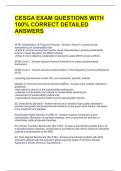
CESGA EXAM QUESTIONS WITH
100% CORRECT DETAILED
ANSWERS
SFDR Classification of Financial Products - Answer--Article 6: should provide
transparency on sustainability risks
-Article 8: promote environment and/or social characteristics, binding sustainability
factors in asset allocation but DNSH optional
-Article 9: have objective sustainable investments, apply DNSH across portfolio
SFDR Level 1 - Answer-requires financial institutions to make principle-based
disclosures
SFDR Level 2 - Answer-requires implementation of the Regulatory Technical Standards
(RTS)
-reporting requirements include PAI, pre-contractual, periodic, website
Markets in Financial Instruments Directive (MiFID) - Answer-main updates reflected in
guidelines:
-information to clients on the sustainability preferences
-collection of information from clients on sustainability peeferences
-assessment of sustainability preferences
-organizational requirements (staff must be appropriately trained)
EU Green Bond Standard - Answer-serves as a voluntary high-quality standard to
promote the growth and environmental ambitions in the green bond market; still needs
to be confirmed and adopted
Shareholder Rights Directive II (SRD II) - Answer-requires companies to give
shareholders information on general meetings; aims to promote the exercise of
shareholder rights at general meetings
EU Climate Transition Benchmark (EU CTB) - Answer-a benchmark portfolio that is on
a decarbonization trajectory; constructed in accordance with certain minimum standards
outlined in amendments to the EBR
EU Paris-Aligned Benchmark (EU PAB) - Answer-a benchmark portfolio with GHG
emissions aligned with the long-term global warming target of the Paris Climate
Agreement; stricter minimum requirements
, Climate Stress Test Results on Banks - Answer--transition and physical risk have a
material impact on the risk profile
-banks have made considerable progress with their climate stress-testing capabilities
Pillar 3 Disclosures - Answer-disclosure framework that:
-promotes transparency as a main driver of market discipline in the financial sector
-to reduce information asymmetry
-to address potential risks
International Sustainability Standards Board (ISSB) - Answer-established to develop a
global baseline of ESG reporting
Technical Expert Group (TEG) - Answer--published its final report on EU taxonomy in
2020 which outlines the overarching structure of the taxonomy
Sustainable Investing Assets by Strategy - Answer-1. ESG Integration
2. Negative/exclusionary screening
3. Corp engagement and shareholder action
4. Norms-based screening
5. Sustainability themed investing
6. Positive/best-in-class screening
7. Impact/community investing
Institutional vs Retail Investors - Answer-institutional investors dominate sustainable
investing but interest by retail investors is growing (~25% of assets)
Sustainable assets across asset classes - Answer-fixed income is the main category,
followed by public equity
Top 3 barriers to sustainability investment - Answer-all concerns are connected to the
underlying data (lack of availability, standardization, and quality)
Sustainable Development - Answer-development that meets the needs of the present
without compromising the ability of future generations to meet their own needs
Triple Bottom Line - Answer-focuses corporations on the economic value,
environmental value, and social value that they add or destroy
Corporate Social Responsibility - Answer-the responsibility of enterprises for their
impacts on society
High-Level Expert Group (HLEG) - Answer-an expert group formed in 2016 to provide
advice to the European Commission in regard of the sustainable change of the financial
system
100% CORRECT DETAILED
ANSWERS
SFDR Classification of Financial Products - Answer--Article 6: should provide
transparency on sustainability risks
-Article 8: promote environment and/or social characteristics, binding sustainability
factors in asset allocation but DNSH optional
-Article 9: have objective sustainable investments, apply DNSH across portfolio
SFDR Level 1 - Answer-requires financial institutions to make principle-based
disclosures
SFDR Level 2 - Answer-requires implementation of the Regulatory Technical Standards
(RTS)
-reporting requirements include PAI, pre-contractual, periodic, website
Markets in Financial Instruments Directive (MiFID) - Answer-main updates reflected in
guidelines:
-information to clients on the sustainability preferences
-collection of information from clients on sustainability peeferences
-assessment of sustainability preferences
-organizational requirements (staff must be appropriately trained)
EU Green Bond Standard - Answer-serves as a voluntary high-quality standard to
promote the growth and environmental ambitions in the green bond market; still needs
to be confirmed and adopted
Shareholder Rights Directive II (SRD II) - Answer-requires companies to give
shareholders information on general meetings; aims to promote the exercise of
shareholder rights at general meetings
EU Climate Transition Benchmark (EU CTB) - Answer-a benchmark portfolio that is on
a decarbonization trajectory; constructed in accordance with certain minimum standards
outlined in amendments to the EBR
EU Paris-Aligned Benchmark (EU PAB) - Answer-a benchmark portfolio with GHG
emissions aligned with the long-term global warming target of the Paris Climate
Agreement; stricter minimum requirements
, Climate Stress Test Results on Banks - Answer--transition and physical risk have a
material impact on the risk profile
-banks have made considerable progress with their climate stress-testing capabilities
Pillar 3 Disclosures - Answer-disclosure framework that:
-promotes transparency as a main driver of market discipline in the financial sector
-to reduce information asymmetry
-to address potential risks
International Sustainability Standards Board (ISSB) - Answer-established to develop a
global baseline of ESG reporting
Technical Expert Group (TEG) - Answer--published its final report on EU taxonomy in
2020 which outlines the overarching structure of the taxonomy
Sustainable Investing Assets by Strategy - Answer-1. ESG Integration
2. Negative/exclusionary screening
3. Corp engagement and shareholder action
4. Norms-based screening
5. Sustainability themed investing
6. Positive/best-in-class screening
7. Impact/community investing
Institutional vs Retail Investors - Answer-institutional investors dominate sustainable
investing but interest by retail investors is growing (~25% of assets)
Sustainable assets across asset classes - Answer-fixed income is the main category,
followed by public equity
Top 3 barriers to sustainability investment - Answer-all concerns are connected to the
underlying data (lack of availability, standardization, and quality)
Sustainable Development - Answer-development that meets the needs of the present
without compromising the ability of future generations to meet their own needs
Triple Bottom Line - Answer-focuses corporations on the economic value,
environmental value, and social value that they add or destroy
Corporate Social Responsibility - Answer-the responsibility of enterprises for their
impacts on society
High-Level Expert Group (HLEG) - Answer-an expert group formed in 2016 to provide
advice to the European Commission in regard of the sustainable change of the financial
system


