

Written by students who passed Immediately available after payment Read online or as PDF Wrong document? Swap it for free 4.6 TrustPilot
logo-home
Document preview thumbnail
Preview 2 out of 6 pages
Exam (elaborations)

Biology 1 Exam Questions and Correct Answers

Document preview thumbnail
Preview 2 out of 6 pages

How are seed plants divided? - -Into gymnosperms and angiosperms. Which kingdom does not have a cell wall? - -Animalia. What is the male reproductive structure of a flower called? - -Stamen. What do xylem and phloem transport in plants? - -Xylem transports water and minerals; phloem transports nutrients and food. What characteristics describe Eubacteria and Archaebacteria? - -Both are prokaryotic and unicellular. If a plant is vascular and cone-producing, what type is it? - -Gymnosperm. A seed is a structure that protects a fertilized plant egg or - -embryo. How are angiosperms classified? - -As monocots and dicots. Which kingdom has the most diverse types of organisms described as 'plant-like', 'animal-like', or 'fungus-like'? - -Kingdom Protista. What are the two types of cones created by cone-bearing plants? - -Male and female. What is the term for the movement of pollen to the stigma in flowering plants? - Pollination. What is the main difference between mosses and other plant types like ferns and roses? - -Mosses do not have vascular tissue, while the others do. What is the function of vascular tissue in plants? - -To transport water, nutrients, and food. What type of tissue do ferns and mosses lack? - -Vascular tissue. What is the primary characteristic of angiosperms? - -They produce flowers and seeds. What is the women reproductive structure of a flower called? - -Pistil. Vascular plants like ferns do not reproduce with seeds instead they make what - -spores Biology Biology Biology what tiny structures do mushrooms release that grows into new mushrooms - -spores is eubacteria, unicellular or multicellular? - -unicellular is archaebacteria, unicellular or multicellular? - -unicellular is fungi, unicellular or multicellular? - -both is protista, unicellular or multicellular? - -both is animalia, unicellular or multicellular? - -multicellular is plantae , unicellular or multicellular? - -multicellular are plantae autotroph or heterotrophs? - -autotrophs are eubacteria autotroph or heterotrophs? - -both are archaebacteria autotroph or heterotrophs? - -both are protista autotroph or heterotrophs? - -both are fungi autotroph or heterotrophs? - -heterotrophs are animalia autotroph or heterotrophs? - -heterotrophs which level of classification contains more organisms the class or the order? - -class DNA is replicated in a what manner - -semiconservative Where is DNA located in eukaryotes? - -nucleus RNA contains the sugar what - -ribose The double coiled shape of a DNA is called a what - -helix In a eukaryotic cell transcription takes place in what - -nucleus in a eukaryotic cell translation occurs at the - -ribosome unlike DNARNA contains the nitrogenous base what - -uracil how many codons are in the following strand of mRNA? AUGCCAGGU - -one Biology Biology DNA is copied during a process called - -replication which characteristics are unique to DNA - -double stranded, deoxyribose, thymine A monomer of a nucleic acid is a - -nucelotide A difference in transcription between prokaryotic and eukaryotic is that transcription and eukaryotic cell requires a process of - -splicing The process of WHAT produces a new / exact copy of an organism's genetic before cell division - -replication copying replication The backbone of a DNA phosphates deoxyribose molecule is a helix made of alternating - -phosphates and deoxyribose sugars What is produced during transcription - -RNA molecules Which of the following makes up a nucleotide found in DNA ? - -deoxyribose + phosphate group + thymine In DNA , WHAT always forms hydrogen bonds with guanine . - -cytosine Replicate the following strand of DNA : TTTCGATATCC - -AAAGCTATAGG A triplet of mRNA is called a - -codon What happens during the process of translation - -mRNA is decoded into amino acids to build proteins mRNA tRNA RNA polymerase codon transcription amino acid translation are examples of gene expression or DNA replication - -gene expression DNA polymerase splicing ligase are all examples of gene expression or DNA replication - -DNA replication DNA helicase primase tepoismerase ribosomes RN gene expression or DNA replication - -both A nucleotide is made up of - -phosphate Sugar️ hydrogen bond In humans heterozygous , having a cleft chin C is dominant to having a smooch chin. If two people heterozygous for the to trait have children what percentage of their offspring will be heterozygous - -50% homozygous dominant - -TT Biology Biology Homozygous recessive - -tt heterozygous - -Tt are heterozygous for hybrids or true breeding - -hybrids are homozygous, true breeds or hybrids - -true breeds What does the notation TT mean to geneticists ? - -two dominant alleles , homozygous dominant An organism's physical appearance is its - -phenotype WHAT means that the two members of the allelic pair in the zygote are the same . - homozygous If a homozygous black guinea pig ( BB ) is crossed with a homozygous white guinea pig bb what is the probability that an offspring will have black fur ? - -100% In humans , detached earlobes ( D ) is dominant to attached earlobes d . Alison and her father have attached earlobes. Her mother has detached earlobes. What is Alison's genotype ? - -dd If a homozygous dominant parent ( TT ) were crossed with a homozygous recessive parent ( tt ) . what would be the probability that the offspring would be homozygous recessive ? - -0 % WHAT is when the individual is heterozygous at two genes . - -dihybrid cross What does codominance mean in genetics ? - -The alleles are neither dominant nor recessive , both phenotypes are present . ) A heterozygous organism has - -two different alleles for a trait . What does a Punnett square show ? - -all the possible outcomes of a genetic cross The different forms of a gene are called - -alleles Scientists call an organism that has two different alleles for a trait a - -Scientists hybrid Any chromosome that is not a sex chromosome in humans is - -autosomal If an organism's diploid number is 12 , its haploid number is - -6 Biology Biology The pedigree chart shown depicts the inheritance pattern of - -An autosomal recessive characteristic with both parents being heterozygous When Gregor Mendel crossed true breeding tall plants with true - breeding short plants , all the offspring were tall because - -the allele for tall plants is dominant Why are sex - linked traits more common in males than in females ? - -A recessive allele on the X chromosome will always produce the trait in a male . Pod color in pea plants can be either green or yellow with green ( G ) being dominant to yellow What would be the alleles for the parental generation in a monohybrid cross for this trait - -Gg x Gg A capital letter indicates a / an WHAT allele . - -dominant Role of transcription factors - -regulate the expression of genetic information when does DNA replication take place? - -during the S stage of interphase mitosis - -prophase metaphase anaphase telophase define lyse as a step of dna extraction - -initial step where cells are broken open, releasing the DNA and other cellular contents artificial selection - -process where humans, rather than nature, select which organisms get to reproduce based on desired traits ex. Dogs crops livestock. natural selection - -where organisms with traits better suited to their environment survive and reproduce more successfully fe's long necks, Darwin's finches what did darwin find abt adaptions of finches? - -the finches on different islands had beaks of varying sizes and shapes, each adapted to the specific food sources available on their respective island Species - -group of organisms that can interbreed and produce fertile offspring Viruses vs. Bacteria - -Viruses are much smaller, acellular, and need a host cell to replicate, while bacteria are single-celled organisms that can reproduce on their own dorsal/ventral - -back/belly anterior and posterior - -front and back Biology examples of seedless plants - -ferns, horsetails, club mosses examples of non vascular plants - -mosses, liverworts, hornworts examples of gymnosperms - -pines and fir tree is the kingdom archaebacteria prokaryotic or eukaryotic - -Eukaryotic is the kingdom animalia prokaryotic or eukaryotic - -eukaryotic is the kingdom fungi prokaryotic or eukaryotic - -eukaryotic is the kingdom protista prokaryotic or eukaryotic - -eukaryotic is the kingdom archaebacteria prokaryotic or eukaryotic - -Prokaryotic is the kingdom eubacteria prokaryotic or eukaryotic - -Prokaryotic Linnaeus' contribution to taxonomy - -classification of organisms components of a scientific name - -genus + species capillary action - -the attraction of the surface of a liquid to the surface of a solid Adhesion - -The property or properties of water responsible for a tree's ability to transport water from the roots all the way to top of the tree capillary action and adhesion in plant xylem - -Play the crucial war role in water transport Osmosis - -absorption at roots; root pressure; forces water up through the xylem for a short distance Define coelom - -body cavity Diploid vs. Haploid - -Diploid refers to the number of complete chromosome sets present in each cell of an organism: diploid cells contain two complete sets. Haploid organisms, on the other hand, only contain one complete chromosome set. gametes for somatic cells - -Gametes are produced by meiosis in the

Content preview

Biology


Biology 1 Exam Questions and
Correct Answers
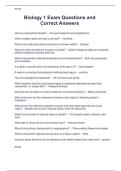
How are seed plants divided? - -Into gymnosperms and angiosperms.

Which kingdom does not have a cell wall? - -Animalia.

What is the male reproductive structure of a flower called? - -Stamen.

What do xylem and phloem transport in plants? - -Xylem transports water and minerals;
phloem transports nutrients and food.

What characteristics describe Eubacteria and Archaebacteria? - -Both are prokaryotic
and unicellular.

If a plant is vascular and cone-producing, what type is it? - -Gymnosperm.

A seed is a structure that protects a fertilized plant egg or - -embryo.

How are angiosperms classified? - -As monocots and dicots.

Which kingdom has the most diverse types of organisms described as 'plant-like',
'animal-like', or 'fungus-like'? - -Kingdom Protista.

What are the two types of cones created by cone-bearing plants? - -Male and female.

What is the term for the movement of pollen to the stigma in flowering plants? - -
Pollination.

What is the main difference between mosses and other plant types like ferns and
roses? - -Mosses do not have vascular tissue, while the others do.

What is the function of vascular tissue in plants? - -To transport water, nutrients, and
food.

What type of tissue do ferns and mosses lack? - -Vascular tissue.

What is the primary characteristic of angiosperms? - -They produce flowers and seeds.

What is the women reproductive structure of a flower called? - -Pistil.

Vascular plants like ferns do not reproduce with seeds instead they make what - -spores

Biology

, Biology


what tiny structures do mushrooms release that grows into new mushrooms - -spores

is eubacteria, unicellular or multicellular? - -unicellular

is archaebacteria, unicellular or multicellular? - -unicellular

is fungi, unicellular or multicellular? - -both

is protista, unicellular or multicellular? - -both

is animalia, unicellular or multicellular? - -multicellular

is plantae , unicellular or multicellular? - -multicellular

are plantae autotroph or heterotrophs? - -autotrophs

are eubacteria autotroph or heterotrophs? - -both

are archaebacteria autotroph or heterotrophs? - -both

are protista autotroph or heterotrophs? - -both

are fungi autotroph or heterotrophs? - -heterotrophs

are animalia autotroph or heterotrophs? - -heterotrophs

which level of classification contains more organisms the class or the order? - -class

DNA is replicated in a what manner - -semiconservative

Where is DNA located in eukaryotes? - -nucleus

RNA contains the sugar what - -ribose

The double coiled shape of a DNA is called a what - -helix

In a eukaryotic cell transcription takes place in what - -nucleus

in a eukaryotic cell translation occurs at the - -ribosome

unlike DNARNA contains the nitrogenous base what - -uracil

how many codons are in the following strand of mRNA? AUGCCAGGU - -one


Biology

Document information

Uploaded on
August 29, 2025
Number of pages
6
Written in
2025/2026
Type
Exam (elaborations)
Contains
Questions & answers
$10.99

Wrong document? Swap it for free Within 14 days of purchase and before downloading, you can choose a different document. You can simply spend the amount again.
Written by students who passed
Immediately available after payment
Read online or as PDF

Seller avatar
Reputation scores are based on the amount of documents a seller has sold for a fee and the reviews they have received for those documents. There are three levels: Bronze, Silver and Gold. The better the reputation, the more your can rely on the quality of the sellers work.
AlexScorer
2.5
(2)
Sold
11
Followers
0
Items
1800
Last sold
2 weeks ago


Why students choose Stuvia

Created by fellow students, verified by reviews

Quality you can trust: written by students who passed their tests and reviewed by others who've used these notes.

Didn't get what you expected? Choose another document

No worries! You can instantly pick a different document that better fits what you're looking for.

Pay as you like, start learning right away

No subscription, no commitments. Pay the way you're used to via credit card and download your PDF document instantly.

Student with book image

“Bought, downloaded, and aced it. It really can be that simple.”

Alisha Student

Working on your references?

Create accurate citations in APA, MLA and Harvard with our free citation generator.

Working on your references?

Frequently asked questions
