

Written by students who passed Immediately available after payment Read online or as PDF Wrong document? Swap it for free 4.6 TrustPilot
logo-home
Document preview thumbnail
Preview 1 out of 4 pages
Class notes

AP English Language and Composition Terms

Document preview thumbnail
Preview 1 out of 4 pages

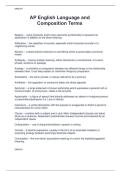
Allegory - -using character and/or story elements symbolically to represent an abstraction in addition to the literal meaning Alliteration - -the repetition of sounds, especially initial consonant sounds in 2+ neighboring words Allusion - -a direct/indirect reference to something which is presumably commonly known Ambiguity - -having multiple meaning, either intentional or unintentional, of a word, phrase, sentence or passage Analogy - -a similarity or comparison between two different things or the relationship between them. It can help explain an unfamiliar things by comparison. Antecedent - -the word, phrase, or clause referred to by a pronoun Antithesis - -the opposition or contrast of ideas; the direct opposite Aphorism - -a terse statement of known authorship which expresses a general truth or moral principle. (If anonymous, called a folk proverb) Apostrophe - -a figure of speech that directly addresses an absent or imaginary person or personified abstraction (i.e. Love or liberty) Caricature - -a verbal description with the purpose to exaggerate or distort a person's characteristics for comic effect Clause - -contains both a subject and a verb. Main (independent) clauses can stand alone as a sentence. Dependent (subordinate) clauses must be accompanied by an independent clause. Colloquialism - -use of slang/informalities in speech or writing Conceit - -a fanciful expression, usually in the form of an extended metaphor or surprising analogy between seemingly dissimilar objects. Connotation - -the non-literal, associative meaning of a word; the implied/suggested meaning. ENGLISH ENGLISH Denotation - -the strict, literal dictionary definition of a word Diction - -the writer's word choices Didactic - -literally means teaching; describes words that are for teaching or instructing, especially with morals or ethical principles Euphemism - -less offensive substitute for an unpleasant word or idea. Ex. Earthly remains instead of corpse Extended metaphor - -a metaphor developed at great length, occurring frequently in/throughout a work Figurative language - -writing or speech not intended to carry literal meaning Hyperbole - -a figure of speech using deliberate exaggeration or overstatement Imagery - -sensory details of figurative language used to describe, arouse emotion, or represent abstractions Invective - -an emotionally violent, verbal denunciation or attack using strong, abusive language Irony - -the contrast between what is explicitly stated and what is really meant. Or, the difference between what appears to be and what is actually true. Verbal irony - -the words literally state the opposite of the writer's meaning Situational irony - -when events turn out the opposite of what was expected Dramatic irony - -when facts or events are unknown to a character in a play or piece of fiction but known to the reader, audience or other characters in the work Litotes (sounds like little tee) - -a form of understatement that involves making an affirmative point by denying its opposite; opposite of hyperbole Loose/ non-periodic sentence - -type of sentence in which the main clause comes first followed by dependent clause(s). Metaphor - -figure of speech using implied comparison Metonymy - -figure of speech in which the name of an object is substituted for a similar name. Ex. The white house for the president Onomatopoeia - -figure of speech when woods imitate sounds. Ex. Hiss, crack, band ENGLISH ENGLISH Oxymoron - -figure of speech where the author groups contradictory things to suggest a paradox. Ex. Jumbo shrimp and cruel kindness Paradox - -a statement that appears to be self-contradictory but has some degree of truth or validity Parallelism - -also known as parallel structure, ordering words, phrases or paragraphs to create structural similarity Anaphora - -a type of parallelism with the exact repetition of words or phrases is at the beginning of successive lines or sentences Parody - -a work that closely imitates the style or content of another with the specific aim of comedy or ridicule Pedantic - -describes words, phrases or general tone that is overly scholarly, academic or bookish Periodic sentence - -dependent clause first, then main clause at end. Personification - -figure of speech when concepts, animals or inanimate objects are given humanlike characteristics or emotions Repetition - -exact or approximate duplication of any element of language such as sound, word, phrase, clause, sentence or grammatical pattern Rhetoric - -principles of how to write effectively, eloquently and persuasively Rhetorical modes - -the variety, conventions and purposes of the major kinds of writing. The four most common rhetorical modes are exposition (explain and analyze), argumentation (aka persuasive writing), description (describe for the reader) and narration (tell a stroy or narrate an event) Sarcasm - -bitter language that is meant to hurt or ridicule someone or something. Satire - -a work that targets human vice or follies or social conventions and institutions to reform or ridicule Semantics - -branch of linguistics that studies the meaning and origin of words Subject complement - -the word or clause that follows a linking verb that describes the subject by renaming the subject (predicate nominative) or describing the subject (predicate adjective) ENGLISH Syllogism - -a deductive system of logic that presents 2 premises that lead to a sound conclusion. Ex. 1. All men are mortal. 2. Socrates is a man. Therefore, Socrates is mortal. Symbol - -anything that represents itself and stands for something else. Natural symbols - -objects or occurrences in nature that symbolize ideas associated with them. Ex. Roses and love Conventional symbols - -symbols that have been invested with meaning by a group. Ex. Cross and christianity Literary symbols - -symboles that are in variety of books and are more generally recognized. Synecdoche - -a figure of speech in which a part of something is used to represent the whole or the whole represents a part. Ex. Calling a car "wheels" or referring to all of the string instruments in an orchestra as "the strings" Synesthesia - -a sensory stimulus that evokes the subjective experience of another. Ex. Seeing red ants makes you itchy Syntax - -the way an author structures his words into phrase, clauses and sentences. Understatement - -the ironic minimalizing of fact Wit - -intellectually amusing language that surprises and delights. Witty statements are humorous while demonstrating the speaker's ability to use words to make ing

Content preview

ENGLISH


AP English Language and
Composition Terms

Allegory - -using character and/or story elements symbolically to represent an
abstraction in addition to the literal meaning

Alliteration - -the repetition of sounds, especially initial consonant sounds in 2+
neighboring words

Allusion - -a direct/indirect reference to something which is presumably commonly
known

Ambiguity - -having multiple meaning, either intentional or unintentional, of a word,
phrase, sentence or passage

Analogy - -a similarity or comparison between two different things or the relationship
between them. It can help explain an unfamiliar things by comparison.

Antecedent - -the word, phrase, or clause referred to by a pronoun

Antithesis - -the opposition or contrast of ideas; the direct opposite

Aphorism - -a terse statement of known authorship which expresses a general truth or
moral principle. (If anonymous, called a folk proverb)

Apostrophe - -a figure of speech that directly addresses an absent or imaginary person
or personified abstraction (i.e. Love or liberty)

Caricature - -a verbal description with the purpose to exaggerate or distort a person's
characteristics for comic effect

Clause - -contains both a subject and a verb. Main (independent) clauses can stand
alone as a sentence. Dependent (subordinate) clauses must be accompanied by an
independent clause.

Colloquialism - -use of slang/informalities in speech or writing

Conceit - -a fanciful expression, usually in the form of an extended metaphor or
surprising analogy between seemingly dissimilar objects.

Connotation - -the non-literal, associative meaning of a word; the implied/suggested
meaning.


ENGLISH

Document information

Uploaded on
August 28, 2025
Number of pages
4
Written in
2025/2026
Type
Class notes
Professor(s)
Unknown
Contains
All classes
$9.99

Wrong document? Swap it for free Within 14 days of purchase and before downloading, you can choose a different document. You can simply spend the amount again.
Written by students who passed
Immediately available after payment
Read online or as PDF

Seller avatar
Reputation scores are based on the amount of documents a seller has sold for a fee and the reviews they have received for those documents. There are three levels: Bronze, Silver and Gold. The better the reputation, the more your can rely on the quality of the sellers work.
AlexScorer
2.5
(2)
Sold
11
Followers
0
Items
1800
Last sold
2 weeks ago


Why students choose Stuvia

Created by fellow students, verified by reviews

Quality you can trust: written by students who passed their tests and reviewed by others who've used these notes.

Didn't get what you expected? Choose another document

No worries! You can instantly pick a different document that better fits what you're looking for.

Pay as you like, start learning right away

No subscription, no commitments. Pay the way you're used to via credit card and download your PDF document instantly.

Student with book image

“Bought, downloaded, and aced it. It really can be that simple.”

Alisha Student

Working on your references?

Create accurate citations in APA, MLA and Harvard with our free citation generator.

Working on your references?

Frequently asked questions
