

Written by students who passed Immediately available after payment Read online or as PDF Wrong document? Swap it for free 4.6 TrustPilot
logo-home
Document preview thumbnail
Preview 2 out of 12 pages
Exam (elaborations)

MCB 461 Final Exam 2025

Document preview thumbnail
Preview 2 out of 12 pages

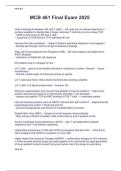
How to distinguish between NK and T cells? - -NK cells rely on diverse repertoire of surface receptors to decide fate of target, whereas T cells rely on one unique TCR - CD56 is also found on NK and T cells -- presence of CD56 without TCR indicates NK cell How are NK cells activated? - -needs 2 different activating receptors to be triggered - binding IgG through CD16 is a high confidence message Killer-cell Immunoglobulin-like Receptors (KIR) - -NK cell receptors that detect HLA A/B/C allotypes - activates or inhibits NK cell response KIR detects one of 4 shapes of HLA γ:δ T cells - -goal is to be flexible and bind to variations of certain "themes" -- tissue maintenance - themes: certain types of molecules acting as signals γ:δ T cells have fewer V(D)J blocks therefore less binding variability γ:δ T cells % of blood lymphocytes - -humans: 5% What are superantigens and how do they disable to immune system? - -highly toxic proteins secreted by bacteria to intentionally stimulate T cell activation - causes non-specific TCR-to-MHC binding of CD4 T cells -- overloads system How do bacterial proteins such as SSLP7 interfere with IgA function? - -staphylococcal superantigen-like protein 7 binds IgA and C5 - prevents phagocytosis and blocks C5-mediated MAC formation Epstein Barr Virus (EBV) - -herpes virus that causes mononucleiosis - after primary infection is beaten, EBV enters latency and is present for life Severe Combined Immunodeficiency (SCID) - -lack T cell-dependent antibody responses and T cell effector responses Understand importance of CD4 and CCR5 as receptors that bind HIV. - -HIV bind to CD4 receptors and CCR5 co-receptors on host cells Highly Active Anti-retroviral Therapy (HAART) - -combination therapy for HIV infection, in which several antiviral drugs are used together to try and avoid the rapid generation of drug-resistant mutant viruses that occurs when one of the drugs is used alone. MCB 461 MCB 461 CCR5-Δ32 - -CCR5-Δ32 individuals are immune to HIV - thought to give protection against bubonic plague and small pox Type I Allergies: IgE and Mast cells - -- antigens bind to IgE on mast cells - receptors MUST cross-link to send signal into cytoplasm - cell degranulates and releases mix of inflammatory molecules considered immediate hypersensitivity because reaction is very fast and can be life threatening Type II Allergies: B cells and Macrophages - -- chemicals introduced to the body result in altered presentation of cell antigens - naive B cells recognize antigen as "non-self" and initiate IgG production - macrophages attack self cells, resulting in tissue damage Type III Allergies: B cells and Neutrophils - -- antibodies cross-react and form complexes in blood - may attach to tissues and result in improper fixation of complement and targeting by effector cells *usually occurs with immunotherapy when large amounts of Ig are introduced Type IV Allergies: Dendritic cells and T cells - -- external molecules form adducts with normal proteins, altering their form - altered proteins are presented to CD4 T cells and activate phagocytosis and CD8 T cell attack Mast cells - -detect infection, stimulate inflammation, repair damage - located in tissue, not blodd - contains granules with proteases and cytokines mucosal mast cell: releases tryptase against microbes connective tissue mast cells: releases chymotryptase to remodel tissue Eosinophils - -has highly toxic pre-formed compounds to attack microbes - highly damaging to surrounding tissues Basophils - -similar function to eosinophils - moves between blood and tissue IgG4 - -can switch arms with other IgG4 to create 2 different antigen binding specificities - more likely to bind to pathogens, but can no longer help to fix complement to targets FcεRI - -receptor that holds IgE tightly onto mast cells MCB 461 MCB 461 FcεRII - -when IgE binds to FcεRII and co-receptor, it induces B cell to become a plasma cell Histamine - -derived from histidine - allergies involve H1 receptors on smooth muscle and endothelium to cause inflammation ABO - -a polymorphic sugar transferase enzyme that adds sugar groups: Type A: version that adds Gal-NAc Type B: version that adds Gal Type AB: has both Type O: has none ABO glycolipid is structurally similar to lipopolysaccharide structures on bacteria surface -- we develop immune responses against other types Rhesus (Rh) factor - -RBC surface proteins Rh+: working Type D allele Rh-: non-working Type D allele Why is blood transfusion incompatibility considered a Type II hypersensitivity? - -sugars on AB type glycolipids and/or presence of RhD proteins lead to IgG attack on donated RBCs Type II Tissue Rejection - -hyperacute reaction due to ABO mismatch *existing IgG aginst wrong ABO blood type Type III Tissue Rejection - -chronic reaction due to HLA (MHC) mismatch - donor's DC migrate into secondary lymphoid tissue - patient's CD8 T cells recognize wrong HLA and activate - MHC is wrong so LOTS of T cells become effector cells *development of new IgG against wrong HLA forms immune complexes Type IV Tissue Rejection - -acute reaction due to HLA (MHC) mismatch - donor's HLA peptides are presented by patient's APC - low-level CD4 T cell activation encourages B cell selection for Ig against donor HLA - constant inflammation damages donated organ *activation of T cells against wrong HLA Myeloablative therapy - -destroys recipient bone marrow; combination of irradiation and chemotherapy creates room for new bone marrow MCB 461 MCB 461 GVHD - -graft-versus-host disease - T cells from donor allo-recognize host's HLA differences - high levels of cytokines cause inflammation Why is HLA matching so important for stem cell transplantation? - -APCs in lymph nodes present antigen using donor's "self" MHC - if donor/recipient HLA are too different, rebooted system won't work -- host T cells won't recognize and respond to antigens presented Haploidentical donors - -donor that has one copy matching HLA allele and another different copy - can help patients clear remaining cancer Type II Autoimmune Disease - -antibody against cell-surface or matrix antigens i.e. hemolytic anemia - erythrocytes bind anti-erythrocyte autoantibodies Type III Autoimmune Disease - -IgG is made against cellular proteins not usually exposed (DNA, histones, ribosomes) i.e. lupus Type IV Autoimmune Disease - -TH cells activate to attack self cells i.e. multiple sclerosis - TH cells activate against myelin sheaths of neurons Rheumatoid Arthritis (Type IV) - -aging joints activate PAD (enzyme that removes arginines from peptides -- called citrullinated), leading to T cells attacking joint tissue - MHC II polymorphisms involving HLA-DR4 allotype favor binding and presentation of citrullinated peptides to T cells Diabetes I (Type IV) - -likely triggered by infection - CD8 T cells destroy insulin-producing Islet β cells of pancreas How do infections trigger autoimmune disease? - -pathogenic antigen can appear to look similar to a normal self-antigen Which of the following is the best example of our innate and adaptive immune systems co-evolving? a) The fact that B cell and T cells derive from a common lymphocyte precursor cell b) Eosinophils can be coated with IgE to target specific parasites c) Macrophages using CR1 receptor to bind complement proteins MCB 461 MCB 461 d) Naïve T cells requiring TCR and CD28 co-stimulation to activate - -b) Eosinophils can be coated with IgE to target specific parasites CD16 (FcγRIII) receptors alone may activate an NK cell because CD16: a) Directly binds a diverse array of different pathogenic antigens b) Binds to complement proteins indicating contact with a pathogen c) Binds to antibodies signifying that the target has been identified as a threat d) Is only expressed during an active infection by pathogen - -c) Binds to antibodies signifying that the target has been identified as a threat Why do NK receptors bind and "measure" the amount of MHC on target cell surfaces? a) Because the NK cell needs to re-calibrate itself to each target cell it contacts in circulation b) Because MHC binding is the one signal that causes NK cells to release cytotoxins c) Because the type of MHC that the target cell presents (I or II) determines whether the NK cell will act as a "helper" or "killer" effector. d) Because either too little or too much MHC can indicate the cell is infected or abnormal - -d) Because either too little or too much MHC can indicate the cell is infected or abnormal A microscope slide of lymphocytes reveals cells that have both CD56 and TCR. These cells are most likely: a) T cells b) NK cells c) Bone-marrow derived lymphoid precursor cells d) Activated B cells - -a) T cells Which of the following is a difference between α:β and γ:δ T cells? a) The chromosome(s) on which the α and δ chain loci are located b) Whether the cells depend on the thymus as part of development c) The degree to which each type binds specific antigen versus broad antigen family d) Whether V(D)J recombination is used to assemble the cell's TCR - -c) The degree to which each type binds specific antigen versus broad antigen family What is the best definition of a viral serotype? a) A family of viruses that never mutates b) The main strain of a virus that is capable of infecting human cells c) A rare version of a virus that cannot be eliminated by the immune system d) A particular version of a virus distinguishable from others by diagnostic antibody assays - -d) A particular version of a virus distinguishable from others by diagnostic antibody assays MCB 461 MCB 461 Why are pandemics with high mortality rates often caused by recombinant viruses? a) Recombinant viruses tend to infect human cells very slowly and therefore spread widely without notice b) Recombinant viruses have novel combinations of features compared to established human viruses c) Recombinant viruses derive only from highly pathogenic human viruses and thus are particularly harmful in people d) Recombinant viruses are not affected by anti-viral medications - -b) Recombinant viruses have novel combinations of features compared to established human viruses How can herpesvirus cause chronic, latent infections that evade the immune system? a) The virus hides in cells that don't properly display viral peptides on MHC b) The virus only infects people with weakened immune systems to start with c) Herpesvirus particles do not have antigens on their outer surface d) Herpesvirus only infects a person late in life, when the immune system no longer detects viruses - -a) The virus hides in cells that don't properly display viral peptides on MHC What is the significance of CD4 and CCR5 in HIV infection? a) Virus particles bind to these receptors to gain entry into human cells b) High expression of CD4 and CCR5 on human cells block HIV infection c) CD4 and CCR5 switch functions during HIV infection to fool the immune system d) Individuals who lack CD4 have healthy immune systems that block HIV - -a) Virus particles bind to these receptors to gain entry into human cells How has introduction of HAART clinical therapy impacted the HIV pandemic? a) HAART is used as a vaccine to make people immune to HIV infection b) HAART shortens the asymptomatic phase of HIV infection so that the disease progresses quicker to the more treatable AIDS stage c) HAART eliminates the patient's infected cells so that the virus is no longer present in the body d) HAART extends the asymptomatic phase of HIV infection by limiting the number of new immune cells that become infected - -d) HAART extends the asymptomatic phase of HIV infection by limiting the number of new immune cells that become infected FcγRIIIA receptors alone may activate an NK cell because FcγRIIIA: a) directly binds a diverse array of different pathogenic antigens b) binds to complement proteins indicating contact with a pathogen c) binds to antibodies signifying that the target is considered a threat MCB 461 MCB 461 d) is only expressed during an active infection by pathogen - -c) binds to antibodies signifying that the target is considered a threat Why do females who inherited a dominant X-linked mutation in an important B cell development gene most often not develop disease? a) because in half of their cells the mutant allele is inactivated b) because the presence of one good copy of the gene overcomes the presence of the bad copy in the B cell c) because the disease causing gene is only expressed in males, not females d) because the gene product will be expressed in only half the amount of B cells of females versus males - -a) because in half of their cells the mutant allele is inactivated Contact with the oils from poison ivy leaves results in chemically-altered human proteins that activate T cells. The resulting irritation and tissue damage is mostly the result of: a) Immediate release of high-affinity IgG by B cells b) T cells and macrophages destroying cells that present altered peptides c) Degranulation of mast cells carrying IgE against poison ivy d) Complement proteins attacking the plant oil molecules - -b) T cells and macrophages destroying cells that present altered peptides Why are Type I allergies (such as against flower pollen and bee stings) called immediate hypersensitivities? a) Because Type I allergens induce strong immune responses that do not depend on elements of adaptive immunity b) Because hypersensitivity to these specific allergens are encoded in our genes c) Because binding & cross-linking of antigen-specific IgE on mast cells leads to very fast release of inflammatory molecules d) Because these allergic responses can be treated by immediately taking antihistamine drugs - -c) Because binding & cross-linking of antigen-specific IgE on mast cells leads to very fast release of inflammatory molecules Which of the following is true about IgG4? a) Activated B cells normally express IgG4 before switching to IgE b) IgG4 has the weakest antigen-binding specificity of all Ig types c) IgG4 light/heavy chains typically have the fewest number of somatic hyper-mutations compared to other IgG types d) IgG4 can suppress cytokine production by macrophages as part of shifting immune response away from inflammation - -d) IgG4 can suppress cytokine production by macrophages as part of shifting immune response away from inflammation What is true about IgE bound to FcεRI on a mast cell? MCB 461 MCB 461 a) IgE is held in a folded conformation, not in an extended "Y" like other Ig types b) The IgE - FcεRI bond is stronger than other Ig types bound to their receptors c) Two or more activated IgE - FcεRI complexes must cross-link in order to send activation signals into the cell d) All of the above are true - -d) All of the above are true One of the concepts in the "hygiene hypothesis" is that: a) Increasing the cleanliness of our daily environments is a key way to suppress development of childhood allergies b) Reduction of exposure to pathogens during childhood leads to hypersensitive reactions to otherwise harmless antigens in the environment c) Individuals who do not maintain good personal hygiene are more likely to develop allergies d) Individuals who do maintain good personal hygiene may be unknowing carriers of allergies that can be spread to those around them

Content preview

MCB 461


MCB 461 Final Exam 2025

How to distinguish between NK and T cells? - -NK cells rely on diverse repertoire of
surface receptors to decide fate of target, whereas T cells rely on one unique TCR
- CD56 is also found on NK and T cells
-- presence of CD56 without TCR indicates NK cell

How are NK cells activated? - -needs 2 different activating receptors to be triggered
- binding IgG through CD16 is a high confidence message

Killer-cell Immunoglobulin-like Receptors (KIR) - -NK cell receptors that detect HLA-
A/B/C allotypes
- activates or inhibits NK cell response

KIR detects one of 4 shapes of HLA

γ:δ T cells - -goal is to be flexible and bind to variations of certain "themes" -- tissue
maintenance
- themes: certain types of molecules acting as signals

γ:δ T cells have fewer V(D)J blocks therefore less binding variability

γ:δ T cells % of blood lymphocytes - -humans: 5%

What are superantigens and how do they disable to immune system? - -highly toxic
proteins secreted by bacteria to intentionally stimulate T cell activation
- causes non-specific TCR-to-MHC binding of CD4 T cells --> overloads system

How do bacterial proteins such as SSLP7 interfere with IgA function? - -staphylococcal
superantigen-like protein 7 binds IgA and C5
- prevents phagocytosis and blocks C5-mediated MAC formation

Epstein Barr Virus (EBV) - -herpes virus that causes mononucleiosis
- after primary infection is beaten, EBV enters latency and is present for life

Severe Combined Immunodeficiency (SCID) - -lack T cell-dependent antibody
responses and T cell effector responses

Understand importance of CD4 and CCR5 as receptors that bind HIV. - -HIV bind to
CD4 receptors and CCR5 co-receptors on host cells

Highly Active Anti-retroviral Therapy (HAART) - -combination therapy for HIV infection,
in which several antiviral drugs are used together to try and avoid the rapid generation
of drug-resistant mutant viruses that occurs when one of the drugs is used alone.

MCB 461

, MCB 461


CCR5-Δ32 - -CCR5-Δ32 individuals are immune to HIV
- thought to give protection against bubonic plague and small pox

Type I Allergies: IgE and Mast cells - -- antigens bind to IgE on mast cells
- receptors MUST cross-link to send signal into cytoplasm
- cell degranulates and releases mix of inflammatory molecules

considered immediate hypersensitivity because reaction is very fast and can be life-
threatening

Type II Allergies: B cells and Macrophages - -- chemicals introduced to the body result
in altered presentation of cell antigens
- naive B cells recognize antigen as "non-self" and initiate IgG production
- macrophages attack self cells, resulting in tissue damage

Type III Allergies: B cells and Neutrophils - -- antibodies cross-react and form
complexes in blood
- may attach to tissues and result in improper fixation of complement and targeting by
effector cells

*usually occurs with immunotherapy when large amounts of Ig are introduced

Type IV Allergies: Dendritic cells and T cells - -- external molecules form adducts with
normal proteins, altering their form
- altered proteins are presented to CD4 T cells and activate phagocytosis and CD8 T
cell attack

Mast cells - -detect infection, stimulate inflammation, repair damage
- located in tissue, not blodd
- contains granules with proteases and cytokines

mucosal mast cell: releases tryptase against microbes
connective tissue mast cells: releases chymotryptase to remodel tissue

Eosinophils - -has highly toxic pre-formed compounds to attack microbes
- highly damaging to surrounding tissues

Basophils - -similar function to eosinophils
- moves between blood and tissue

IgG4 - -can switch arms with other IgG4 to create 2 different antigen binding specificities
- more likely to bind to pathogens, but can no longer help to fix complement to targets

FcεRI - -receptor that holds IgE tightly onto mast cells


MCB 461

Document information

Uploaded on
August 28, 2025
Number of pages
12
Written in
2025/2026
Type
Exam (elaborations)
Contains
Questions & answers
$17.99

Wrong document? Swap it for free Within 14 days of purchase and before downloading, you can choose a different document. You can simply spend the amount again.
Written by students who passed
Immediately available after payment
Read online or as PDF

Seller avatar
Reputation scores are based on the amount of documents a seller has sold for a fee and the reviews they have received for those documents. There are three levels: Bronze, Silver and Gold. The better the reputation, the more your can rely on the quality of the sellers work.
AlexScorer
2.5
(2)
Sold
11
Followers
0
Items
1800
Last sold
2 weeks ago


Why students choose Stuvia

Created by fellow students, verified by reviews

Quality you can trust: written by students who passed their tests and reviewed by others who've used these notes.

Didn't get what you expected? Choose another document

No worries! You can instantly pick a different document that better fits what you're looking for.

Pay as you like, start learning right away

No subscription, no commitments. Pay the way you're used to via credit card and download your PDF document instantly.

Student with book image

“Bought, downloaded, and aced it. It really can be that simple.”

Alisha Student

Working on your references?

Create accurate citations in APA, MLA and Harvard with our free citation generator.

Working on your references?

Frequently asked questions
