

Written by students who passed Immediately available after payment Read online or as PDF Wrong document? Swap it for free 4.6 TrustPilot
logo-home
Document preview thumbnail
Preview 2 out of 15 pages
Exam (elaborations)

HSC 343 Pharmacology Final Exam 2025

Document preview thumbnail
Preview 2 out of 15 pages

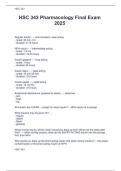
Regular insulin - -- short-duration, slow acting - onset: 30 min-1 hr - duration: 6-10 hours NPH insulin - -- intermediate acting - onset: 1-2 hrs - duration: 16-24 hours Insulin glargine - -- long-acting - onset: 1 hour - duration 24 hours Insulin lispro - -- rapid-acting - onset: 15 min-30 min - duration: 3-5 hours Insulin aspart - -- rapid acting - onset: 12-18 min - duration: 3-5 hours Anatomical absorbance (greatest to latest) - -- abdomen - arm - thigh - hip All insulins are CLEAR--- except for what insulin? - -NPH insulin (it is cloudy) What insulins may be given IV? - - - regular - aspart - lispro - glulisine When mixing insulin, which insulin would you draw up first? What are the steps after that? - -- when mixing insulins, draw up the SHORT-ACTING insulin into the syringe first, then NPH Why would you draw up the short-acting insulin first when mixing insulins? - -this stops contamination of the short-acting insulin w/ NPH HSC 343 HSC 343 HSC 343 S/S of insulin OD - -- hypoglycemia (dizziness) - weakness - sweating - HA - increased HR - anxiety - tremor - mental and visual disturbances How would you treat insulin OD? - -- eat something sweet or out the pt on a sugar drip (if in the hospital) Metformin - -- widely used - oral drug Type II DM - may be used w/ other drugs for diabetes - increases HDL, decreases BP, weight loss - SE: GI upset, acidosis - DO NOT use in pts w/ renal diseases or liver disease - d/c before using iodinated radiocontrast media, wait Acarbose - -- oral drug for Type II DM (glucosidase inhibitor) - inhibits the enzymes that break down oligosaccharides into monosaccharides - delays digestion and prolongs absorption of CHO, decreasing PPH - do not cause postprandial hypoglycemia - adrs: GI upset and flatulence - pts take these drugs w/ first bite of each meal Tolbutamide - -- older drugs that stimulates insulin release from the pancreas - onset: 30 in-1hr - duration: 6-12 hrs Sitagliptin - -- PO used to stimulate insulin release Canagliflozin - -- excretes glucose through the kidneys -- increases urine excretion of kidneys SE: yeast infections and genital gangrene Exanatide - -- injectable, that slows gastric emptying What is PPH? - -postprandial hyperglycemia - it is correlated w/ increased risk of cardiovascular disease Signs of hypoglycemia - -early signs - fatigue, HA, drowsiness, lassitude, tremulousness, nausea Late signs HSC 343 HSC 343 - weakness, sweating, tremors, nervousness, LOC/convulsion (use Glucagon for this) Signs of hyperglycemia - -- thirst. Polyuria, drowsiness, flushed skin, fruity odor to breath, LOC - instruct family to call physician, EMT - have insulin ready - observe pt closely after insulin is administered What is ketoacidosis? - -high blood glucose -- above 300, high ketones in blood and urine How is ketoacidosis treated? - -- IV fluids and electrolytes - IV insulin- but given slowly to reduce blood glucose levels slowly (initial bolus, then continuous infusion to maintain BG levels) - Bicarb for acidosis, K+ for hypokalemia What is HHNKS? - -hyperglycemic hyperosmolar Nonketonic syndrome What does thyroid do? - -- it synthesizes and releases 2 hormones (T3 and T4) What do T3 and T4 do? - -regulate many facets of cellular metabolism Why is thyroid hormone (TH) important? - -- they are the main controller of how we burn calories and are also permissive w/ respect to catecholamines S/S of hypothyroidism - -- fatigue, weakness, cold-intolerance, weight gain, anemia, cretinism S/S of hyperthyroidism - -- nervousness, weakness, heat-intolerance, sweating, weight loss, exophthalmos (Graves disease) Synthroid - -- PO or IV - mimics TH - most commonly prescribed drug in the US - DOC for hypothyroidism -- life long therapy PTU (propylthiouracil) - -- antithyroid - blocks iodine incorporated into ths and also blocks conversion of T3/4 in periphery - long term use in absence or surgery of l131 - safe in first trimester of pregnancy -- the switch to methimazole Methimazole - -- antithyroid L131 - -- destroys thyroid w/ a single (or double) dose - can NOT be used in pts who are pregnant HSC 343 HSC 343 - fast and cheap but produces hypothyroidism Propranolol - -- blocks the CV effects of TH -- decreases the sympathetic activation caused by TH - good during a thyroid storm and pregnancy Use of glucosteroids - -anti-inflammatory, immunosuppression, and replacement therapy in adrenal insufficiency How to dose steroid drugs - -- PO steroids given in the AM to mimic body's normal release or by taper pack Hydrocortisone - -- - used for status asthmaticus, anaphylactic shock (IV); - PO for Addison's disease - Topical form for itching/inflammation Solu-medrol - -- DOC (IV) for acute asthma - allergy inflammation Prednisone - -- given PO - DOC for maintenance therapy in asthma, and other autoimmune disorders Ses of glucosteroids - -- osteoporosis - ulcers - metabolic fat (hyperglycemia, hyperlipidemia, fat redistribution) - growth retardation -- children - adrenal suppression - decreased wound healing - immunosuppression (do not give immunizations) - HTN, glaucoma, increased CNS excitability, menstrual irregularities COX-1 inhibitors - -mediate pain, inflammation, clot formation, vasoconstriction/dilation, platelet aggregation, fever, integrity of gastric mucosal barrier, renal homeostasis, labor and patency of the ductus arteriosus COX-2 Inhibitors - -- more selective for inflammation - ex.: Celecoxib - main use is arthritis, bu it may affect renal function and has a greater risk of MI and stroke - fewer GI bleeds and no effect on clotting time Which antacids cause constipation? - -aluminum salts and Ca carbonate Which antacids cause diarrhea? - -Mg salts HSC 343 HSC 343 Opiate - -- drug for diarrhea - DO NOT USE W/ maois - i.e. Imodium Alosetron - -- for IBS-D and is currently for emergency/restricted use for IB-C Metamucil - -- fiber-based - for constipation - used for flatulence and impaction - takes 1-3 days Docusate - -- osmotic - surface acting to increase H2O into stool Golytely - -- lower GI prep - increases water into feces and is used to treat occasional constipation or used prior to lower GI procedures Drugs for nausea - -- used to prevent nausea and vomiting - some used in pregnancy, but not many are - other uses: pt who's had surgery, motion sickness, and in wasting syndromes Antihistamines (PO or IV) - -- Benedryl, Promethazine - DA antagonists- work to block the effect of DA at the trigger zone in the brain - some given PO (some IV, IM, and PR) - once DA is blocked, nausea and vomiting is subsided - ses: extrapyramidal ses (dystonias) Ondansetron - -- serotonin antagonists - mainly used for chemo and anesthesia-induced nausea Steroids - -- IV steroids may be used following surgery or along w/ chemo - typically, it is used short-term Compazine - -- antipsychotics - DA antagonists - same as Promethazine Emend - -- Aprepitant - substance P/Neurokinin antagonists - used for post-op and chemo-induced NV - given PO --- well tolerated but there are many drug interactions Resistance - -- ability of bacteria, virus, or parasites to "tolerate" an antibiotic and thrive in its presence - Can occur in many different ways HSC 343 HSC 343 Spectrum of activity - -- the microorganisms - narrow = few, selective microorganisms - broad = wide range of microorganisms Resistance - -- ability of bacteria, virus, or parasites to "tolerate" an antibiotic and thrive in its presence - can occur in many different ways Factors that promote resistance - -- poor pt compliance - monotherapy - indiscriminate antibiotic use Superinfections - -- often a problem w/ broad-spectrum drugs - there is an overgrowth of a second organism when drug therapy is treating the first organisms Empiric - -- based on observation - when the pt first comes into the hospital complaining, the dr. Will decided what microorganism it PROBABLY is but not 100% sure and will give that drug to the pt - usually it's broad spectrum drug Culture - -- based on lab results and can know definitely know the organism and its sensitivity Penicillin G - -- class 1 - effective only a/g gram [+] - hypersensitivity a problem 1-10% of the time - cannot be given PO (not acid stable) - used a lot in strep throat - can be given in conjunction w/ another drug - if given IM, it is one and done Amoxicillin - -- class 5 - sensitive to penicillinase - used in sinus infections and uris - used more in the community - given in a high dose- allows for more pt compliance Ampicillin - -- class 5 - sensitive to penicillinase - used in combination w/ other drugs in the hospital Amoxicillin + Clavulantate (Augmentin) - -resistant to penicillinase which makes it very expensive HSC 343 HSC 343 Piperacillin - -- Class 4 - Covers gram -+ pseudomonas (which are water born bugs) - Given PO. Vancomycin - -- DOC for anitbiotic associated pseudomembranous - given for any GI trauma who has a high probability of infection. Need to monitor trough levels to make sure the kidneys are clearing it out - RISK: can cause ototoxicity and nephrotoxicity Cephalosporins - -If patient is allergic to penicillin, then they're probably allergic to Cephalosporin too. Anything with "cef" usually means some sore of bronchitis, sinusitis or soft tissue infection. Cephalexin - -• Used for =MRSA • Side Effects=Ototoxicity,Anemia, Nephrotoxicity, cross sensitivity • Given PO • First generation; narrow spectrum (sensitive to B-lactamase). Cefepime - -• Fourth generation • Used for =MRSA • Side effects =Ototoxicity, Anemia, Nephrotoxicity, cross-sensitivity • Good for surgical prophylaxis Ceftriaxone, Cefixime, and Ceftaroline - -- Used for neurological infections - Third generation (broad Spectrum-B-lactamase resistant). - Side Effects=Neurotoxicity, Nephrotoxicity, Excretion - Given IM or IV. Cross-sensitivity w/ penicillins - -leads to bleeding because of decreased platelet function and clotting factors, including neurotoxicity. Gentamicin - -- All good for gm - aerobes = get into cell via 02- dependent pump. SE=Neurotoxicity, nephrotoxicity, ototoxicity. - Slow IV/IM Synergistic when combined with a B-lactam Erythromycin - -DOC for legionnaires Disease and good in PCN-allergic pt Azithromycin/ Clindamycin - -uris Tetracyclines - -- Used in penicillin allergy, used for acne, travelers diarrhea, rickettsia, chlamydia - SE= superinfection, tooth discoloration, photosensitivity, hepatotoxicity, nephrotoxicity - Dont take with antacids or dairy products Daptomycin - -- Given IV for MRSA and strep infections. - Inserts into bacteral membrane of gm organisms HSC 343 HSC 343 Sulfa drugs - -- Used for UTI and otitis media - SE= photosensitivity, hypersensitivity, hemolytic anemia, stevens- Johnsons syndrome. Crystalluria(drinks lots of h20), sulfa allergy Ciprofloxacin - -- Broad spectrum. Good distribution, Used for LRT, skin and UTI - SE=dizziness, seizures, tendron ruptures (long term use) Metronidazole - -- Bactericidal. Used against anaerobes & parasites - SE= Antabuse like reaction, GI upset, CNS disturbances - MOA- Binds DNA and inhibits its synthesis - can't drink because it binds to the alcohol and forms acid Combination therapy for TB - -- Treatment relies on drug combinations because resistance is so prevalent. - Treatment is challenging because mycobacteria are slow growers who may wall themselves off. - Also, they have a unique cell wall and we can't use bacteriostatic drugs in the immunocompromised host What is DOT? - -Directly Observed Therapy Amphotericin B - -- Drug of choice for fungal infections - SE= fever, chills, nausea, nephrotoxicity, headache, anemia - MOA- Binds to ergosterol in fungal cell membrane Nystatin - -- DOC for oral or intestinal Thrush - MOA-binds to ergosterol in fungal cell membrane Fluconazole/Miconazole - -- Used for immunosuppressed pts with serious fungal infections - MOA- inhibits fungal cytochrome p-450. Funguscant demethylate sterols for plasma membrane Acyclovir - -- used for hsv 1, hsv 2, and varicella zoster. - If given iv, give slowly because it burns, can cause nephrotoxicity Interferon Alpha - -- used for Hep. C PEP (Post-Exposure Prophylaxis) - -- Needle stick, syringed, Iv tubing needles - Decontaminate the wound, document, determine the source, determine th risk - Pep is most effective within 2 hrs Metronidazole (antiparasitic) - -- Used for trichomoniasis, amebiasis, and giardiasis - MOA-Activated intermediates bind DNA and inhibit replication HSC 343 HSC 343 Mebendazole - -- Drug of choice for pinworms, also roundworms - MOA- Disrupts microtubules Permithrin - -- Used for ectoparasit

Content preview

HSC 343


HSC 343 Pharmacology Final Exam
2025

Regular insulin - -- short-duration, slow acting
- onset: 30 min-1 hr
- duration: 6-10 hours

NPH insulin - -- intermediate acting
- onset: 1-2 hrs
- duration: 16-24 hours

Insulin glargine - -- long-acting
- onset: 1 hour
- duration 24 hours

Insulin lispro - -- rapid-acting
- onset: 15 min-30 min
- duration: 3-5 hours

Insulin aspart - -- rapid acting
- onset: 12-18 min
- duration: 3-5 hours

Anatomical absorbance (greatest to latest) - -- abdomen
- arm
- thigh
- hip

All insulins are CLEAR--- except for what insulin? - -NPH insulin (it is cloudy)

What insulins may be given IV? - -
- regular
- aspart
- lispro
- glulisine

When mixing insulin, which insulin would you draw up first? What are the steps after
that? - -- when mixing insulins, draw up the SHORT-ACTING insulin into the syringe
first, then NPH

Why would you draw up the short-acting insulin first when mixing insulins? - -this stops
contamination of the short-acting insulin w/ NPH

HSC 343

, HSC 343


S/S of insulin OD - -- hypoglycemia (dizziness)
- weakness
- sweating
- HA
- increased HR
- anxiety
- tremor
- mental and visual disturbances

How would you treat insulin OD? - -- eat something sweet or out the pt on a sugar drip
(if in the hospital)

Metformin - -- widely used
- oral drug Type II DM
- may be used w/ other drugs for diabetes
- increases HDL, decreases BP, weight loss
- SE: GI upset, acidosis
- DO NOT use in pts w/ renal diseases or liver disease
- d/c before using iodinated radiocontrast media, wait

Acarbose - -- oral drug for Type II DM (glucosidase inhibitor)
- inhibits the enzymes that break down oligosaccharides into monosaccharides
- delays digestion and prolongs absorption of CHO, decreasing PPH
- do not cause postprandial hypoglycemia
- adrs: GI upset and flatulence
- pts take these drugs w/ first bite of each meal

Tolbutamide - -- older drugs that stimulates insulin release from the pancreas
- onset: 30 in-1hr
- duration: 6-12 hrs

Sitagliptin - -- PO used to stimulate insulin release

Canagliflozin - -- excretes glucose through the kidneys --> increases urine excretion of
kidneys
SE: yeast infections and genital gangrene

Exanatide - -- injectable, that slows gastric emptying

What is PPH? - -postprandial hyperglycemia
- it is correlated w/ increased risk of cardiovascular disease

Signs of hypoglycemia - -early signs
- fatigue, HA, drowsiness, lassitude, tremulousness, nausea
Late signs

HSC 343

Document information

Uploaded on
August 26, 2025
Number of pages
15
Written in
2025/2026
Type
Exam (elaborations)
Contains
Questions & answers
$20.49

Wrong document? Swap it for free Within 14 days of purchase and before downloading, you can choose a different document. You can simply spend the amount again.
Written by students who passed
Immediately available after payment
Read online or as PDF

Seller avatar
Reputation scores are based on the amount of documents a seller has sold for a fee and the reviews they have received for those documents. There are three levels: Bronze, Silver and Gold. The better the reputation, the more your can rely on the quality of the sellers work.
AlexScorer
2.5
(2)
Sold
11
Followers
0
Items
1800
Last sold
2 weeks ago


Why students choose Stuvia

Created by fellow students, verified by reviews

Quality you can trust: written by students who passed their tests and reviewed by others who've used these notes.

Didn't get what you expected? Choose another document

No worries! You can instantly pick a different document that better fits what you're looking for.

Pay as you like, start learning right away

No subscription, no commitments. Pay the way you're used to via credit card and download your PDF document instantly.

Student with book image

“Bought, downloaded, and aced it. It really can be that simple.”

Alisha Student

Working on your references?

Create accurate citations in APA, MLA and Harvard with our free citation generator.

Working on your references?

Frequently asked questions
