ENPC Questions With Detailed Answers.
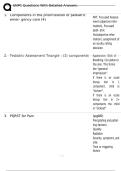
1. Components in the prioritization of pediatric
PAT, Focused Assess-
emer- gency care (4)
ment (objective infor-
mation), Focused
pedi- atric
Hx(subjective infor-
mation), assignment of
an acuity rating
decision
2. Pediatric Assessment Triangle : (3) components Appearance. Work of
Breathing. Circulation to
the skin. This forms
the "general
impression".
If there is an acute
disrup- tion in 1
component, child is
"sicker".
If there is an acute
disrup- tion in 2+
components the child
is "sickest"
3. PQRST for Pain (pg86)
Precipitating and palliat-
ing factors
Quality
Radiation
Severity, symptoms, and
site
Time or triggering
factors
, ENPC Questions With Detailed Answers.
4. What age is the respiratory system 8 years old
considered fully developed?
5. 6P's Assessment for Musculoskeletal Trauma (pg 283)
Pallor : color ditterent from
, ENPC Questions With Detailed Answers.
uninjured
Pain
Pulselessnes
s
Parasthesia
Paralysis
Poikilothermia
6. Burn Transfer Criteria 1. Partial thickness
>10% of BSA
2. Face, hands, feet,
gene- talia, perineum
or major joints
3. Third degree
burns in any age
group.
4. Electrical burns,
includ- ing lightning
injury, and chemical
burns.
5. Inhalation injury.
6. Burn injury in pt
with preexisting
medical disor- ders that
could complicate tx.
7. Concomitant
trauma (such as fx)
in which
the burn injury poses
the greatest risk of
morbidity or
mortality.
1. Components in the prioritization of pediatric
PAT, Focused Assess-
emer- gency care (4)
ment (objective infor-
mation), Focused
pedi- atric
Hx(subjective infor-
mation), assignment of
an acuity rating
decision
2. Pediatric Assessment Triangle : (3) components Appearance. Work of
Breathing. Circulation to
the skin. This forms
the "general
impression".
If there is an acute
disrup- tion in 1
component, child is
"sicker".
If there is an acute
disrup- tion in 2+
components the child
is "sickest"
3. PQRST for Pain (pg86)
Precipitating and palliat-
ing factors
Quality
Radiation
Severity, symptoms, and
site
Time or triggering
factors
, ENPC Questions With Detailed Answers.
4. What age is the respiratory system 8 years old
considered fully developed?
5. 6P's Assessment for Musculoskeletal Trauma (pg 283)
Pallor : color ditterent from
, ENPC Questions With Detailed Answers.
uninjured
Pain
Pulselessnes
s
Parasthesia
Paralysis
Poikilothermia
6. Burn Transfer Criteria 1. Partial thickness
>10% of BSA
2. Face, hands, feet,
gene- talia, perineum
or major joints
3. Third degree
burns in any age
group.
4. Electrical burns,
includ- ing lightning
injury, and chemical
burns.
5. Inhalation injury.
6. Burn injury in pt
with preexisting
medical disor- ders that
could complicate tx.
7. Concomitant
trauma (such as fx)
in which
the burn injury poses
the greatest risk of
morbidity or
mortality.