
CFCI 2025 EXAM QUESTIONS WITH ALL CORRECT & 100%
VERIFIED ANSWERS|LATEST UPDATE|ALREADY GRADED A+
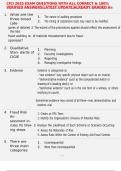
1. What are the
1. The nature of auditing procedures
three broad
2. The timing of substantive tests may need to be modified.
cate-
gories of detailed 3. The extent of the procedures applied should reflect the assessment of
the risks
fraud auditing re- of material misstatement due to fraud.
sponses?
2. Qualitative 1. Planning
Stan- dards of 2. Executing investigations
CIGIE 3. Reporting
4. Managing investigative findings.
3. Evidence Evidence is categorized as
-"real evidence" (any specific physical object such as an invoice);
-"demonstrative evidence" (such as the computerized sketch or
drawing of a loading dock); or
-"testimonial evidence" (such as in the oral form of a witness, or others
testifying in court).
Sometimes evidence may consist of all three—real, demonstrative, and
testimo- nial
4. Fraud Risk 1: Create an FRA Team
As- 2: Identify the Organization's Universe of Potential Risks
sessment in-
cludes the follow- 3: Analyze the Likelihood of Each Scheme or Scenario Occurring
ing steps 4: Assess the Materiality of Risk.
5: Assess Risks Within the Context of Existing Anti-Fraud Controls
5. There are 1. Inconsequential
three main 2. More than inconsequential
categories
, CFCI 2025 EXAM QUESTIONS WITH ALL CORRECT & 100%
VERIFIED ANSWERS|LATEST UPDATE|ALREADY GRADED A+
of materiality in a 3. Material
FRA
6.
, CFCI 2025 EXAM QUESTIONS WITH ALL CORRECT & 100%
VERIFIED ANSWERS|LATEST UPDATE|ALREADY GRADED A+
Ultimate goal of a The ultimate objective of any FRA is to guide the institution's auditors in
adjusting
FRA Alerts, Notifi- cations or Warn- ings from a
Con- sumer Reporting Agency
7. Approaches to
FRAs will differ
from organiza-
tion to organi-
zation, but
most FRAs
focus on
identifying
fraud risks in
six key
categories:
8. FRA step 3:
An- alyze the
Like- lihood of
Each Scheme
or Sce- nario
Occurring
International
au- diting
standards
specify four
risk levels:
9. FACTA Red
Flags List of
Suggest- ed
, CFCI 2025 EXAM QUESTIONS WITH ALL CORRECT & 100%
VERIFIED ANSWERS|LATEST UPDATE|ALREADY GRADED A+
their audit plans to
incorporate specific
techniques for detecting
fraud, and to assist 1. Suspicious Documents
management in
2. Suspicious Personal Identifying Information
formulating and/or
3. Unusual Use of, or Suspicious Activity Related to, the Covered
adjusting its anti-fraud Account
controls to reduce the 4. Notice from Customers, Victims of Identity Theft, Law Enforcement
risk of fraud. Authorities, or Other Persons Regarding Possible Identity Theft in
Connection with Covered Accounts Held by the Financial Institution or
1. Fraudulent financial
reporting Creditors
2. Misappropriation of
assets
3. Expenditures and
liabilities for an improper
purpose
4. Revenue and assets
obtained by fraud
5. Costs and expenses
avoided by fraud
6. Financial misconduct
by senior management
1. Remote
2. More than remote
3. Reasonably possible
4. Probable
VERIFIED ANSWERS|LATEST UPDATE|ALREADY GRADED A+
1. What are the
1. The nature of auditing procedures
three broad
2. The timing of substantive tests may need to be modified.
cate-
gories of detailed 3. The extent of the procedures applied should reflect the assessment of
the risks
fraud auditing re- of material misstatement due to fraud.
sponses?
2. Qualitative 1. Planning
Stan- dards of 2. Executing investigations
CIGIE 3. Reporting
4. Managing investigative findings.
3. Evidence Evidence is categorized as
-"real evidence" (any specific physical object such as an invoice);
-"demonstrative evidence" (such as the computerized sketch or
drawing of a loading dock); or
-"testimonial evidence" (such as in the oral form of a witness, or others
testifying in court).
Sometimes evidence may consist of all three—real, demonstrative, and
testimo- nial
4. Fraud Risk 1: Create an FRA Team
As- 2: Identify the Organization's Universe of Potential Risks
sessment in-
cludes the follow- 3: Analyze the Likelihood of Each Scheme or Scenario Occurring
ing steps 4: Assess the Materiality of Risk.
5: Assess Risks Within the Context of Existing Anti-Fraud Controls
5. There are 1. Inconsequential
three main 2. More than inconsequential
categories
, CFCI 2025 EXAM QUESTIONS WITH ALL CORRECT & 100%
VERIFIED ANSWERS|LATEST UPDATE|ALREADY GRADED A+
of materiality in a 3. Material
FRA
6.
, CFCI 2025 EXAM QUESTIONS WITH ALL CORRECT & 100%
VERIFIED ANSWERS|LATEST UPDATE|ALREADY GRADED A+
Ultimate goal of a The ultimate objective of any FRA is to guide the institution's auditors in
adjusting
FRA Alerts, Notifi- cations or Warn- ings from a
Con- sumer Reporting Agency
7. Approaches to
FRAs will differ
from organiza-
tion to organi-
zation, but
most FRAs
focus on
identifying
fraud risks in
six key
categories:
8. FRA step 3:
An- alyze the
Like- lihood of
Each Scheme
or Sce- nario
Occurring
International
au- diting
standards
specify four
risk levels:
9. FACTA Red
Flags List of
Suggest- ed
, CFCI 2025 EXAM QUESTIONS WITH ALL CORRECT & 100%
VERIFIED ANSWERS|LATEST UPDATE|ALREADY GRADED A+
their audit plans to
incorporate specific
techniques for detecting
fraud, and to assist 1. Suspicious Documents
management in
2. Suspicious Personal Identifying Information
formulating and/or
3. Unusual Use of, or Suspicious Activity Related to, the Covered
adjusting its anti-fraud Account
controls to reduce the 4. Notice from Customers, Victims of Identity Theft, Law Enforcement
risk of fraud. Authorities, or Other Persons Regarding Possible Identity Theft in
Connection with Covered Accounts Held by the Financial Institution or
1. Fraudulent financial
reporting Creditors
2. Misappropriation of
assets
3. Expenditures and
liabilities for an improper
purpose
4. Revenue and assets
obtained by fraud
5. Costs and expenses
avoided by fraud
6. Financial misconduct
by senior management
1. Remote
2. More than remote
3. Reasonably possible
4. Probable


