

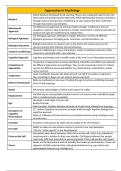
Approaches in Psychology
Albert Bandura developed Social Learning Theory and conducted experiments into
observational learning using the Bobo doll. While agreeing that humans could learn
Bandura
through classical and operant conditioning, he also argued that they could learn
through observation and imitation.
The Behaviourist approach to learning studied changes in behaviour that are
Behaviourist
caused by a person’s direct experience of their environment, using the principles of
Approach
classical and operant conditioning to explain them..
The Biological approach attempts to explain behaviour in terms of different
Biological Approach biological processes, including genes, hormones, neurotransmitters, etc.
Biological structures are organs (such as the brain) and systems (such as the
Biological Structures
nervous system) that influence human behaviour
Classical conditioning is a type of learning in which an existing involuntary reflex
Classical Conditioning
response is associated with a new stimulus.
Cognitive Approach Cognitive psychology is the scientific study of the mind as an information processor.
Comparison of approaches involves identifying similarities and differences between
Comparison of the different approaches in psychology. They can be compared in terms of criteria
Approaches such as the different issues and debates (e.g. determinism, reductionism, nature
versus nurture).
Level of similarity between the ideal self and real self.If we achieve congruence
Congruence
then according to Roger we can achieve personal growth.
Defence mechanism is one way of helping the ego to balance conflicting demands
Defence Mechanisms of thr Id and superego
Denial Refusing to acknowledge or admist some aspect of reality
Transferring an unacceptable emotion from its true source onto a substitute target
Displacement
that is considered more acceptable
Develops in anal stage 2-3 years old
Ego Reality Principle
Main function: Mediate between de,amds of Id and moral standards of superego
21st centurt:Cognitvie neuroscience emeged which brought together biological an
Emergence of
cognitive approach
Cognitive
Study of: Influence of brain structures on mental processes using techniques such
Neuroscience
as brain scans
Evolution Evolution is the process by which species adapts to its environment
Ability to make our own choices and be in control of our own behaviour
Free Will
*We are “active agents” in our development
Humanistic ideas about behaviour often focus on the self, which is an individual’s
Focus on the Self consciousness in relation to their own identity. Carl Rogers believed that people
could only fulfil their potential for personal growth if they had positive self-regard.
Genes are the biochemical units of heredity that make up chromosomes. Genes are
Genes segments of DNA molecules that code physical features (e.g. eye colour) and
psychological features (e.g. intelligence).
Albert Bandura developed Social Learning Theory and conducted experiments into
observational learning using the Bobo doll. While agreeing that humans could learn
Bandura
through classical and operant conditioning, he also argued that they could learn
through observation and imitation.
The Behaviourist approach to learning studied changes in behaviour that are
Behaviourist
caused by a person’s direct experience of their environment, using the principles of
Approach
classical and operant conditioning to explain them..
The Biological approach attempts to explain behaviour in terms of different
Biological Approach biological processes, including genes, hormones, neurotransmitters, etc.
Biological structures are organs (such as the brain) and systems (such as the
Biological Structures
nervous system) that influence human behaviour
Classical conditioning is a type of learning in which an existing involuntary reflex
Classical Conditioning
response is associated with a new stimulus.
Cognitive Approach Cognitive psychology is the scientific study of the mind as an information processor.
Comparison of approaches involves identifying similarities and differences between
Comparison of the different approaches in psychology. They can be compared in terms of criteria
Approaches such as the different issues and debates (e.g. determinism, reductionism, nature
versus nurture).
Level of similarity between the ideal self and real self.If we achieve congruence
Congruence
then according to Roger we can achieve personal growth.
Defence mechanism is one way of helping the ego to balance conflicting demands
Defence Mechanisms of thr Id and superego
Denial Refusing to acknowledge or admist some aspect of reality
Transferring an unacceptable emotion from its true source onto a substitute target
Displacement
that is considered more acceptable
Develops in anal stage 2-3 years old
Ego Reality Principle
Main function: Mediate between de,amds of Id and moral standards of superego
21st centurt:Cognitvie neuroscience emeged which brought together biological an
Emergence of
cognitive approach
Cognitive
Study of: Influence of brain structures on mental processes using techniques such
Neuroscience
as brain scans
Evolution Evolution is the process by which species adapts to its environment
Ability to make our own choices and be in control of our own behaviour
Free Will
*We are “active agents” in our development
Humanistic ideas about behaviour often focus on the self, which is an individual’s
Focus on the Self consciousness in relation to their own identity. Carl Rogers believed that people
could only fulfil their potential for personal growth if they had positive self-regard.
Genes are the biochemical units of heredity that make up chromosomes. Genes are
Genes segments of DNA molecules that code physical features (e.g. eye colour) and
psychological features (e.g. intelligence).


