1
ISC 321 Test Review Res Methods The
Isc Professional (University of Kentucky)
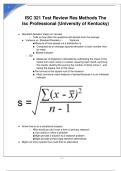
● Standard deviation steps (on canvas)
○ Tells us how often the questions will deviate from the average
● Variance vs. Standard Deviation ○ Variance
■ Measure of how spread out a distribution is
■ Computed as an average squared deviation of each number from
its mean
■ Biased indicator
○ SD
■ Measures of dispersion calculated by subtracting the mean of the
series from each value in a series, squaring each result, summing
the results, dividing the sum by the number of items minus 1, and
taking the square root of this value
■ The formula is the square root of the variance
■ Most commonly used measure of spread because it is an unbiased
indicator
● Know how to do a situational analysis
○ Why would you do it over a form of primary research
■ Can clarify or refine a problem
■ Might provide a solution to a research problem
■Might provide primary data research alternatives
● Might not find a solution but could find an alternative
pg. 1
,2
■ Can alert the researchers to other problems
■Provides background information enhancing research credibility
■ Provides the sample frame
○ Studying the decision making environment within which the market
research will take place
○SWOT analysis (strength, weakness, opportunity, threat)
■ SO - Internal
■ WT -
External ○ Can be as
simple as
■ Talking to brand managers
■ Reading company reports
■ Visiting production facility
● Know what qualitative research is and how to
conduct a focus group and why you would choose to do it
○ Qualitative
■ Research whose findings are not subject to quantification or
quantitative analysis
■ It’s research conclusions are not based on precisely, measureable
statistics but on more subjective observations and analysis
○ Focus group
■ 8-12 participants lead by a moderator in an in-depth
discussion on one particular topic or concept ■ Key characteristics
● Good for idea generation, brainstorming, and
understanding customer vocabulary
● Can be helpful in gaining insight to motives,
attitudes, perceptions
● Can reveal needs/likes & dislikes/ prejudices
driven by emotions
● Group dynamics. The moderator must manage
this factor deftly ○ Conducting a focus group (steps on
Canvas)
■ Steps ■
Step 1:
● Decide on the key focus group objectives
● Use secondary research to hone questions
● Select focus group facility and participants
● Begin recruiting after deciding on participant
incentives ■ Step 2:
● Select a moderator
● Develop a moderator guide to chart flow of focus
group ■ Step 3:
pg. 2
, 3
● Conduct the focus group - generally about two
hours ■ Step 4:
● Review the video tape and analyze the results
● Prepare a written report
■ The facility
● A research facility consisting of a conference
room of living room setting and separate observation room with
a one-way mirror or live audiovisual feed
■ The participants
● Selection process
○ Potential opinion leaders are best
○ Participants must be screened for relevance to
the topic. ■ The moderator
● Smile - make connection
● Get physical - handshake or dialog
● Turn on the charm - seem relatable
● Offer empathy - if there are problems, address
these issues
● Be real - make actions sincere
● Mind the details - include logistics such as
mentioned where food, drink and bathrooms, make sure
everyone is comfortable
● Complete closure - make comments final and say
firm goodbyes
■ Good moderator
● Be adaptable, ask short questions, change
activities every 20 mins ○ Discussion guide
■ Written outline of the topics to be covered during the
session ■ Discussion goes through three stages
● Rapport is established
● Intensive discussion is provoked
● Significant conclusions are summarized ○
Focus group length
■ Managers - prefer shorter
■ Average group - 90 minutes
● Longer groups - get more things done in a single
session
● Allow respondents to get more involved-in more
time-consuming task and interact more extensively ○ Client’s
role
■ The client selects the markets where groups will be held and
specifies the characteristics of the groups respondents
pg. 3
ISC 321 Test Review Res Methods The
Isc Professional (University of Kentucky)
● Standard deviation steps (on canvas)
○ Tells us how often the questions will deviate from the average
● Variance vs. Standard Deviation ○ Variance
■ Measure of how spread out a distribution is
■ Computed as an average squared deviation of each number from
its mean
■ Biased indicator
○ SD
■ Measures of dispersion calculated by subtracting the mean of the
series from each value in a series, squaring each result, summing
the results, dividing the sum by the number of items minus 1, and
taking the square root of this value
■ The formula is the square root of the variance
■ Most commonly used measure of spread because it is an unbiased
indicator
● Know how to do a situational analysis
○ Why would you do it over a form of primary research
■ Can clarify or refine a problem
■ Might provide a solution to a research problem
■Might provide primary data research alternatives
● Might not find a solution but could find an alternative
pg. 1
,2
■ Can alert the researchers to other problems
■Provides background information enhancing research credibility
■ Provides the sample frame
○ Studying the decision making environment within which the market
research will take place
○SWOT analysis (strength, weakness, opportunity, threat)
■ SO - Internal
■ WT -
External ○ Can be as
simple as
■ Talking to brand managers
■ Reading company reports
■ Visiting production facility
● Know what qualitative research is and how to
conduct a focus group and why you would choose to do it
○ Qualitative
■ Research whose findings are not subject to quantification or
quantitative analysis
■ It’s research conclusions are not based on precisely, measureable
statistics but on more subjective observations and analysis
○ Focus group
■ 8-12 participants lead by a moderator in an in-depth
discussion on one particular topic or concept ■ Key characteristics
● Good for idea generation, brainstorming, and
understanding customer vocabulary
● Can be helpful in gaining insight to motives,
attitudes, perceptions
● Can reveal needs/likes & dislikes/ prejudices
driven by emotions
● Group dynamics. The moderator must manage
this factor deftly ○ Conducting a focus group (steps on
Canvas)
■ Steps ■
Step 1:
● Decide on the key focus group objectives
● Use secondary research to hone questions
● Select focus group facility and participants
● Begin recruiting after deciding on participant
incentives ■ Step 2:
● Select a moderator
● Develop a moderator guide to chart flow of focus
group ■ Step 3:
pg. 2
, 3
● Conduct the focus group - generally about two
hours ■ Step 4:
● Review the video tape and analyze the results
● Prepare a written report
■ The facility
● A research facility consisting of a conference
room of living room setting and separate observation room with
a one-way mirror or live audiovisual feed
■ The participants
● Selection process
○ Potential opinion leaders are best
○ Participants must be screened for relevance to
the topic. ■ The moderator
● Smile - make connection
● Get physical - handshake or dialog
● Turn on the charm - seem relatable
● Offer empathy - if there are problems, address
these issues
● Be real - make actions sincere
● Mind the details - include logistics such as
mentioned where food, drink and bathrooms, make sure
everyone is comfortable
● Complete closure - make comments final and say
firm goodbyes
■ Good moderator
● Be adaptable, ask short questions, change
activities every 20 mins ○ Discussion guide
■ Written outline of the topics to be covered during the
session ■ Discussion goes through three stages
● Rapport is established
● Intensive discussion is provoked
● Significant conclusions are summarized ○
Focus group length
■ Managers - prefer shorter
■ Average group - 90 minutes
● Longer groups - get more things done in a single
session
● Allow respondents to get more involved-in more
time-consuming task and interact more extensively ○ Client’s
role
■ The client selects the markets where groups will be held and
specifies the characteristics of the groups respondents
pg. 3