

Written by students who passed Immediately available after payment Read online or as PDF Wrong document? Swap it for free 4.6 TrustPilot
logo-home
Document preview thumbnail
Preview 2 out of 9 pages
Exam (elaborations)

Nutrition latest Test Bank 2025

Document preview thumbnail
Preview 2 out of 9 pages

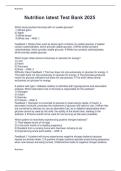
Which food provides the body with no usable glucose? 1) Wheat germ 2) Apple 3) White bread 4) White rice - -ANS: 1 Feedback 1 Dietary fiber such as wheat germ contains no usable glucose. 2 Apples contain carbohydrates, which provide usable glucose. 3 White bread contains carbohydrates, which provide usable glucose. 4 White rice contains carbohydrates, which provide usable glucose. Which organ relies almost exclusively on glucose for energy? 1) Liver 2) Heart 3) Pancreas 4) Brain - -ANS: 4 Difficulty: Easy Feedback 1 The liver does not rely exclusively on glucose for energy. 2 The heart does not rely exclusively on glucose for energy. 3 The pancreas produces insulin for glucose utilization but does not use glucose. 4 The brain relies almost exclusively on glucose for energy. A patient with type 1 diabetes mellitus is admitted with hyperglycemia and associated acidosis. Which alternative fuel in the body is responsible for the acidosis? 1) Glycogen 2) Insulin 3) Ketones 4) Proteins - -ANS: 3 Feedback 1 Glycogen is converted to glucose to meet energy needs. 2 Insulin, a pancreatic hormone, promotes the movement of glucose into cells for use. 3 When fats are converted to ketones for use as alternative fuel, as in diabetic ketoacidosis when glucose cannot by used by the cells, the acidity of the blood rises, leading to the acidosis. 4 Proteins would not be used for fuel as long as fats were available. Which patient is most likely experiencing positive nitrogen balance? 1) Third-degree burns of his legs 2) In the sixth month of a healthy pregnancy 3) Resident from a nursing home who has been refusing to eat 4) Experiencing acute pancreatitis - -ANS: 2 Feedback 1 A patient with burns experiences negative nitrogen balance because tissues are broken down. 2 A positive nitrogen balance typically exists during pregnancy when new tissues are being formed. 3 Malnutrition leads to negative nitrogen balance Nutrition Nutrition because tissues are broken down. 4 Serious illnesses lead to negative nitrogen balance because tissues are broken down. Which polysaccharide is stored in the liver? 1) Insulin 2) Ketones 3) Glycogen 4) Glucose - -ANS: 3 1 Insulin is a pancreatic hormone that promotes the movement of glucose into cells. 2 If fats must be used for energy, they are converted directly into ketones. 3 Humans store glucose in the liver as polysaccharides, known as glycogen. 4 Glycogen is converted back into glucose to meet energy needs through a process known as glycogenolysis. While addressing a community group, the nurse explains the importance of replacing saturated fats in the diet with mono- and polyunsaturated fats. Which complication can be reduced if this action is taken? 1) Kidney failure 2) Liver failure 3) Stroke 4) Lung cancer - -ANS: 3 1 Replacing saturated fats in the diet with mono- and polyunsaturated fats has no effect on kidney function. 2 Replacing saturated fats in the diet with mono- and polyunsaturated fats has no effect on liver function. 3 Replacing saturated fats in the diet with mono- and polyunsaturated fats reduces the risk of stroke. 4 Replacing saturated fats in the diet with mono- and polyunsaturated fats has no effect on the development of lung cancer. Patients may be deficient in which vitamin during the winter months? 1) A 2) D 3) E 4) K - -ANS: 2 There is no seasonal tie to a vitamin A deficiency. 2 The body can synthesize vitamin D from a cholesterol compound in the skin when exposed to adequate sunlight. People at risk for vitamin D deficiency are those who spend little time outdoors, older people, and people who live in an institution (e.g., a nursing home). The deficiency can also occur in the winter at northern and southern latitudes, in people who keep their bodies covered (e.g., traditional Muslim women), and in those who use sunscreen. Because breast milk contains only small amounts of vitamin D, breastfed infants who are not exposed to enough sunlight are at risk of the deficiency and rickets. 3 There is no seasonal tie to a vitamin E deficiency. 4 There is no seasonal tie to a vitamin K deficiency. Which nutrient deficiency increases the risk for pressure ulcers? 1) Carbohydrate Nutrition Nutrition 2) Protein 3) Fat 4) Vitamin K - -ANS: 2 1 Carbohydrates are the primary fuel of the body. 2 Protein is necessary for growth and maintenance of body tissues. Protein deficiency places the patient at risk for skin breakdown and pressure ulcer formation. 3 Fat is a source of energy and contains essential nutrients. 4 Vitamin K aids blood clotting. A patient has anemia. An appropriate goal for that the patient would be for him to increase the intake of which nutrient? 1) Calcium 2) Magnesium 3) Potassium 4) Iron - -ANS: 4 1 Increasing calcium intake helps prevent osteoporosis. 2 Magnesium supplementation may decrease the risk of hypertension and coronary artery disease in women. 3 Potassium is essential for muscle contraction, acid-base balance, and blood pressure control. 4 Iron deficiency causes anemia; therefore, the nurse should encourage the patient with anemia to increase his intake of iron. A patient with leg cramps is irritable and febrile and has dry mucous membranes. Based on these findings, the patient most likely has excess levels of which mineral? 1) Sodium 2) Potassium 3) Phosphorus 4) Magnesium - -ANS: 1 1 Signs and symptoms associated with sodium excess include thirst, fever, dry and sticky tongue and mucous membranes, restlessness, irritability, and seizures. 2 Findings associated with potassium excess include cardiac arrhythmias, weakness, abdominal cramps, diarrhea, anxiety, and paresthesia. 3 Phosphorus excess leads to tetany and seizures. 4 Magnesium excess causes weakness, nausea, and malaise. A patient who was prescribed furosemide (Lasix) is deficient in potassium. Therefore, the patient should be instructed to increase his intake of which foods? 1) Bananas, peaches, molasses, and potatoes 2) Eggs, baking soda, and baking powder 3) Wheat bran, chocolate, eggs, and sardines 4) Egg yolks, nuts, and sardines - -ANS: 1 1 Foods rich in potassium include bananas, peaches, molasses, meats, avocados, milk, shellfish, dates, figs, and potatoes. 2 Eggs, baking soda, and baking powder have high sodium content. 3 Dairy products, beef, pork, beans, sardines, eggs, chicken, wheat Nutrition Nutrition bran, and chocolate are rich in phosphorus. 4 Egg yolks, nuts, sardines, dairy products, broccoli, and legumes are rich in calcium. During the day shift, a patient's temperature measures 97F (36.1C) orally. At 2000, the patient's temperature measures 102F (38.9C). What effect does this rise in temperature have on the patient's basal metabolic rate? 1) Increases the rate by 7% 2) Decreases the rate by 14% 3) Increases the rate by 35% 4) Decreases the rate by 28% - -ANS: 3 Feedback 1 Basal metabolic rate increases 7% for each degree Fahrenheit (0.56C); therefore, this patient's temperature rise is an increase of 35%. 2 Basal metabolic rate increases 7% for each degree Fahrenheit (0.56C); therefore, this patient's temperature rise is an increase of 35%. 3 Basal metabolic rate increases 7% for each degree Fahrenheit (0.56C); therefore, this patient's temperature rise is an increase of 35%. 4 Basal metabolic rate increases 7% for each degree Fahrenheit (0.56C); therefore, this patient's temperature rise is an increase of 35%. A mother brings her 4-month-old infant for a well-baby checkup. The mother tells the nurse that she would like to start bottle feeding her baby because she cannot keep up with the demands of breastfeeding since returning to work. Which response by the nurse is appropriate? 1) "Make sure you give your baby an iron-fortified formula to supplement any stored breast milk you have." 2) "You really need to continue breastfeeding your baby." 3) "Give your baby formula until he is 6 months old; then you can introduce whole milk." 4) "Your baby weighs 14 pounds, so he will require about 36 ounces of formula a day." - -ANS: 1 1 The nurse should emphasize the importance of giving the baby iron-fortified formula because fetal iron stores become depleted by 4 to 6 months of age. 2 The nurse should not make the mother feel guilty about her decision to stop breastfeeding. 3 Infants younger than 1 year of age should not receive regular cow's milk because it may place a strain on the immature kidneys. 4 Because the baby weighs 14 pounds, he will require about 21 ounces of formula a day (not 36 ounces), based on the nutritional recommendations that infants require 80 to 100 mL of formula or breast milk per kilogram of body weight per day. After instructing a mother about nutrition for a preschool-age child, which statement by the mother would indicate correct understanding of the topic? 1) "I usually use dessert only as a reward for eating other foods." 2) "I will hide vegetables in casseroles and stews to get my child to eat them." 3) "I do not give my child snacks; they simply spoil his appetite for meals." 4) "I know that lifelong food habits are developed during this stage of life." - -ANS: 4 Nutrition Nutrition 1) Desserts should not be used as rewards for eating other foods. This practice can shape an attitude about food that can lead to eating disorders later in life. 2 Preschool age children often refuse combined foods such as casseroles and stews. 3 Because they are active, preschoolers require nutritious between-meal snacks. 4 Lifelong food habits are developed during the preschool stage of life. Therefore, the mother should widen the variety of foods she introduces to her child. The nurse is providing nutrition counseling for a patient planning pregnancy. The nurse should emphasize the importance of consuming which nutrient to prevent neural tube defects? 1) Folic acid 2) Calcium 3) Protein 4) Vitamin D - -ANS: 1 1 The nurse should emphasize the importance of consuming folic acid even before conception to prevent neural tube defects from developing. 2 Calcium does not prevent neural tube defects. 3 Protein does not prevent neural tube defects. 4 Vitamin D does not prevent neural tube defects A middle-aged patient with a history of alcohol abuse is admitted with acute pancreatitis. This patient will most likely be deficient in which nutrient? 1) Iron 2) B vitamins 3) Calcium 4) Phosphorus - -ANS: 2 1 Alcohol intake is not associated with an iron deficiency. 2 Patients who regularly abuse alcohol may be deficient in many nutrients; however, they are commonly deficient in the B vitamins and folic acid. 3 Alcohol intake is not associated with a calcium deficiency. 4 Alcohol intake is not associated with a phosphorous deficiency. A patient who underwent surgery 24 hours ago is prescribed a clear liquid diet. The patient asks for something to drink. Which item may the nurse provide for the patient? 1) Tea with cream 2) Orange juice 3) Gelatin 4) Skim milk - -ANS: 3 1 Cream is permitted on a full liquid diet. 2 Orange juice is permitted on a full liquid diet. 3 A clear liquid diet consists of water; tea (without cream); coffee; broth; clear juices, such as apple, grape, or cranberry; popsicles; carbonated beverages; and gelatin. 4 Skim milk is permitted on a full liquid diet. A patient with trigeminal neuralgia is prescribed a mechanical soft diet. This diet places the patient at risk for which complication? Nutrition Nutrition 1) Dehydration 2) Constipation 3) Hyperglycemia 4) Diarrhea - -ANS: 2 1 A mechanical soft diet does not place the patient at risk for dehydration. 2 Because of its lack of fiber, a mechanical soft diet places the patient at risk for constipation. 3 A mechanical soft diet does not place the patient at risk for hyperglycemia. 4 A mechanical soft diet does not place the patient at risk for diarrhea. Which nutritional goal is appropriate for a patient newly diagnosed with hypertension? 1) Limit his intake of protein. 2) Avoid foods containing gluten. 3) Restrict his use of sodium. 4) Limit his intake of potassium-rich foods. - -ANS: 3 1 Patients with liver disease should control their protein intake. 2 Patients with celiac disease should avoid foods containing gluten. 3. Patients with hypertension should limit their intake of sodium. 4 Patients with renal disease must limit their intake of potassium rich foods. The nurse notices that a patient has spoon-shaped, brittle nails. This suggests that the patient is experiencing Imbalanced Nutrition: Less Than Body Requirements related to deficiency of which of the following nutrients? 1) Iron 2) Vitamin A 3) Protein 4) Vitamin C - -ANS: 1 1 Patients with iron deficiency may have spoon-shaped, brittle nails. 2 Pale, poor blanching, and mottled nails are associated with a vitamin A deficiency. 3 Transverse ridges are associated with protein deficiency. 4 Splinte

Content preview

Nutrition


Nutrition latest Test Bank 2025
Which food provides the body with no usable glucose?
1) Wheat germ
2) Apple
3) White bread
4) White rice - -ANS: 1

Feedback 1 Dietary fiber such as wheat germ contains no usable glucose. 2 Apples
contain carbohydrates, which provide usable glucose. 3 White bread contains
carbohydrates, which provide usable glucose. 4 White rice contains carbohydrates,
which provide usable glucose.

Which organ relies almost exclusively on glucose for energy?
1) Liver
2) Heart
3) Pancreas
4) Brain - -ANS: 4
Difficulty: Easy Feedback 1 The liver does not rely exclusively on glucose for energy. 2
The heart does not rely exclusively on glucose for energy. 3 The pancreas produces
insulin for glucose utilization but does not use glucose. 4 The brain relies almost
exclusively on glucose for energy.

A patient with type 1 diabetes mellitus is admitted with hyperglycemia and associated
acidosis. Which alternative fuel in the body is responsible for the acidosis?
1) Glycogen
2) Insulin
3) Ketones
4) Proteins - -ANS: 3
Feedback 1 Glycogen is converted to glucose to meet energy needs. 2 Insulin, a
pancreatic hormone, promotes the movement of glucose into cells for use. 3 When fats
are converted to ketones for use as alternative fuel, as in diabetic ketoacidosis when
glucose cannot by used by the cells, the acidity of the blood rises, leading to the
acidosis. 4 Proteins would not be used for fuel as long as fats were available.

Which patient is most likely experiencing positive nitrogen balance?
1) Third-degree burns of his legs
2) In the sixth month of a healthy pregnancy
3) Resident from a nursing home who has been refusing to eat
4) Experiencing acute pancreatitis - -ANS: 2

Feedback 1 A patient with burns experiences negative nitrogen balance because
tissues are broken down. 2 A positive nitrogen balance typically exists during pregnancy
when new tissues are being formed. 3 Malnutrition leads to negative nitrogen balance

Nutrition

, Nutrition


because tissues are broken down. 4 Serious illnesses lead to negative nitrogen balance
because tissues are broken down.

Which polysaccharide is stored in the liver?
1) Insulin
2) Ketones
3) Glycogen
4) Glucose - -ANS: 3

1 Insulin is a pancreatic hormone that promotes the movement of glucose into cells. 2 If
fats must be used for energy, they are converted directly into ketones. 3 Humans store
glucose in the liver as polysaccharides, known as glycogen. 4 Glycogen is converted
back into glucose to meet energy needs through a process known as glycogenolysis.

While addressing a community group, the nurse explains the importance of replacing
saturated fats in the diet with mono- and polyunsaturated fats. Which complication can
be reduced if this action is taken?
1) Kidney failure
2) Liver failure
3) Stroke
4) Lung cancer - -ANS: 3

1 Replacing saturated fats in the diet with mono- and polyunsaturated fats has no effect
on kidney function. 2 Replacing saturated fats in the diet with mono- and
polyunsaturated fats has no effect on liver function. 3 Replacing saturated fats in the
diet with mono- and polyunsaturated fats reduces the risk of stroke. 4 Replacing
saturated fats in the diet with mono- and polyunsaturated fats has no effect on the
development of lung cancer.

Patients may be deficient in which vitamin during the winter months? 1) A
2) D
3) E
4) K - -ANS: 2

There is no seasonal tie to a vitamin A deficiency. 2 The body can synthesize vitamin D
from a cholesterol compound in the skin when exposed to adequate sunlight. People at
risk for vitamin D deficiency are those who spend little time outdoors, older people, and
people who live in an institution (e.g., a nursing home). The deficiency can also occur in
the winter at northern and southern latitudes, in people who keep their bodies covered
(e.g., traditional Muslim women), and in those who use sunscreen. Because breast milk
contains only small amounts of vitamin D, breastfed infants who are not exposed to
enough sunlight are at risk of the deficiency and rickets. 3 There is no seasonal tie to a
vitamin E deficiency. 4 There is no seasonal tie to a vitamin K deficiency.

Which nutrient deficiency increases the risk for pressure ulcers?
1) Carbohydrate

Nutrition

Document information

Uploaded on
August 21, 2025
Number of pages
9
Written in
2025/2026
Type
Exam (elaborations)
Contains
Questions & answers
$12.49

Wrong document? Swap it for free Within 14 days of purchase and before downloading, you can choose a different document. You can simply spend the amount again.
Written by students who passed
Immediately available after payment
Read online or as PDF

Seller avatar
Reputation scores are based on the amount of documents a seller has sold for a fee and the reviews they have received for those documents. There are three levels: Bronze, Silver and Gold. The better the reputation, the more your can rely on the quality of the sellers work.
AlexScorer
2.5
(2)
Sold
11
Followers
0
Items
1800
Last sold
2 weeks ago


Why students choose Stuvia

Created by fellow students, verified by reviews

Quality you can trust: written by students who passed their tests and reviewed by others who've used these notes.

Didn't get what you expected? Choose another document

No worries! You can instantly pick a different document that better fits what you're looking for.

Pay as you like, start learning right away

No subscription, no commitments. Pay the way you're used to via credit card and download your PDF document instantly.

Student with book image

“Bought, downloaded, and aced it. It really can be that simple.”

Alisha Student

Working on your references?

Create accurate citations in APA, MLA and Harvard with our free citation generator.

Working on your references?

Frequently asked questions
