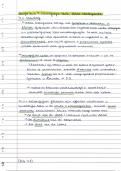
Biol230 Exam 1 QUESTIONS AND VERIFIED SOLUTIONS 2
Biochemistry - ✔✔Study of the chemistry of living things Organic Chem - ✔✔Study of
carbon containing compounds Valence - ✔✔# of electrons the outer shell needs to be
filled Covalent Bond - ✔✔Sharing of electrons between 2 atoms Atomic # - ✔✔Number of
protons Atomic weight - ✔✔# of protons + Neutrons Calorie - ✔✔amount of energy needed
to raise the temp of 1g of a substance 1 degree Celsius Cation - ✔✔lose electron,
positively charged Anion - ✔✔Gains electron, negatively charged Cohesive - ✔✔water
molecules are attracted to each other due to hydrogen bonding Hydrogen bonding in water
makes water have high: - ✔✔1. surface tension 2. Boiling point 3. specific heat 4. heat of
vaporization Van der Waals forces - ✔✔weak attractions between 2 atoms that occur if the
atoms are close to one another Hydrophobic interactions - ✔✔tendency of nonpolar
groups within a macromolecule to associate w each other and minimize their contact w
water Sugars (CHO) turn into - ✔✔Polysaccharides Fatty acids - ✔✔Fats/ lipids/
membranes (CHO) Amino acids - ✔✔Proteins (CHONS) Nucleotides - ✔✔Nucleic acids
(CHONP) Why is water important biochemically? - ✔✔1. Most nutrients are dissolved in
water 2. water helps transport of food and waste into and out of cell 3. water is the medium
for most chem reactions 4. makes up on average 65-75% of cells mass How H bonds make
water special - ✔✔1. Has high boiling point and low freezing point. Water freezes from top
down 2. Polarity makes it an excellent solvent; liquid able to dissolve other substances 3.
Polarity allows it to act as a donor of hydroxide (OH-) and (H+) molecules 4. Strong H bonds
make water a good temp buffer Specific heat - ✔✔amount of heat a substance must
absorb to raise the temp 1 degree celsius Temp stabilizing capacity; - ✔✔heat has to first
break the hydrogen bonds, which means water changes temp slowly. Without this, the
energy released from metabolism would cause overheating and death Diffusion - ✔✔Slow
movement of molecules from an area of high concentration to an area of low
concentration Osmosis - ✔✔Movement of water from an area of high concentration to an
area of low concentration through a membrane Isotonic solution - ✔✔The concentration is
equal or balanced Hypotonic - ✔✔Less water inside the cell than outside, water moves in.
More solute inside cell. Can cause cell to lyse. Hypertonic - ✔✔More water inside cell than
outside. Can cause cell to dessicate or dry up. pH scale - ✔✔1- acidic (OH-<H+) 7- Neutral
(OH-=H+) 14- Basic (OH->H+) Functions of sugars - ✔✔1. Nutrient for energy 2. Nutrient
storage 3. Structural functions in cell walls of plants or other structures and intercellular
matrices 4. Signal transduction function Monosaccharide - ✔✔May have 3+ Carbons
Production of polymers - ✔✔1. Macromolecules are synthesized by stepwise
Biochemistry - ✔✔Study of the chemistry of living things Organic Chem - ✔✔Study of
carbon containing compounds Valence - ✔✔# of electrons the outer shell needs to be
filled Covalent Bond - ✔✔Sharing of electrons between 2 atoms Atomic # - ✔✔Number of
protons Atomic weight - ✔✔# of protons + Neutrons Calorie - ✔✔amount of energy needed
to raise the temp of 1g of a substance 1 degree Celsius Cation - ✔✔lose electron,
positively charged Anion - ✔✔Gains electron, negatively charged Cohesive - ✔✔water
molecules are attracted to each other due to hydrogen bonding Hydrogen bonding in water
makes water have high: - ✔✔1. surface tension 2. Boiling point 3. specific heat 4. heat of
vaporization Van der Waals forces - ✔✔weak attractions between 2 atoms that occur if the
atoms are close to one another Hydrophobic interactions - ✔✔tendency of nonpolar
groups within a macromolecule to associate w each other and minimize their contact w
water Sugars (CHO) turn into - ✔✔Polysaccharides Fatty acids - ✔✔Fats/ lipids/
membranes (CHO) Amino acids - ✔✔Proteins (CHONS) Nucleotides - ✔✔Nucleic acids
(CHONP) Why is water important biochemically? - ✔✔1. Most nutrients are dissolved in
water 2. water helps transport of food and waste into and out of cell 3. water is the medium
for most chem reactions 4. makes up on average 65-75% of cells mass How H bonds make
water special - ✔✔1. Has high boiling point and low freezing point. Water freezes from top
down 2. Polarity makes it an excellent solvent; liquid able to dissolve other substances 3.
Polarity allows it to act as a donor of hydroxide (OH-) and (H+) molecules 4. Strong H bonds
make water a good temp buffer Specific heat - ✔✔amount of heat a substance must
absorb to raise the temp 1 degree celsius Temp stabilizing capacity; - ✔✔heat has to first
break the hydrogen bonds, which means water changes temp slowly. Without this, the
energy released from metabolism would cause overheating and death Diffusion - ✔✔Slow
movement of molecules from an area of high concentration to an area of low
concentration Osmosis - ✔✔Movement of water from an area of high concentration to an
area of low concentration through a membrane Isotonic solution - ✔✔The concentration is
equal or balanced Hypotonic - ✔✔Less water inside the cell than outside, water moves in.
More solute inside cell. Can cause cell to lyse. Hypertonic - ✔✔More water inside cell than
outside. Can cause cell to dessicate or dry up. pH scale - ✔✔1- acidic (OH-<H+) 7- Neutral
(OH-=H+) 14- Basic (OH->H+) Functions of sugars - ✔✔1. Nutrient for energy 2. Nutrient
storage 3. Structural functions in cell walls of plants or other structures and intercellular
matrices 4. Signal transduction function Monosaccharide - ✔✔May have 3+ Carbons
Production of polymers - ✔✔1. Macromolecules are synthesized by stepwise