

Written by students who passed Immediately available after payment Read online or as PDF Wrong document? Swap it for free 4.6 TrustPilot
logo-home
Document preview thumbnail
Preview 2 out of 5 pages
Exam (elaborations)

MDIA 2350 MIDTERM EXAM 2025

Document preview thumbnail
Preview 2 out of 5 pages

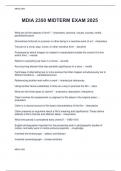
What are all the aspects of form? - -characters, storyline, visuals, sounds, motifs, parallels/structure (Sometimes fictional) is a person or other being in a narrative work of art - -characters The plot of a novel, play, movie, or other narrative form - -storyline Processes by which imagery is created or manipulated outside the context of a live action shot. - -visuals Refers to everything we hear in a movie - -sounds Any recurring element that has symbolic significance in a story. - -motifs Technique of alternating two or more scenes that often happen simultaneously but in different locations. - -parallels/structure Referencing another work within a work - -intertextual references Using familiar faces (celebrities) in films as a way to promote the film - -stars What are the three types of claims? - -evaluative, descriptive, interpretive Claim involves the assessment or judgment of the ideas in the original piece - evaluative Claim is a neutral account of the basic characteristics of the film - -descriptive Claim presents an argument about a film's meaning and significance. These claims address a film's themes and abstract ideas - -interpretive What time period is considered early cinema? - - English photographer important for his pioneering work in photographic studies of motion, and early work in motion-picture projection - -muybridge Invented the kinetoscope - -edison and dickson Invented conematograph - -lumiere brothers MDIA 2350 MDIA 2350 MDIA 2350 A trip to the moon - -melies Films to be viewed by one individual at a time through a peephole viewer window at the top of the device. - -kinetoscope An early motion-picture projector - -cinematograph Everyday life, fantastic, modern technology, staged narratives, visual jokes, exotic locales, human sexuality, exhibition practices, - -objects of early cinema The goal is to "show something" - -cinema of attraction What arose when elements if attraction became storytelling mediums - -narrative tradition Monopolized east coast, upstarts headed west to hollywood. - -edison trust What came out of the independent moving pictures (imp) merge? - -universal studios Why narrative cinema? - -debt to theatre, readily available material Story-world, characters, setting, etc. - -diagetic elements Score music, text, voice over - -non-diagetic elements Images or visual inserts that are not of the story world. - -non-diagetic insert The total story-world - -fabula The parts of the narrative onscreen and their order, not necessarily in order. - -syuzhet 3 act structure: exposition, rising action, turning point, climax, resolutions (denouement) - -narrative structure Clarity and unity, clear resolution, not open ended. - -the rules of hollywood narrative Fundamental unit of film aesthetics- unedited, uncut piece of exposed film. - -the shot Chs creates illusion of unity, seamless editing, so you don't notice the cut- minimized disruption of story. - -continuity editing Positions viewer in the middle of action during dialogue. Over the shoulder pov of conversation. - -shot-reverse-shot See where a character is looking, then see what they are supposedly looking at. - -eye line match MDIA 2350 MDIA 2350 Two actions occurring simultaneously - -parallel editing/cross-cutting Axis of action, as long as camera stays on one side to show characters consistently . If it crosses the axis of action, the image becomes flipped. - -180* rule Cut without in depth transition - -traditional/direct cut One image bleeds into the next - -dissolve One image pushed out of the frame by the next image - -wipe Fades to black and then into next picture - -fade in/out More subtle, a shape/graphic/image is transformed into a similar scene. - -graphic match Someone does an action, there is a cut that shows some action still being done from a different perspective - -match on action The staging of the scene, artful arrangement of the actors scenery, lighting and props. - -mise en scene Narrative function, cultural relevance, generic expectations (specific places for westerns, musicals, etc) - -setting Casting, acting style, costuming, figure arrangement - -actors Hard/soft, 3 point set up, (key, fill, back) - -lighting Light/dark, warm/cool, saturated/desaturated - -color/hues Lines, balance, symmetry, framing loose/tight - -composition What time was the early silent film era? Before film exhibitions - -'s Time for consolidation of film industry, very competitive environment- movies being cranked out like cars and burgers - -1920's- end of silent film era First sound films that have music and sound effects but no dialogue. - -talkies Similar to volume, indicates spatial relations within film - -loudness High/low, so we can differentiate sounds like voices. - -pitch Tonal quality of sound, psychological effects - -timbre MDIA 2350 MDIA 2350 Much of sound we can hear is not produced by objects we see on screen. How much we believe that it is coming from object seems consistent, illusion of coherence. - fidelity/ verisimilitude External to the world of the story, only heard by audience, soundtrack music, mood sounds - -non-diagetic sounds Exist in the narrative world, heard by the characters, dialogue, street sounds, radio music. - -diagetic sounds Voice in somebody's head - -internal diagetic What does sound do in film? - -conveys time, creates space, directs gaze, adds emotional intensity. 1890's-1910's - -early cinema - -classic hollywood 1950's - -transitional era 1960-70's - -new hollywood film Not just artistic or entertaining but to make money, efficiencies of film making, formulaic and followed the rules, must fulfill expectations of genres, satisfy codes and audiences. - -commercial orientation Followed the rules, some directors pushing aesthetic boundaries but only so much - minimal experimentation Closure, limitations on sexuality within film, imposed morality, limited depiction of social problems - -limitations of Chs rules Censorship of social problems and sex - -hayes code Art cinema according to bordwell - -a distinct mode of film practice Has a definite historical existence, set of formal conventions, not just a word for non commercial/non-hollywood film. - -art cinema When did art cinema first begin? - -post wwii europe Art cinema was a reaction to what? - -hollywood's dominance in europe. MDIA 2350 Breaking rules, unconventional, exploratory of cinema as medium, playful/reflexive about film making, interested in film authorship. - -french new wave "breathless" - -art cinema, by goddard, 1960 When was the french new wave? - -mid 1950's-1960's The creative treatment of actuality - -documentary 1. Cause and effect 2. Story elements based on real world events 3. Satisfying story and complex reality - -narrative documentaries Voice over narration and images - -voice of authority Verbal testimony and images, rely fully on interviews (ex. Tower) - -talking heads Verbal testimony and images, director provides testimony. - -director-participant Purely operational without director's perspective being evident - -direct cinema and cinema vérité Process of film-making as part of the subject matter, exposes the way the medium constructs reality. - -self-reflexive What rhetorical strategy does "grizzly man" use - -self-reflexive Films that pose as documentaries, adopt documentary strategies. - -mockumentary Purpose of documentaries - -inform, encourage, change, question The poetics and politics of the avant-garde - -experimental film Limited understanding of time, conventional use of filmic space, manufactured realism, over reliance in narrative/story, conventional objects/people - -politics of chs- bound by the rules Helps to step outside the chs/classical narration to see alternatives. CHs--art cinema- _________? - -experimental film Un chein andelou (an andalusian dog) by roger ebert

Content preview

MDIA 2350


MDIA 2350 MIDTERM EXAM 2025

What are all the aspects of form? - -characters, storyline, visuals, sounds, motifs,
parallels/structure

(Sometimes fictional) is a person or other being in a narrative work of art - -characters

The plot of a novel, play, movie, or other narrative form - -storyline

Processes by which imagery is created or manipulated outside the context of a live
action shot. - -visuals

Refers to everything we hear in a movie - -sounds

Any recurring element that has symbolic significance in a story. - -motifs

Technique of alternating two or more scenes that often happen simultaneously but in
different locations. - -parallels/structure

Referencing another work within a work - -intertextual references

Using familiar faces (celebrities) in films as a way to promote the film - -stars

What are the three types of claims? - -evaluative, descriptive, interpretive

Claim involves the assessment or judgment of the ideas in the original piece - -
evaluative

Claim is a neutral account of the basic characteristics of the film - -descriptive

Claim presents an argument about a film's meaning and significance. These claims
address a film's themes and abstract ideas - -interpretive

What time period is considered early cinema? - -1890-1915

English photographer important for his pioneering work in photographic studies of
motion, and early work in motion-picture projection - -muybridge

Invented the kinetoscope - -edison and dickson

Invented conematograph - -lumiere brothers


MDIA 2350

, MDIA 2350


A trip to the moon - -melies

Films to be viewed by one individual at a time through a peephole viewer window at the
top of the device. - -kinetoscope

An early motion-picture projector - -cinematograph

Everyday life, fantastic, modern technology, staged narratives, visual jokes, exotic
locales, human sexuality, exhibition practices, - -objects of early cinema

The goal is to "show something" - -cinema of attraction

What arose when elements if attraction became storytelling mediums - -narrative
tradition

Monopolized east coast, upstarts headed west to hollywood. - -edison trust

What came out of the independent moving pictures (imp) merge? - -universal studios

Why narrative cinema? - -debt to theatre, readily available material

Story-world, characters, setting, etc. - -diagetic elements

Score music, text, voice over - -non-diagetic elements

Images or visual inserts that are not of the story world. - -non-diagetic insert

The total story-world - -fabula

The parts of the narrative onscreen and their order, not necessarily in order. - -syuzhet

3 act structure: exposition, rising action, turning point, climax, resolutions (denouement)
- -narrative structure

Clarity and unity, clear resolution, not open ended. - -the rules of hollywood narrative

Fundamental unit of film aesthetics- unedited, uncut piece of exposed film. - -the shot

Chs creates illusion of unity, seamless editing, so you don't notice the cut- minimized
disruption of story. - -continuity editing

Positions viewer in the middle of action during dialogue. Over the shoulder pov of
conversation. - -shot-reverse-shot

See where a character is looking, then see what they are supposedly looking at. - -eye-
line match

MDIA 2350

Document information

Uploaded on
August 20, 2025
Number of pages
5
Written in
2025/2026
Type
Exam (elaborations)
Contains
Questions & answers
$11.49

Wrong document? Swap it for free Within 14 days of purchase and before downloading, you can choose a different document. You can simply spend the amount again.
Written by students who passed
Immediately available after payment
Read online or as PDF

Seller avatar
Reputation scores are based on the amount of documents a seller has sold for a fee and the reviews they have received for those documents. There are three levels: Bronze, Silver and Gold. The better the reputation, the more your can rely on the quality of the sellers work.
AlexScorer
2.5
(2)
Sold
11
Followers
0
Items
1800
Last sold
2 weeks ago


Why students choose Stuvia

Created by fellow students, verified by reviews

Quality you can trust: written by students who passed their tests and reviewed by others who've used these notes.

Didn't get what you expected? Choose another document

No worries! You can instantly pick a different document that better fits what you're looking for.

Pay as you like, start learning right away

No subscription, no commitments. Pay the way you're used to via credit card and download your PDF document instantly.

Student with book image

“Bought, downloaded, and aced it. It really can be that simple.”

Alisha Student

Working on your references?

Create accurate citations in APA, MLA and Harvard with our free citation generator.

Working on your references?

Frequently asked questions

