Sheila’s change
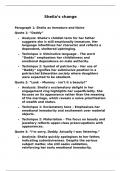
Paragraph 1: Sheila as Immature and Naïve
Quote 1: “Daddy”
Analysis: Sheila’s childish term for her father
suggests she is still emotionally immature. Her
language infantilises her character and reflects a
dependent, sheltered upbringing.
Technique 1: Diminutive language – The word
“Daddy” emphasises her childishness and
emotional dependence on male authority.
Technique 2: Symbol of patriarchy – Her use of
“Daddy” signifies her submissive position in a
patriarchal Edwardian society where daughters
were expected to be obedient.
Quote 2: “Look – Mummy – isn’t it a beauty?”
Analysis: Sheila’s exclamatory delight in her
engagement ring highlights her superficiality. She
focuses on its appearance rather than the meaning
of the marriage, which reveals a naïve prioritisation
of wealth and status.
Technique 1: Exclamatory tone – Emphasises her
emotional immaturity and excitement over material
objects.
Technique 2: Materialism – The focus on beauty and
jewellery reflects upper-class preoccupations with
appearances.
Quote 3: “I’m sorry, Daddy. Actually I was listening.”
Analysis: Sheila quickly apologises to her father,
indicating submissiveness. Despite the serious
subject matter, she still seeks validation,
reinforcing her early emotional immaturity.
, Technique 1: Contrite tone – Shows deference and a
desire for approval.
Technique 2: Irony – She claims to have been
listening, yet her actions suggest she was initially
oblivious to the social issues discussed.
Paragraph 2: First Signs of Guilt and Responsibility
Quote 1: “It was my own fault.”
Analysis: Sheila’s straightforward acceptance of
blame marks a turning point in her development.
She shows honesty and accountability, contrasting
with the evasiveness of the older generation.
Technique 1: First-person narrative – “My”
highlights her personal responsibility.
Technique 2: Direct statement – Lacks excuse or
deflection, reinforcing her maturity.
Quote 2: “I’ll never, never do it again to anybody.”
Analysis: The repetition of “never” shows genuine
remorse and a firm moral commitment. It signals a
desire to grow and change, aligning with Priestley’s
view of the younger generation as morally
redeemable.
Technique 1: Repetition – Emphasises the strength
of her regret.
Technique 2: Emotive language – “Never do it
again” reveals a sincere emotional response and
capacity for learning.
Quote 3: “You and I aren’t the same people who sat
down to dinner here.”
Analysis: Sheila asserts that her worldview has
changed. She no longer aligns herself with the
values of her family, highlighting ideological
transformation.
Paragraph 1: Sheila as Immature and Naïve
Quote 1: “Daddy”
Analysis: Sheila’s childish term for her father
suggests she is still emotionally immature. Her
language infantilises her character and reflects a
dependent, sheltered upbringing.
Technique 1: Diminutive language – The word
“Daddy” emphasises her childishness and
emotional dependence on male authority.
Technique 2: Symbol of patriarchy – Her use of
“Daddy” signifies her submissive position in a
patriarchal Edwardian society where daughters
were expected to be obedient.
Quote 2: “Look – Mummy – isn’t it a beauty?”
Analysis: Sheila’s exclamatory delight in her
engagement ring highlights her superficiality. She
focuses on its appearance rather than the meaning
of the marriage, which reveals a naïve prioritisation
of wealth and status.
Technique 1: Exclamatory tone – Emphasises her
emotional immaturity and excitement over material
objects.
Technique 2: Materialism – The focus on beauty and
jewellery reflects upper-class preoccupations with
appearances.
Quote 3: “I’m sorry, Daddy. Actually I was listening.”
Analysis: Sheila quickly apologises to her father,
indicating submissiveness. Despite the serious
subject matter, she still seeks validation,
reinforcing her early emotional immaturity.
, Technique 1: Contrite tone – Shows deference and a
desire for approval.
Technique 2: Irony – She claims to have been
listening, yet her actions suggest she was initially
oblivious to the social issues discussed.
Paragraph 2: First Signs of Guilt and Responsibility
Quote 1: “It was my own fault.”
Analysis: Sheila’s straightforward acceptance of
blame marks a turning point in her development.
She shows honesty and accountability, contrasting
with the evasiveness of the older generation.
Technique 1: First-person narrative – “My”
highlights her personal responsibility.
Technique 2: Direct statement – Lacks excuse or
deflection, reinforcing her maturity.
Quote 2: “I’ll never, never do it again to anybody.”
Analysis: The repetition of “never” shows genuine
remorse and a firm moral commitment. It signals a
desire to grow and change, aligning with Priestley’s
view of the younger generation as morally
redeemable.
Technique 1: Repetition – Emphasises the strength
of her regret.
Technique 2: Emotive language – “Never do it
again” reveals a sincere emotional response and
capacity for learning.
Quote 3: “You and I aren’t the same people who sat
down to dinner here.”
Analysis: Sheila asserts that her worldview has
changed. She no longer aligns herself with the
values of her family, highlighting ideological
transformation.