
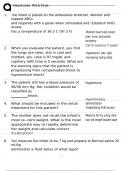
Heartcode PALS Final.
1. The infant is placed on the ambulance stretcher -Monitor and
support ABCs
and responds with a groan when stimulated and -Establish IV/IO
access
has a temperature of 36.3 C (97.3 F) -Monitor heart rate, blood
pres- sure, and pulse
oximetry
-Call for assistance if needed
2. When you evaluate the patient, you find
the lungs are clear, skin is cool and -Hypotension (late sign)
mottled, glu- cose is 97 mg/dL and -Increasing tachycardia
capillary refill time is 5 seconds. What are
the warning signs that the patient is
progressing from compensated shock to
hypotensive shock?
3. The patient still has a blood pressure of Hypotensive
58/38 mm Hg. Her condition would be
classified as
shock.
-Rapid fluid bolus
4. What should be included in the initial administration
treatment for this patient? -Establishing IV/IO access
5. The mother does not recall the infant's Measure her by using color-
most re- cent weight. What is the most cod- ed length-based tape
appropriate way to rapidly determine
her weight and calculate correct
medication?
6. You measure the infant to be 7 kg and prepare to Normal saline 20
mL/kg
administer a fluid bolus of what type?
1/
31
, Heartcode PALS Final.
7. What is the most appropriate method of deliver- A syringe and 3-way
stopcock
ing rapid fluid boluses to this patient?
8. After the first fluid bolus is administered, the Deliver a second fluid
bolus of 20
child is reassessed and her vital signs are HR 167, mL/kg and reassess
2/
31
, Heartcode PALS Final.
BP 58/44 mm Hg, RR 56/min and SpO2
92%. Her skin is still cool and pale and she
is still lethargic and weak.
What should be the next intervention?
9. When should vasoactive therapy be If the child remains
considered be considered in managing hypotensive and poorly
distributive shock? perfused despite rapid bolus
fluid administration
10. How does the clinical presentation of distributive Distributive shock has
more vari-
shock compare with hypovolemic shock? able presentation than that of hy-
povolemic shock
11. For general shock management, For general shock management,
administer an
isotonic crytalloid bolus of mL/kg over to administer
an isotonic crytalloid
minutes typically occur
in anaphylactic
shock?
12. What signs distinguish anaphylactic shock
from other types of shock? 15. What should
you evaluate
to recognize
septic shock?
13. in a child with anaphylactic shock, what is
the most appropriate initial
treatment?
14. How soon after exposure do symptoms
3/
31
, Heartcode PALS Final.
bolus of 20 mL/kg over 5 to 20 minutes
-Angioedema (swelling of the face, lips and tongue)
-Urticaria (hives)
-Respiratory distress with stridor, wheezing or both
IM epinephrine
Seconds to minutes
-Temp
-Heart rate
-Systemic perfusion
4/
31


