

Anatomy and Physiology
Health and Social Care Level 3
P2)
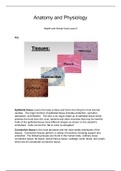
Epithelial tissue covers the body surface and forms the lining for most internal
cavities. The major function of epithelial tissue includes protection, secretion,
absorption, and filtration. The skin is an organ made up of epithelial tissue which
protects the body from dirt, dust, bacteria and other microbes that may be harmful.
Cells of the epithelial tissue have different shapes as shown on the student's
worksheet. Cells can be thin, flat to cubic to elongated.
Connective tissue is the most abundant and the most widely distributed of the
tissues. Connective tissues perform a variety of functions including support and
protection. The following tissues are found in the human body, ordinary loose
connective tissue, fat tissue, dense fibrous tissue, cartilage, bone, blood, and lymph,
which are all considered connective tissue.
Health and Social Care Level 3
P2)
Epithelial tissue covers the body surface and forms the lining for most internal
cavities. The major function of epithelial tissue includes protection, secretion,
absorption, and filtration. The skin is an organ made up of epithelial tissue which
protects the body from dirt, dust, bacteria and other microbes that may be harmful.
Cells of the epithelial tissue have different shapes as shown on the student's
worksheet. Cells can be thin, flat to cubic to elongated.
Connective tissue is the most abundant and the most widely distributed of the
tissues. Connective tissues perform a variety of functions including support and
protection. The following tissues are found in the human body, ordinary loose
connective tissue, fat tissue, dense fibrous tissue, cartilage, bone, blood, and lymph,
which are all considered connective tissue.



