100% satisfaction guarantee Immediately available after payment Both online and in PDF No strings attached 4.2 TrustPilot
logo-home
Exam (elaborations)

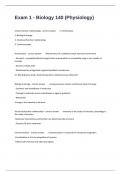
Exam 1 - Biology 140 (Physiology) Certification Review Exam Questions And Answers Pass Guaranteed.

Rating
-
Sold
-
Pages
8
Grade
A+
Uploaded on
14-08-2025
Written in
2025/2026

4 basic themes of physiology - correct answer 1. Homeostasis 2. Biological energy 3. Structure/function relationships 4. Communication Homeostasis - correct answer -Maintenance of a stable/constant internal environment - Set point = acceptable/desired target value around which an acceptable range is set, usually an average - Dynamic steady state - Maintained by antagonistic negative feedback mechanisms Ex. Blood glucose levels, body temperature, blood pressure, blood pH Biological energy - correct answer -Living processes require continuous input of energy -Synthesis and breakdown of molecules -Transport molecules across membranes or against gradients -Movement -Energy is the capacity to do work Structure/function relationships - correct answer -Anatomy is the study of structure, physiology is the study of function -Molecular interactions and function are determined by structure -Enzymes fit their substrates Communication - correct answer -Communication is required for functional integration -Coordination is vital to integration of systems -Utilize both chemical and electrical signals -Allows information to flow especially across cell membranes 3 Types of work - correct answer 1. Chemical(making/breaking of bonds) 2. Transport(across membranes, within cells, in/out of body) 3. Mechanical(movement; cellular and organismal levels) 2 Types of energy - correct answer 1. Potential(energy of position, stored energy) ex = chemical bonds, concentration gradients 2. Kinetic(energy of movement) ex = organelle transport, muscle contraction, movement down gradient Circulatory system - correct answer -Transport materials between cells in the body -Critical for pH balance Digestive (gastrointestinal) system - correct answer -Process food for energy, nutrient uptake, waste elimination Endocrine system - correct answer -Coordinate body function through the synthesis and release of regulatory molecules Immune system - correct answer -Defense against foreign invaders Integumentary system - correct answer -Protection from external environment Lymphatic system - correct answer -Maintenance of blood volume, immunity, fat absorption Musculoskeletal system - correct answer -Support and movement Nervous system - correct answer -Coordination of function through electrical signals and regulatory molecules Reproductive system - correct answer -Perpetuation of the species Respiratory system - correct answer -Exchange of oxygen and carbon dioxide between internal and external environments -Critical for pH balance Urinary (renal) system - correct answer -Maintenance of internal water levels, waste removal -Critical for pH balance Covalent bonds - correct answer -Strong -Electrons shared between molecules -Most stable electron configuration -Polar, unequal electron sharing -Non-polar, equal electron sharing Ionic bonds - correct answer -Strength depends on environment -Electrons donated/accepted -Form ions -Ions of opposite charge attracted to each other Hydrogen bonds - correct answer -Weak attractive forces between H and nearby electronegative atoms Van der Waals - correct answer -Weak, nonspecific interactions between a nucleus and electrons of a nearby atom -Creates regions of slightly positive and slightly negative charge 4 Types of biomolecules - correct answer 1. Carbohydrates 2. Lipids 3. Proteins 4. Nucleic Acids Carbohydrates - correct answer -4 Cal/g -CH2O (chemical formula) -Polar -Energy source/storage, structure, signaling (functions) -Monosaccharide (fundamental unit) Lipid - correct answer -9 Cal/g -CHO (chemical formula) -Nonpolar -Energy source/storage, cell membrane, signaling (functions) -Fatty acid (fundamental unit) Protein - correct answer -4 Cal/g -CHON (chemical formula) -Mostly polar -Structure, catalysis, membrane transport, carriers (functions) -Amino Acid (fundamental unit) Nucleic Acid - correct answer - 0 Cal/g -CHONP (chemical formula) -Polar -Information storage and energy carrier (functions) -Nucleotide (fundamental unit) 3 Principal Parts of a cell - correct answer 1. Cytosol 2. Cell membrane 3. Organelles Cytosol - correct answer -Liquid portion of the cell -Known as the intracellular fluid (ICF) -fluid around the organelles where chemical reactions take place -not the same as cytoplasm (which is all cellular contents that includes cytosol and organelles) Cell membrane (plasma membrane) - correct answer -Made up of a mixture of lipids and proteins -Physical isolation -separates the internal portions of the cell from external cellular environment cell thereby providing an element of protection -Regulation of exchange with environment; semi-permeable barrier, regulate what comes in/goes out -Support structure -Separation of charge Phospholipids - correct answer -Similar to triglycerides as they have a glycerol molecule with two fatty acids and one phosphate-containing group attached -Amphipathic in nature, they have both hydrophilic (polar, phosphate-containing head) and hydrophobic (nonpolar, fatty acid tails) ends. Cholesterol - correct answer -Steroid precursor that helps to regulate membrane fluidity and permeability Integral proteins - correct answer -Span through both phospholipid layers and pass through the polar portions as well. -They are generally amphipathic in nature as they span the entire membrane - They often form channels or transport proteins to help polar molecules pass through the membrane because they cannot pass through on their own -Structural support Lipid-anchored proteins - correct answer -Covalently bound to lipid that inserts into membrane Peripheral proteins - correct answer -Found on either side of the membrane, but they do not pass through it -Thus, they are associated with one side of the membrane or the other -They often serve as cytoskeleton elements or embedded enzymes -They are not amphipathic since they just interact with polar components of the membrane -Functions -Structural -Enzymes -Communication -Signaling -Receptors -Transporters Organelles - correct answer -Specific, specialized parts of the cell ("tiny organs") -Allow compartmentalization and division of labor -Keep reactions apart so they are separated in time and space -Divided into nonmembraneous and membraneous organelles Nonmembraneous Organelles - correct answer -Do not have a phospholipid bilayer; in direct contact with the cytosol -RNA containing nonmembranous organelles -Ribosomes -Can be found free in cytoplasm or attached to endoplasmic reticulum (RER). -Important in protein synthesis -Vaults -Discovered recently -Their function is unknown, but they have been associated with the nuclear membrane and thought to possibly control transport -Protein Type Nonmembranous Organelles -Proteasomes -Large protein machine that degrades other proteins -Exhibits specificity, will only degrade proteins that are specifically sent to it Cytoskeleton - correct answer -Protein structure that makes up the cell "scaffolding" -Composed of three types of protein filaments -Microfilaments -Intermediate filaments -Microtubules -Several functions A. Cell shape -Mechanical support B. Internal or

Show more Read less
Institution
BIO 20 PHYSIOLOGY
Course
BIO 20 PHYSIOLOGY


Whoops! We can’t load your doc right now. Try again or contact support.

Written for

Institution
BIO 20 PHYSIOLOGY
Course
BIO 20 PHYSIOLOGY

Document information

Uploaded on
August 14, 2025
Number of pages
8
Written in
2025/2026
Type
Exam (elaborations)
Contains
Questions & answers

Subjects

Content preview

Exam 1 - Biology 140 (Physiology)

4 basic themes of physiology - correct answer 1. Homeostasis

2. Biological energy

3. Structure/function relationships

4. Communication


Homeostasis - correct answer -Maintenance of a stable/constant internal environment

- Set point = acceptable/desired target value around which an acceptable range is set, usually an
average

- Dynamic steady state

- Maintained by antagonistic negative feedback mechanisms

Ex. Blood glucose levels, body temperature, blood pressure, blood pH


Biological energy - correct answer -Living processes require continuous input of energy

-Synthesis and breakdown of molecules

-Transport molecules across membranes or against gradients

-Movement

-Energy is the capacity to do work


Structure/function relationships - correct answer -Anatomy is the study of structure, physiology is
the study of function

-Molecular interactions and function are determined by structure

-Enzymes fit their substrates


Communication - correct answer -Communication is required for functional integration

-Coordination is vital to integration of systems

-Utilize both chemical and electrical signals

, -Allows information to flow especially across cell membranes


3 Types of work - correct answer 1. Chemical(making/breaking of bonds)

2. Transport(across membranes, within cells, in/out of body)

3. Mechanical(movement; cellular and organismal levels)


2 Types of energy - correct answer 1. Potential(energy of position, stored energy) ex = chemical
bonds, concentration gradients

2. Kinetic(energy of movement) ex = organelle transport, muscle contraction, movement down gradient


Circulatory system - correct answer -Transport materials between cells in the body

-Critical for pH balance


Digestive (gastrointestinal) system - correct answer -Process food for energy, nutrient uptake, waste
elimination


Endocrine system - correct answer -Coordinate body function through the synthesis and release of
regulatory molecules


Immune system - correct answer -Defense against foreign invaders


Integumentary system - correct answer -Protection from external environment


Lymphatic system - correct answer -Maintenance of blood volume, immunity, fat absorption


Musculoskeletal system - correct answer -Support and movement


Nervous system - correct answer -Coordination of function through electrical signals and regulatory
molecules

Get to know the seller

Seller avatar
Reputation scores are based on the amount of documents a seller has sold for a fee and the reviews they have received for those documents. There are three levels: Bronze, Silver and Gold. The better the reputation, the more your can rely on the quality of the sellers work.
Rechga Nursing
View profile
Follow You need to be logged in order to follow users or courses
Sold
14
Member since
1 year
Number of followers
2
Documents
2232
Last sold
1 month ago

5.0

10 reviews

5
10
4
0
3
0
2
0
1
0

Recently viewed by you

Why students choose Stuvia

Created by fellow students, verified by reviews

Quality you can trust: written by students who passed their tests and reviewed by others who've used these notes.

Didn't get what you expected? Choose another document

No worries! You can instantly pick a different document that better fits what you're looking for.

Pay as you like, start learning right away

No subscription, no commitments. Pay the way you're used to via credit card and download your PDF document instantly.

Student with book image

“Bought, downloaded, and aced it. It really can be that simple.”

Alisha Student

Frequently asked questions