Professional Responsibilities - MPRE Practice
Review Test Questions.
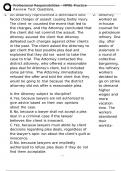
1. An Attorney represented a defendant who 2. Attorney
faced charges of assault causing bodily injury. worked as
The client re- counted the event that led to in-house
the charges, and the Attorney concluded that counsel for
the client did not commit the assault. The a petroleum
Attorney assured the client that Attorney refinery. One
defeated such charges against other clients day, after
in the past. The client asked the Attorney to weeks of
get client the best possible plea deal and stalemate in
explained that they did not want to take the a round of
case to trial. The Attorney contacted the collective
district attorney, who offered a reasonable bargaining,
plea deal for Attorney's client, but it included the refinery
some jail time. The Attorney immediately workers
refused the offer and told the client that they decided to
would be going to trial because the district go on strike
attorney did not offer a reasonable plea. to demand
higher
Is the Attorney subject to discipline? wages and
A. Yes, because lawyers are not authorized to more
give advice based on their own opinions vacation
about the case. time. The
B. No, because a lawyer shall not accept a plea workers
deal in a criminal case if the lawyer abandoned
believes the client is innocent. their
C. Yes, because lawyers must abide by client worksta-
decisions regarding plea deals, regardless of
the lawyer's opin- ion about the client's guilt or
innocence.
D. No, because lawyers are impliedly
authorized to refuse plea deals if they do not
find them acceptable.
, Professional Responsibilities - MPRE Practice
Review Test Questions.
C. Yes, because lawyers must abide by client de- cisions regarding
plea deals, regardless of the lawyer's opinion about the client's guilt or
innocence.
B. No, because in an emer- gency a lawyer may give advice or
assistance in a matter in which the lawyer does not have the skill or-
, Professional Responsibilities - MPRE Practice
Review Test Questions.
tions and picketed on the sidewalk in front of advice was
the refinery. Late in the evening, some of the incorrect
picketers moved their protests onto the given the
refinery compound, in- cluding some hazardous special
areas. The usual safety per- sonnel were also circumstanc
on strike, so there was a substan- tial risk of an e
explosion at the refinery if the protes- tors surrounding
engaged in vandalism. There was also a risk of the collative
injuries to the protestors. At midnight, the bargaining.
refinery's manager called Attorney to obtain The refinery
guidance on hiring a private security force and was subject
having all the picketers arrested and removed to
from the compound. Although Attorney initially substantial
suggested that they simply remove the liability both
protestors from the hazardous areas, the to the
manager believed that the protesters on the injured indi-
sidewalk would simply migrate over to the viduals and
same areas to fill the gaps from those removed possible
and then pose an ongoing safety risk. Attorney fines
knew nothing about protester rights or the imposed by
rights of striking workers. Attorney tried to call the federal
one or two lawyers Attorney knew who might labor board.
know the an- swer but nobody answered the
call given the late hour. Without a basis for
forming an opinion related to labor laws and
dealing with strikers, Attorney advised the
manager that it would be fine for the private
security personnel to remove the picketers by
force. Unfortu- nately during the ensuing
scuffle with the private se- curity personnel,
several workers and security officers were
seriously injured. It turned out that Attorney's
, Professional Responsibilities - MPRE Practice
Review Test Questions.
dinarily required, were re- ferral to or consultation or association with
another lawyer would be impracti- cal.
Review Test Questions.
1. An Attorney represented a defendant who 2. Attorney
faced charges of assault causing bodily injury. worked as
The client re- counted the event that led to in-house
the charges, and the Attorney concluded that counsel for
the client did not commit the assault. The a petroleum
Attorney assured the client that Attorney refinery. One
defeated such charges against other clients day, after
in the past. The client asked the Attorney to weeks of
get client the best possible plea deal and stalemate in
explained that they did not want to take the a round of
case to trial. The Attorney contacted the collective
district attorney, who offered a reasonable bargaining,
plea deal for Attorney's client, but it included the refinery
some jail time. The Attorney immediately workers
refused the offer and told the client that they decided to
would be going to trial because the district go on strike
attorney did not offer a reasonable plea. to demand
higher
Is the Attorney subject to discipline? wages and
A. Yes, because lawyers are not authorized to more
give advice based on their own opinions vacation
about the case. time. The
B. No, because a lawyer shall not accept a plea workers
deal in a criminal case if the lawyer abandoned
believes the client is innocent. their
C. Yes, because lawyers must abide by client worksta-
decisions regarding plea deals, regardless of
the lawyer's opin- ion about the client's guilt or
innocence.
D. No, because lawyers are impliedly
authorized to refuse plea deals if they do not
find them acceptable.
, Professional Responsibilities - MPRE Practice
Review Test Questions.
C. Yes, because lawyers must abide by client de- cisions regarding
plea deals, regardless of the lawyer's opinion about the client's guilt or
innocence.
B. No, because in an emer- gency a lawyer may give advice or
assistance in a matter in which the lawyer does not have the skill or-
, Professional Responsibilities - MPRE Practice
Review Test Questions.
tions and picketed on the sidewalk in front of advice was
the refinery. Late in the evening, some of the incorrect
picketers moved their protests onto the given the
refinery compound, in- cluding some hazardous special
areas. The usual safety per- sonnel were also circumstanc
on strike, so there was a substan- tial risk of an e
explosion at the refinery if the protes- tors surrounding
engaged in vandalism. There was also a risk of the collative
injuries to the protestors. At midnight, the bargaining.
refinery's manager called Attorney to obtain The refinery
guidance on hiring a private security force and was subject
having all the picketers arrested and removed to
from the compound. Although Attorney initially substantial
suggested that they simply remove the liability both
protestors from the hazardous areas, the to the
manager believed that the protesters on the injured indi-
sidewalk would simply migrate over to the viduals and
same areas to fill the gaps from those removed possible
and then pose an ongoing safety risk. Attorney fines
knew nothing about protester rights or the imposed by
rights of striking workers. Attorney tried to call the federal
one or two lawyers Attorney knew who might labor board.
know the an- swer but nobody answered the
call given the late hour. Without a basis for
forming an opinion related to labor laws and
dealing with strikers, Attorney advised the
manager that it would be fine for the private
security personnel to remove the picketers by
force. Unfortu- nately during the ensuing
scuffle with the private se- curity personnel,
several workers and security officers were
seriously injured. It turned out that Attorney's
, Professional Responsibilities - MPRE Practice
Review Test Questions.
dinarily required, were re- ferral to or consultation or association with
another lawyer would be impracti- cal.