ServSafe Manager Exam With Verified Answers.
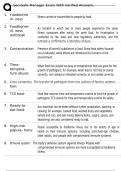
1. Foodborne
Illness carried or transmitted to people by food.
ill- ness
2. Foodborne-
An incident in which two or more people experience the same
ill- ness
illness symptoms after eating the same food. An investigation is
outbreak
conducted by the state and local regulatory authorities, and the
outbreak is confirmed by a laboratory analysis.
3. Contamination Presence of harmful substances in food. Some food safety hazards
occur naturally, while others are introduced by humans or the
environment.
4. Time- When food has stayed too long at temperatures that are good for the
tempera- growth of pathogens; for example, when food is not held or stored
ture abuse: correctly, not cooked or reheated correctly, or not cooled correctly.
5. Cross-contamina- The transfer of pathogens from one surface of food to another.
tion:
6. TCS food: Food that requires time and temperature control to limit the growth of
pathogens. TCS stands for time and temperature control for safety.
7. Ready-to- Any food that can be eaten without further preparation, washing, or
eat food: cooking; for example, cooked food, washed fruits and vegetables
(whole and cut), and deli meats. Bakery items, sugars, spices, and
seasonings are also considered ready to eat.
8. High-risk People susceptible to foodborne illness due to the ettects of age or
popula- tions: health on their immune systems, including preschool-age children,
older adults, and people with compromised immune systems.
9. Immune system: The body's defense system against illness. People with
compromised immune systems are more susceptible to foodborne
illness.
1/
7
, ServSafe Manager Exam With Verified Answers.
10. What are the po- Loss of guests and sales, Loss of reputation, Negative media
exposure, Lawsuits
tential costs asso- and legal fees, Increased insurance premiums, Lowered statt morale,
Statt absen-
2/
7
1. Foodborne
Illness carried or transmitted to people by food.
ill- ness
2. Foodborne-
An incident in which two or more people experience the same
ill- ness
illness symptoms after eating the same food. An investigation is
outbreak
conducted by the state and local regulatory authorities, and the
outbreak is confirmed by a laboratory analysis.
3. Contamination Presence of harmful substances in food. Some food safety hazards
occur naturally, while others are introduced by humans or the
environment.
4. Time- When food has stayed too long at temperatures that are good for the
tempera- growth of pathogens; for example, when food is not held or stored
ture abuse: correctly, not cooked or reheated correctly, or not cooled correctly.
5. Cross-contamina- The transfer of pathogens from one surface of food to another.
tion:
6. TCS food: Food that requires time and temperature control to limit the growth of
pathogens. TCS stands for time and temperature control for safety.
7. Ready-to- Any food that can be eaten without further preparation, washing, or
eat food: cooking; for example, cooked food, washed fruits and vegetables
(whole and cut), and deli meats. Bakery items, sugars, spices, and
seasonings are also considered ready to eat.
8. High-risk People susceptible to foodborne illness due to the ettects of age or
popula- tions: health on their immune systems, including preschool-age children,
older adults, and people with compromised immune systems.
9. Immune system: The body's defense system against illness. People with
compromised immune systems are more susceptible to foodborne
illness.
1/
7
, ServSafe Manager Exam With Verified Answers.
10. What are the po- Loss of guests and sales, Loss of reputation, Negative media
exposure, Lawsuits
tential costs asso- and legal fees, Increased insurance premiums, Lowered statt morale,
Statt absen-
2/
7