ServSafe Exam Review Practice Q & A.
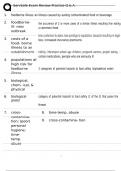
1. foodborne illness an illness caused by eating contaminated food or beverage
2. foodborne- the occurence of 2 or more cases of a similar illness resulting fron eating
ill- ness a common food
outbreak
lose customers & sales, lose prestige & reputation, lawsuits resulting in legal
3. costs of a fees, increased incurance premiums
food- borne
illness to an
establishment elderly, infants/pre-school age children, pregnant women, people taking
certain medications, perople who are seriously ill
4. populations at
high risk for
foodborne 3 categories of potential hazards to food saftey (alphabetical order)
illness
5. biological,
chem- ical, &
physical
6. biological category of potential hazards to food safety (1 of the 3) that poses the
greatest
threat
7. cross- 8. time-temp. abuse
contamina-
tion; (poor) 9. cross-contamina- tion
personal
hygiene;
time-
temp.
abuse
1/
20
, ServSafe Exam Review Practice Q & A.
3 common factors that are
responsible for foodborne illness any time food has been allowed to remian too long @ temps favorable to
(cpt) the growth of foodborne microorganisms
occurs when microorganisms are transferred from one surface or food to
another
10. flow of food path food takes from purchasing to receiving all the way to serving
2/
20
, ServSafe Exam Review Practice Q & A.
11. FDA Food code service based reference for retail food establishments or how to prevent
food-
borne illness
12. contamination prescence of harmful substances in food
13. pathogen illness-causing microorganism
14. bacteria single-celled living microorganisms that can spoil food & cause fooborne
illnesses
15. virus the smallest of the microbial food contaminants
16. parasite microorganism that needs to live in a host organism to survive
17. fungi range in size, from microscopic, single-celled organisms to very large,
multicellu- lar organisms
18. pH measure of a food's acidity or alkality
19. mold types of fungus that cause food spoilage
20. Food (Source) F in FAT TOM
21. Acidity A in FAT TOM
(Level/
(Slightly
acidic)
22. FAT TOM conditions favorable for bacteria to grow & reproduce
23. (Room) first T in FAT TOM
Tempera- ture
24. (Adequate) Timesecond T in FAT TOM
25. Oxygen O in FAT TOM
3/
20
1. foodborne illness an illness caused by eating contaminated food or beverage
2. foodborne- the occurence of 2 or more cases of a similar illness resulting fron eating
ill- ness a common food
outbreak
lose customers & sales, lose prestige & reputation, lawsuits resulting in legal
3. costs of a fees, increased incurance premiums
food- borne
illness to an
establishment elderly, infants/pre-school age children, pregnant women, people taking
certain medications, perople who are seriously ill
4. populations at
high risk for
foodborne 3 categories of potential hazards to food saftey (alphabetical order)
illness
5. biological,
chem- ical, &
physical
6. biological category of potential hazards to food safety (1 of the 3) that poses the
greatest
threat
7. cross- 8. time-temp. abuse
contamina-
tion; (poor) 9. cross-contamina- tion
personal
hygiene;
time-
temp.
abuse
1/
20
, ServSafe Exam Review Practice Q & A.
3 common factors that are
responsible for foodborne illness any time food has been allowed to remian too long @ temps favorable to
(cpt) the growth of foodborne microorganisms
occurs when microorganisms are transferred from one surface or food to
another
10. flow of food path food takes from purchasing to receiving all the way to serving
2/
20
, ServSafe Exam Review Practice Q & A.
11. FDA Food code service based reference for retail food establishments or how to prevent
food-
borne illness
12. contamination prescence of harmful substances in food
13. pathogen illness-causing microorganism
14. bacteria single-celled living microorganisms that can spoil food & cause fooborne
illnesses
15. virus the smallest of the microbial food contaminants
16. parasite microorganism that needs to live in a host organism to survive
17. fungi range in size, from microscopic, single-celled organisms to very large,
multicellu- lar organisms
18. pH measure of a food's acidity or alkality
19. mold types of fungus that cause food spoilage
20. Food (Source) F in FAT TOM
21. Acidity A in FAT TOM
(Level/
(Slightly
acidic)
22. FAT TOM conditions favorable for bacteria to grow & reproduce
23. (Room) first T in FAT TOM
Tempera- ture
24. (Adequate) Timesecond T in FAT TOM
25. Oxygen O in FAT TOM
3/
20