

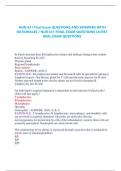
NUR-631 Final Exam QUESTIONS AND ANSWERS WITH
RATIONALES / NUR 631 FINAL EXAM QUESTIONS LATEST
REAL EXAM QUESTIONS
In which structure does B lymphocytes mature and undergo changes that commit
them to becoming B cells?
Thymus gland
Regional lymph nodes
Bone marrow
Spleen - ANSWER- ANS: C
RATIONALE: B lymphocytes mature and become B cells in specialized (primary)
lymphoid organs—the thymus gland for T cells and the bone marrow for B cells.
Neither regional lymph nodes nor the spleen are involved in changing B
lymphocytes into B cells.
An individual's acquired immunity is dependent on the function of which cells?
(Select all that apply.)
T lymphocytes
B lymphocytes
Macrophages
Opsonins
Neutrophils - ANSWER- ANS: A, B, C
RATIONALE: T lymphocytes, B lymphocytes, macrophages, and dendritic cells
are involved in acquired immunity. Opsonins are molecules that tag
microorganisms for destruction by cells of the inflammatory system; these cells are
primarily neutrophils. Neutrophils are white blood cells.
The common hay fever allergy is expressed through a reaction that is mediated by
which class of immunoglobulins?
IgE
IgG
IgM
,T cells - ANSWER- ANS: A
RATIONALE: Type I reactions are mediated by antigen-specific IgE and the
products of tissue mast cells. The most common allergies (e.g., pollen allergies) are
type I reactions. In addition, most type I reactions occur against environmental
antigens and are therefore allergic. Hay fever allergy is not mediated by IgG, IgM,
or T cells.
During an IgE-mediated hypersensitivity reaction, which leukocyte is activated?
a. Neutrophils
b. Monocytes
c. Eosinophils
d. T lymphocytes - ANSWER- ANS: C
RATIONALE: Of the options provided, only eosinophils are activated during IgE-
mediated hypersensitivity reactions.
During an IgE-mediated hypersensitivity reaction, what causes bronchospasm?
a. Bronchial edema caused by the chemotactic factor of anaphylaxis
b. Bronchial edema caused by binding of the cytotropic antibody
c. Smooth muscle contraction caused by histamine bound to H1 receptors
d. Smooth muscle contraction caused by histamine bound to H2 receptors -
ANSWER- ANS: C
RATIONALE: During an IgE-mediated hypersensitivity reaction, smooth muscle
contraction caused by histamine bound to H1 receptors results in bronchospasms.
The bronchospasm is not caused by edema or by histamine binding to H2
receptors.
A patient is having an IgE-mediated hypersensitivity reaction. What action by the
healthcare professional is best?
a. Give the patient an antihistamine.
b. Prepare to give the patient a blood transfusion.
c. Ask the patient is he/she is having pain at the site.
d. Apply warm, moist heat to the affected area. - ANSWER- ANS: A
RATIONALE: Histamine is the most potent mediator in an IgE-mediated
hypersensitivity reaction (Type 1). Histamine bound to H2 results in the
degranulation of mast cells with the release of histamine. Blocking histamine
receptors with antihistamines can control some type I responses. The healthcare
professional would not need to give the patient blood; warm; moist heat; or ask
about pain.
,A student asks about the mechanism that results in type II hypersensitivity
reactions. What description by the professor is best?
a. Antibodies coat mast cells by binding to receptors that signal its degranulation,
followed by a discharge of preformed mediators.
b. Antibodies bind to soluble antigens that were released into body fluids, and the
immune complexes are then deposited in the tissues.
c. Cytotoxic T lymphocytes or lymphokine-producing helper T 1 cells directly
attack
and destroy cellular targets.
d. Antibodies bind to the antigens on the cell surface. - ANSWER- ANS: D
RATIONALE: The mechanism that results in a type II hypersensitivity reaction
begins with antibody binding to tissue-specific antigens or antigens that have
attached to particular tissues. The cell can be destroyed by antibody IgG or IgM
and activation of the complement cascade through the classical pathway.
How are target cells destroyed in a type II hypersensitivity reaction?
a. Tissue damage from mast cell degranulation
b. Antigen-antibody complexes deposited in vessel walls
c. Cytotoxic T lymphocytes attack the cell directly.
d. Natural killer cells - ANSWER- ANS: D
RATIONALE: The mechanism that results in a type II hypersensitivity reaction
involves a subpopulation of cytotoxic cells that are not antigen specific (natural
killer [NK] cells). Antibody on the target cell is recognized by Fc receptors on the
NK cells, which releases toxic substances that destroy the target cell. Tissue
damage from mast cell degranulation occurs in type I hypersensitivity reactions.
Antigen-antibody complexes are active in type III hypersensitivity responses.
Cytotoxic lymphocytes are involved in type IV hypersensitivity responses.
Graves disease (hyperthyroidism) is an example of which type II hypersensitivity
reaction?
a. Modulation
b. Antibody-dependent cell-mediated cytotoxicity
c. Neutrophil-mediated damage
d. Complement-mediated lysis - ANSWER- ANS: A
RATIONALE: The antibody reacts with the receptors on the target cell surface
and modulates the function of the receptor by preventing interactions with their
normal ligands, replacing the ligand and inappropriately stimulating the receptor or
destroying the receptor. For example, in the hyperthyroidism (excessive thyroid
activity) of Graves disease, autoantibody binds to and activates receptors for
thyroid-stimulating hormone (TSH) (a pituitary hormone that controls the
, production of the hormone thyroxine by the thyroid). Graves disease is not a result
of cell- mediated cytotoxicity, neutrophil-mediated damage, or complement-
mediated lysis.
Immunoglobulin E (IgE) is associated with which type of hypersensitivity
reaction? a. I
b. II c. III d. IV - ANSWER- ANS: A
RATIONALE: Hypersensitivity reactions have been divided into four distinct
types: type I (IgE-mediated) hypersensitivity reactions, type II (tissue-specific)
hypersensitivity reactions, type III (immune complex-mediated) hypersensitivity
reactions, and type IV (cell-mediated) hypersensitivity reactions.
A Rh-negative woman gave birth to a Rh-positive baby. When discussing Rho[D]
immunoglobulin with her, what information should the healthcare professional
provide?
It provides protection against infection from poor immunity in the baby.
It prevents alloimmunity and hemolytic anemia of the newborn.
It provides necessary antibodies in case the mother doesn't breastfeed.
It causes the intestinal tract of the newborn to produce antibodies. - ANSWER-
ANS: B
RATIONALE: Alloimmunity occurs when an individual's immune system reacts
against antigens on the tissues of other members of the same species. This can
occur when a woman is Rh-negative and gives birth to an Rh-positive baby,
leading to hemolytic anemia of the newborn. Rho[D] immunoglobulin does not
provide protection against infection, provide antibodies to a bottle-fed baby, or
cause the intestine to produce antibodies.
Which mother does the healthcare professional prepare to administer Rh immune
globulin (Rho- GAM) to?
a. Is Rh-positive and the fetus is Rh-negative
b. Is Rh-negative and the fetus is Rh-positive
c. Has type A blood and the fetus has type O
d. Has type AB blood and the fetus has type B - ANSWER- ANS: B
RATIONALE: Hemolytic disease of the fetus and newborn (HDFN) can occur
only if antigens on fetal erythrocytes differ from antigens on maternal erythrocytes.
Maternal-fetal incompatibility exists only if the mother and fetus differ in ABO
blood type or if the fetus is Rh-positive and the mother is Rh-negative. The
healthcare professional would plan to administer Rho-GAM to the mother who is
Rh-negative whose baby is Rh positive.
RATIONALES / NUR 631 FINAL EXAM QUESTIONS LATEST
REAL EXAM QUESTIONS
In which structure does B lymphocytes mature and undergo changes that commit
them to becoming B cells?
Thymus gland
Regional lymph nodes
Bone marrow
Spleen - ANSWER- ANS: C
RATIONALE: B lymphocytes mature and become B cells in specialized (primary)
lymphoid organs—the thymus gland for T cells and the bone marrow for B cells.
Neither regional lymph nodes nor the spleen are involved in changing B
lymphocytes into B cells.
An individual's acquired immunity is dependent on the function of which cells?
(Select all that apply.)
T lymphocytes
B lymphocytes
Macrophages
Opsonins
Neutrophils - ANSWER- ANS: A, B, C
RATIONALE: T lymphocytes, B lymphocytes, macrophages, and dendritic cells
are involved in acquired immunity. Opsonins are molecules that tag
microorganisms for destruction by cells of the inflammatory system; these cells are
primarily neutrophils. Neutrophils are white blood cells.
The common hay fever allergy is expressed through a reaction that is mediated by
which class of immunoglobulins?
IgE
IgG
IgM
,T cells - ANSWER- ANS: A
RATIONALE: Type I reactions are mediated by antigen-specific IgE and the
products of tissue mast cells. The most common allergies (e.g., pollen allergies) are
type I reactions. In addition, most type I reactions occur against environmental
antigens and are therefore allergic. Hay fever allergy is not mediated by IgG, IgM,
or T cells.
During an IgE-mediated hypersensitivity reaction, which leukocyte is activated?
a. Neutrophils
b. Monocytes
c. Eosinophils
d. T lymphocytes - ANSWER- ANS: C
RATIONALE: Of the options provided, only eosinophils are activated during IgE-
mediated hypersensitivity reactions.
During an IgE-mediated hypersensitivity reaction, what causes bronchospasm?
a. Bronchial edema caused by the chemotactic factor of anaphylaxis
b. Bronchial edema caused by binding of the cytotropic antibody
c. Smooth muscle contraction caused by histamine bound to H1 receptors
d. Smooth muscle contraction caused by histamine bound to H2 receptors -
ANSWER- ANS: C
RATIONALE: During an IgE-mediated hypersensitivity reaction, smooth muscle
contraction caused by histamine bound to H1 receptors results in bronchospasms.
The bronchospasm is not caused by edema or by histamine binding to H2
receptors.
A patient is having an IgE-mediated hypersensitivity reaction. What action by the
healthcare professional is best?
a. Give the patient an antihistamine.
b. Prepare to give the patient a blood transfusion.
c. Ask the patient is he/she is having pain at the site.
d. Apply warm, moist heat to the affected area. - ANSWER- ANS: A
RATIONALE: Histamine is the most potent mediator in an IgE-mediated
hypersensitivity reaction (Type 1). Histamine bound to H2 results in the
degranulation of mast cells with the release of histamine. Blocking histamine
receptors with antihistamines can control some type I responses. The healthcare
professional would not need to give the patient blood; warm; moist heat; or ask
about pain.
,A student asks about the mechanism that results in type II hypersensitivity
reactions. What description by the professor is best?
a. Antibodies coat mast cells by binding to receptors that signal its degranulation,
followed by a discharge of preformed mediators.
b. Antibodies bind to soluble antigens that were released into body fluids, and the
immune complexes are then deposited in the tissues.
c. Cytotoxic T lymphocytes or lymphokine-producing helper T 1 cells directly
attack
and destroy cellular targets.
d. Antibodies bind to the antigens on the cell surface. - ANSWER- ANS: D
RATIONALE: The mechanism that results in a type II hypersensitivity reaction
begins with antibody binding to tissue-specific antigens or antigens that have
attached to particular tissues. The cell can be destroyed by antibody IgG or IgM
and activation of the complement cascade through the classical pathway.
How are target cells destroyed in a type II hypersensitivity reaction?
a. Tissue damage from mast cell degranulation
b. Antigen-antibody complexes deposited in vessel walls
c. Cytotoxic T lymphocytes attack the cell directly.
d. Natural killer cells - ANSWER- ANS: D
RATIONALE: The mechanism that results in a type II hypersensitivity reaction
involves a subpopulation of cytotoxic cells that are not antigen specific (natural
killer [NK] cells). Antibody on the target cell is recognized by Fc receptors on the
NK cells, which releases toxic substances that destroy the target cell. Tissue
damage from mast cell degranulation occurs in type I hypersensitivity reactions.
Antigen-antibody complexes are active in type III hypersensitivity responses.
Cytotoxic lymphocytes are involved in type IV hypersensitivity responses.
Graves disease (hyperthyroidism) is an example of which type II hypersensitivity
reaction?
a. Modulation
b. Antibody-dependent cell-mediated cytotoxicity
c. Neutrophil-mediated damage
d. Complement-mediated lysis - ANSWER- ANS: A
RATIONALE: The antibody reacts with the receptors on the target cell surface
and modulates the function of the receptor by preventing interactions with their
normal ligands, replacing the ligand and inappropriately stimulating the receptor or
destroying the receptor. For example, in the hyperthyroidism (excessive thyroid
activity) of Graves disease, autoantibody binds to and activates receptors for
thyroid-stimulating hormone (TSH) (a pituitary hormone that controls the
, production of the hormone thyroxine by the thyroid). Graves disease is not a result
of cell- mediated cytotoxicity, neutrophil-mediated damage, or complement-
mediated lysis.
Immunoglobulin E (IgE) is associated with which type of hypersensitivity
reaction? a. I
b. II c. III d. IV - ANSWER- ANS: A
RATIONALE: Hypersensitivity reactions have been divided into four distinct
types: type I (IgE-mediated) hypersensitivity reactions, type II (tissue-specific)
hypersensitivity reactions, type III (immune complex-mediated) hypersensitivity
reactions, and type IV (cell-mediated) hypersensitivity reactions.
A Rh-negative woman gave birth to a Rh-positive baby. When discussing Rho[D]
immunoglobulin with her, what information should the healthcare professional
provide?
It provides protection against infection from poor immunity in the baby.
It prevents alloimmunity and hemolytic anemia of the newborn.
It provides necessary antibodies in case the mother doesn't breastfeed.
It causes the intestinal tract of the newborn to produce antibodies. - ANSWER-
ANS: B
RATIONALE: Alloimmunity occurs when an individual's immune system reacts
against antigens on the tissues of other members of the same species. This can
occur when a woman is Rh-negative and gives birth to an Rh-positive baby,
leading to hemolytic anemia of the newborn. Rho[D] immunoglobulin does not
provide protection against infection, provide antibodies to a bottle-fed baby, or
cause the intestine to produce antibodies.
Which mother does the healthcare professional prepare to administer Rh immune
globulin (Rho- GAM) to?
a. Is Rh-positive and the fetus is Rh-negative
b. Is Rh-negative and the fetus is Rh-positive
c. Has type A blood and the fetus has type O
d. Has type AB blood and the fetus has type B - ANSWER- ANS: B
RATIONALE: Hemolytic disease of the fetus and newborn (HDFN) can occur
only if antigens on fetal erythrocytes differ from antigens on maternal erythrocytes.
Maternal-fetal incompatibility exists only if the mother and fetus differ in ABO
blood type or if the fetus is Rh-positive and the mother is Rh-negative. The
healthcare professional would plan to administer Rho-GAM to the mother who is
Rh-negative whose baby is Rh positive.


