Wilfrid Laurier University
2025 Winter CH203, CH205, and CH207
Midterm 1 Preparation Worksheet
Instructor: I-San Chan
Please note that this worksheet provides additional practice questions; this worksheet is not a
complete review of the midterm.
Section 1: Multiple Choice Questions
Instructions:
Circle the best answer on this test and fill in your final answer on your bubble sheet.
Your grade for this section is based solely on the answers you upload to Gradescope.
Therefore, you should ensure that your answers are clearly marked using HB (#2) pencils,
and you should properly upload your bubble sheet to Gradescope.
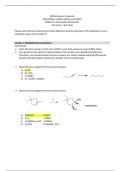
1. Select the best reagents for the reaction shown.
A. H2, Pt
B. Na, NH3
C. xs NaNH2
D. H2, Lindlar’s catalyst
2. Select the best reagents for the reaction shown.
A. 1) RCO3H 2) H3O+
B. 1) O3 2) DMS
C. 1) Hg(OAc)2, H2O 2) NaBH4
D. 1) OsO4 2) NaHSO3, H2O
,3. Select the best reagents for the reaction shown.
A. H2CrO4
B. H2SO4, H2O, HgSO4
C. 1) O3, 2) H2O
D. 1) OsO4 2) NaHSO3, H2O
4. What reagents are suitable to carry out the conversion from cyclohexene to cis-1,2-
cyclohexanediol?
A. H2SO4, heat
B. RCO3H, H3O+
C. KMnO4, H3O+, cold
D. KMnO4, NaOH, cold
5. Which of the following describes an efficient strategy for the transformation given here?
A. addition, followed by substitution
B. addition, followed by elimination
C. elimination, followed by addition
D. substitution, followed by addition
6. Which of the following describes an efficient strategy for the transformation given here?
A. addition, followed by substitution
B. addition, followed by elimination
C. elimination, followed by addition
D. substitution, followed by addition
, 7. Which reaction sequence best accomplishes this transformation?
A.
B.
C.
D.
8. What is the IUPAC name of the following compound?
A. 1-bromo-2-butanol
B. 3-bromo-2-butanol
C. 1-bromo-2-propanol
D. 2-bromo-1-propanol
9. Which of the following is the major (strongest) intermolecular interaction existing between
molecules of diols?
A. hydrogen bond
B. dipole-dipole force
C. dispersion (London) force
D. all of the above have equal strength.
10. Which of the following alcohols is the most acidic?
These 3 compounds
are equally acidic.
A. B. C. D.
2025 Winter CH203, CH205, and CH207
Midterm 1 Preparation Worksheet
Instructor: I-San Chan
Please note that this worksheet provides additional practice questions; this worksheet is not a
complete review of the midterm.
Section 1: Multiple Choice Questions
Instructions:
Circle the best answer on this test and fill in your final answer on your bubble sheet.
Your grade for this section is based solely on the answers you upload to Gradescope.
Therefore, you should ensure that your answers are clearly marked using HB (#2) pencils,
and you should properly upload your bubble sheet to Gradescope.
1. Select the best reagents for the reaction shown.
A. H2, Pt
B. Na, NH3
C. xs NaNH2
D. H2, Lindlar’s catalyst
2. Select the best reagents for the reaction shown.
A. 1) RCO3H 2) H3O+
B. 1) O3 2) DMS
C. 1) Hg(OAc)2, H2O 2) NaBH4
D. 1) OsO4 2) NaHSO3, H2O
,3. Select the best reagents for the reaction shown.
A. H2CrO4
B. H2SO4, H2O, HgSO4
C. 1) O3, 2) H2O
D. 1) OsO4 2) NaHSO3, H2O
4. What reagents are suitable to carry out the conversion from cyclohexene to cis-1,2-
cyclohexanediol?
A. H2SO4, heat
B. RCO3H, H3O+
C. KMnO4, H3O+, cold
D. KMnO4, NaOH, cold
5. Which of the following describes an efficient strategy for the transformation given here?
A. addition, followed by substitution
B. addition, followed by elimination
C. elimination, followed by addition
D. substitution, followed by addition
6. Which of the following describes an efficient strategy for the transformation given here?
A. addition, followed by substitution
B. addition, followed by elimination
C. elimination, followed by addition
D. substitution, followed by addition
, 7. Which reaction sequence best accomplishes this transformation?
A.
B.
C.
D.
8. What is the IUPAC name of the following compound?
A. 1-bromo-2-butanol
B. 3-bromo-2-butanol
C. 1-bromo-2-propanol
D. 2-bromo-1-propanol
9. Which of the following is the major (strongest) intermolecular interaction existing between
molecules of diols?
A. hydrogen bond
B. dipole-dipole force
C. dispersion (London) force
D. all of the above have equal strength.
10. Which of the following alcohols is the most acidic?
These 3 compounds
are equally acidic.
A. B. C. D.