

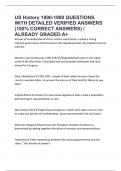
US History 1800-1900 QUESTIONS
WITH DETAILED VERIFIED ANSWERS
(100% CORRECT ANSWERS) /
ALREADY GRADED A+
Articles of Confederation✔✔First written constitution. Lacked a strong
national government and focused on the individual states. No president and no
judiciary
Western Land Ordinances 1785-1787✔✔Regulated land sales in the region
north of the Ohio River. Controlled and concentrated settlement and raise
money for Congress
Shay's Rebellion✔✔1786-1787, crowds of debt-ridden farmers closed the
courts in western Mass. to prevent the seizure of their land for failure to pay
taxes
Virginia Plan✔✔Creation of a two-house legislature with a state's population
determining its representation in each
New Jersey Plan✔✔Single-house Congress in which each state cast one vote,
as under the Articles of Confederation. Equal representation for each state.
Electoral College✔✔Determines the President. Number of electors is
determined by adding together allocation of senators and representatives
Federalism✔✔the relationship between the national government and the
states. "the division of powers"
,Separation of powers✔✔"checks and balances" between the different
branches of the national govt.
fugitive slave clause✔✔the condition of bondage remained attached to a
person even if he or she escaped to a state where slavery had been abolished.
three-fifths compromise✔✔provided three-fifths of the slave population
would be counted in determining each state's representation in the House of
Representatives and its electoral votes for president
The Federalist Papers✔✔a series of eighty-five essays that appeared in
newspapers under the pen name Publius. Written by Hamilton, Madison, John
Jay
Annuity system✔✔yearly grants of federal money to Indian tribes that
institutionalized continuing govt. influence in tribal affairs
Thomas Jefferson✔✔Louisiana Purchase; yeoman farmers; Anit-Federalist; the
embargo
James Madison✔✔Writer of the Federalist papers. Stronger national
government. "Father of the Constitution". Virginia Plan.
John Jay✔✔Writer of the Federalist papers
Alexander Hamilton✔✔Vigorous proponent of an energetic government.
Writer of the Federalist papers.
, Impressment✔✔Kidnapping sailors to serve in their navy. British kidnapped
Colonists
Federalist Party✔✔supporters of the Washington administration, pro British,
favored Hamilton's economic program, big federal govt.
Republican Party✔✔Led by Madison and Jefferson, Pro French, more faith in
democratic self-government
The Whiskey Rebellion✔✔back country Pennsylvania farmers sought to block
collection of the new tax on distilled spirits
Democratic-Republican societies✔✔supporters of the French Revolution and
critics of the Washington administration
Mary Wollstonecraft✔✔published pamphlet in England. A vindication of the
rights of woman asserted that the "rights of humanity" should not be
"confined to the male line"
Alien and Sedition Acts✔✔allowed the deportation of persons from abroad
deemed dangerous by federal authorities. Authorized the prosecution of
virtually any public assembly or publication critical of the govt.
Virginia and Kentucky resolutions✔✔attached the Sedition act as
unconstitutional violation of the First Amendment
Gabriel's Rebellion✔✔a plot by slaves in Virginia itself to gain their freedom
WITH DETAILED VERIFIED ANSWERS
(100% CORRECT ANSWERS) /
ALREADY GRADED A+
Articles of Confederation✔✔First written constitution. Lacked a strong
national government and focused on the individual states. No president and no
judiciary
Western Land Ordinances 1785-1787✔✔Regulated land sales in the region
north of the Ohio River. Controlled and concentrated settlement and raise
money for Congress
Shay's Rebellion✔✔1786-1787, crowds of debt-ridden farmers closed the
courts in western Mass. to prevent the seizure of their land for failure to pay
taxes
Virginia Plan✔✔Creation of a two-house legislature with a state's population
determining its representation in each
New Jersey Plan✔✔Single-house Congress in which each state cast one vote,
as under the Articles of Confederation. Equal representation for each state.
Electoral College✔✔Determines the President. Number of electors is
determined by adding together allocation of senators and representatives
Federalism✔✔the relationship between the national government and the
states. "the division of powers"
,Separation of powers✔✔"checks and balances" between the different
branches of the national govt.
fugitive slave clause✔✔the condition of bondage remained attached to a
person even if he or she escaped to a state where slavery had been abolished.
three-fifths compromise✔✔provided three-fifths of the slave population
would be counted in determining each state's representation in the House of
Representatives and its electoral votes for president
The Federalist Papers✔✔a series of eighty-five essays that appeared in
newspapers under the pen name Publius. Written by Hamilton, Madison, John
Jay
Annuity system✔✔yearly grants of federal money to Indian tribes that
institutionalized continuing govt. influence in tribal affairs
Thomas Jefferson✔✔Louisiana Purchase; yeoman farmers; Anit-Federalist; the
embargo
James Madison✔✔Writer of the Federalist papers. Stronger national
government. "Father of the Constitution". Virginia Plan.
John Jay✔✔Writer of the Federalist papers
Alexander Hamilton✔✔Vigorous proponent of an energetic government.
Writer of the Federalist papers.
, Impressment✔✔Kidnapping sailors to serve in their navy. British kidnapped
Colonists
Federalist Party✔✔supporters of the Washington administration, pro British,
favored Hamilton's economic program, big federal govt.
Republican Party✔✔Led by Madison and Jefferson, Pro French, more faith in
democratic self-government
The Whiskey Rebellion✔✔back country Pennsylvania farmers sought to block
collection of the new tax on distilled spirits
Democratic-Republican societies✔✔supporters of the French Revolution and
critics of the Washington administration
Mary Wollstonecraft✔✔published pamphlet in England. A vindication of the
rights of woman asserted that the "rights of humanity" should not be
"confined to the male line"
Alien and Sedition Acts✔✔allowed the deportation of persons from abroad
deemed dangerous by federal authorities. Authorized the prosecution of
virtually any public assembly or publication critical of the govt.
Virginia and Kentucky resolutions✔✔attached the Sedition act as
unconstitutional violation of the First Amendment
Gabriel's Rebellion✔✔a plot by slaves in Virginia itself to gain their freedom


