
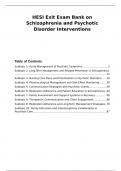
HESI Exit Exam Bank on
Schizophrenia and Psychotic
Disorder Interventions
Table of Contents
Subtopic 1: Acute Management of Psychotic Symptoms.................................2
Subtopic 2: Long-Term Management and Relapse Prevention in Schizophrenia
.......................................................................................................................11
Subtopic 3: Nursing Care Plans and Prioritization in Psychotic Disorders......20
Subtopic 4: Pharmacological Management and Side Effect Monitoring.........30
Subtopic 5: Communication Strategies with Psychotic Clients......................39
Subtopic 6: Medication Adherence and Patient Education in Schizophrenia..49
Subtopic 7: Family Involvement and Support Systems in Recovery...............58
Subtopic 8: Therapeutic Communication and Client Engagement.................68
Subtopic 9: Medication Adherence and Long-Term Management Strategies..78
Subtopic 10: Family Education and Interdisciplinary Collaboration in
Psychosis Care...............................................................................................87
,Subtopic 1: Acute Management of Psychotic
Symptoms
Question 1
A client with schizophrenia is experiencing command hallucinations
instructing them to harm themselves. What is the nurse's priority action?
A. Encourage the client to journal their thoughts
B. Ask the client what the voices are saying
C. Ensure immediate safety and notify the healthcare provider
D. Reassure the client the voices are not real
Correct Answer: C. Ensure immediate safety and notify the healthcare
provider
Rationale: Command hallucinations pose an immediate safety risk. The nurse
must prioritize client safety and collaborate with the healthcare team
promptly.
Question 2
Which medication is most effective in treating acute psychosis in
schizophrenia?
A. Lithium
B. Lorazepam
C. Haloperidol
D. Sertraline
Correct Answer: C. Haloperidol
,Rationale: Haloperidol is a first-generation antipsychotic commonly used in
acute episodes to rapidly reduce psychotic symptoms such as delusions and
hallucinations.
Question 3
A patient with schizophrenia is pacing and appears increasingly agitated.
What is the most appropriate nursing intervention?
A. Reduce environmental stimuli and speak calmly
B. Give the patient more privacy
C. Redirect the patient to watch TV
D. Administer PRN pain medication
Correct Answer: A. Reduce environmental stimuli and speak calmly
Rationale: A calm, low-stimulus environment helps de-escalate agitation and
prevent potential aggression.
Question 4
The nurse notes that a client with schizophrenia is laughing to themselves
with no apparent external stimulus. What is the best response?
A. “Why are you laughing?”
B. “You must be hearing voices.”
C. “Are you hearing something others can’t hear?”
D. “Stop laughing and talk to me.”
Correct Answer: C. “Are you hearing something others can’t hear?”
Rationale: This therapeutic response is nonjudgmental and helps assess for
hallucinations without reinforcing them.
, Question 5
A newly admitted patient with schizophrenia believes that the staff are FBI
agents. What is the best initial nursing response?
A. “I know you believe that, but I don’t see evidence of that.”
B. “That’s not true. We’re here to help.”
C. “You’re being paranoid again.”
D. “We’ll discuss that later.”
Correct Answer: A. “I know you believe that, but I don’t see evidence of
that.”
Rationale: This response acknowledges the patient's belief without validating
the delusion, maintaining trust and reality orientation.
Question 6
Which nursing intervention is most appropriate when a client with
schizophrenia is experiencing persecutory delusions?
A. Engage in logical debate
B. Promote reality-based conversations without challenging beliefs
C. Provide detailed explanations about the world
D. Isolate the client for safety
Correct Answer: B. Promote reality-based conversations without challenging
beliefs
Rationale: Confronting delusions increases defensiveness. Instead,
redirecting gently to reality is therapeutic.
Schizophrenia and Psychotic
Disorder Interventions
Table of Contents
Subtopic 1: Acute Management of Psychotic Symptoms.................................2
Subtopic 2: Long-Term Management and Relapse Prevention in Schizophrenia
.......................................................................................................................11
Subtopic 3: Nursing Care Plans and Prioritization in Psychotic Disorders......20
Subtopic 4: Pharmacological Management and Side Effect Monitoring.........30
Subtopic 5: Communication Strategies with Psychotic Clients......................39
Subtopic 6: Medication Adherence and Patient Education in Schizophrenia..49
Subtopic 7: Family Involvement and Support Systems in Recovery...............58
Subtopic 8: Therapeutic Communication and Client Engagement.................68
Subtopic 9: Medication Adherence and Long-Term Management Strategies..78
Subtopic 10: Family Education and Interdisciplinary Collaboration in
Psychosis Care...............................................................................................87
,Subtopic 1: Acute Management of Psychotic
Symptoms
Question 1
A client with schizophrenia is experiencing command hallucinations
instructing them to harm themselves. What is the nurse's priority action?
A. Encourage the client to journal their thoughts
B. Ask the client what the voices are saying
C. Ensure immediate safety and notify the healthcare provider
D. Reassure the client the voices are not real
Correct Answer: C. Ensure immediate safety and notify the healthcare
provider
Rationale: Command hallucinations pose an immediate safety risk. The nurse
must prioritize client safety and collaborate with the healthcare team
promptly.
Question 2
Which medication is most effective in treating acute psychosis in
schizophrenia?
A. Lithium
B. Lorazepam
C. Haloperidol
D. Sertraline
Correct Answer: C. Haloperidol
,Rationale: Haloperidol is a first-generation antipsychotic commonly used in
acute episodes to rapidly reduce psychotic symptoms such as delusions and
hallucinations.
Question 3
A patient with schizophrenia is pacing and appears increasingly agitated.
What is the most appropriate nursing intervention?
A. Reduce environmental stimuli and speak calmly
B. Give the patient more privacy
C. Redirect the patient to watch TV
D. Administer PRN pain medication
Correct Answer: A. Reduce environmental stimuli and speak calmly
Rationale: A calm, low-stimulus environment helps de-escalate agitation and
prevent potential aggression.
Question 4
The nurse notes that a client with schizophrenia is laughing to themselves
with no apparent external stimulus. What is the best response?
A. “Why are you laughing?”
B. “You must be hearing voices.”
C. “Are you hearing something others can’t hear?”
D. “Stop laughing and talk to me.”
Correct Answer: C. “Are you hearing something others can’t hear?”
Rationale: This therapeutic response is nonjudgmental and helps assess for
hallucinations without reinforcing them.
, Question 5
A newly admitted patient with schizophrenia believes that the staff are FBI
agents. What is the best initial nursing response?
A. “I know you believe that, but I don’t see evidence of that.”
B. “That’s not true. We’re here to help.”
C. “You’re being paranoid again.”
D. “We’ll discuss that later.”
Correct Answer: A. “I know you believe that, but I don’t see evidence of
that.”
Rationale: This response acknowledges the patient's belief without validating
the delusion, maintaining trust and reality orientation.
Question 6
Which nursing intervention is most appropriate when a client with
schizophrenia is experiencing persecutory delusions?
A. Engage in logical debate
B. Promote reality-based conversations without challenging beliefs
C. Provide detailed explanations about the world
D. Isolate the client for safety
Correct Answer: B. Promote reality-based conversations without challenging
beliefs
Rationale: Confronting delusions increases defensiveness. Instead,
redirecting gently to reality is therapeutic.


