

Written by students who passed Immediately available after payment Read online or as PDF Wrong document? Swap it for free 4.6 TrustPilot
logo-home
Document preview thumbnail
Preview 2 out of 12 pages
Exam (elaborations)

Chapter 18 Fetal Assessment During Labor Lowdermilk Study Guide Test.

Document preview thumbnail
Preview 2 out of 12 pages

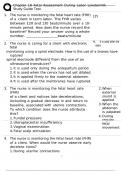
Chapter 18 Fetal Assessment During Labor Lowdermilk Study Guide Test. 1. The nurse is monitoring the fetal heart rate (FHR) of a client in term labor. The FHR varies between 120 and 130 beats/minute over a 10-minute period. How does the nurse record the baseline? Record your answer using a whole number. beats/minute 2. The nurse is caring for a client with electronic fetal 125 4. It is used after the mem- monitoring using a spiral electrode. How is the use of a branes have ruptured spiral electrode different from the use of an ultrasound transducer? 1. It is used only during the antepartum period. 2. It is used when the cervix has not yet dilated. 3. It is applied firmly to the maternal abdomen. 4. It is used after the membranes have ruptured. 3. The nurse is monitoring the fetal heart rate (FHR) of a client and notices late decelerations, including a gradual decrease in and return to baseline, associated with uterine contractions. To which condition does the nurse attribute this? 1. Fundal pressure 2. Uteroplacental insufficiency 3. Vaginal examination 4. Fetal scalp stimulation 4. The nurse is monitoring the fetal heart rate (FHR) of a client. When would the nurse observe early decelera- tions? 1. During uterine contractions 2. When external sound is applied 3. When the abdomen is palpated 4. During regular fetal movement 2. Uteroplacental insufl- ciency 1. During uterine contrac- tions 5. You are evaluating the fetal monitor tracing of your client, who is in active labor. Suddenly you see the fetal heart rate (FHR) drop from its baseline of 125 down to 80. You reposition the mother, provide oxy- gen, increase IV fluid, and perform a vaginal exam. The cervix has not changed. Five minutes have passed, and the FHR remains in the 80s. What additional nursing measures should you take? 1. Call for help. 2. Insert a Foley catheter. 3. Start oxytocin (Pitocin). 4. Notify the primary health care provider immediately. 6. The nurse caring for a laboring woman is aware that maternal cardiac output can be increased by what? 1. Change in position 2. Oxytocin administration 3. Regional anesthesia 4. Intravenous analgesic 7. Which laboring client does the nurse expect to be a likely candidate for amnioinfusion? 4. Notify the primary health care provider im- mediately. 1. Change in position 1.A client with heavily meconium-stained amni- 1. A client with heavily meconium-stained amniotic flu- otic fluid (or a low amniotic id (or a low amniotic fluid index [AFI]) 2. A client with an increase in uterine activity 3. A client with hypertension and diabetes 4. A client with an overdistended uterine cavity 8. While monitoring the fetal heart rate (FHR) of a client, fluid index [AFI]) 1. Early signs of fetal dis- the nurse notes tachycardia. What is a probable cause tress for this condition? 1. Early signs of fetal distress

Content preview

Chapter 18 Fetal Assessment During Labor Lowdermilk
Study Guide Test.
1. The nurse is monitoring the fetal heart rate (FHR) 125
of a client in term labor. The FHR varies
between 120 and 130 beats/minute over a 10-
minute period. How does the nurse record the
baseline? Record your answer using a whole
number. beats/minute
4. It is used after the
2. The nurse is caring for a client with electronic
mem-
fetal
monitoring using a spiral electrode. How is the use of a branes have
ruptured
spiral electrode different from the use of an
ultrasound transducer?
1. It is used only during the antepartum period.
2. It is used when the cervix has not yet dilated.
3. It is applied firmly to the maternal abdomen.
4. It is used after the membranes have ruptured.

3. The nurse is monitoring the fetal heart rate 2. When
(FHR) external
of a client and notices late decelerations, sound is
including a gradual decrease in and return to applied
baseline, associated with uterine contractions. 3. When the
To which condition does the nurse attribute abdomen
is palpated
this?
4. During
1. Fundal pressure
regular
2. Uteroplacental insufficiency fetal
3. Vaginal examination movement
4. Fetal scalp stimulation

4. The nurse is monitoring the fetal heart rate (FHR)
of a client. When would the nurse observe early
decelera- tions?
1. During uterine contractions
1/
12

, Chapter 18 Fetal Assessment During Labor Lowdermilk
Study Guide Test.
2. Uteroplacental insufl- ciency


1. During uterine contrac- tions


2/
12

Document information

Uploaded on
July 29, 2025
Number of pages
12
Written in
2024/2025
Type
Exam (elaborations)
Contains
Questions & answers
$15.49

Wrong document? Swap it for free Within 14 days of purchase and before downloading, you can choose a different document. You can simply spend the amount again.
Written by students who passed
Immediately available after payment
Read online or as PDF

Seller avatar
Reputation scores are based on the amount of documents a seller has sold for a fee and the reviews they have received for those documents. There are three levels: Bronze, Silver and Gold. The better the reputation, the more your can rely on the quality of the sellers work.
Nursewendo
3.7
(22)
Sold
71
Followers
19
Items
4976
Last sold
2 months ago


Why students choose Stuvia

Created by fellow students, verified by reviews

Quality you can trust: written by students who passed their tests and reviewed by others who've used these notes.

Didn't get what you expected? Choose another document

No worries! You can instantly pick a different document that better fits what you're looking for.

Pay as you like, start learning right away

No subscription, no commitments. Pay the way you're used to via credit card and download your PDF document instantly.

Student with book image

“Bought, downloaded, and aced it. It really can be that simple.”

Alisha Student

Working on your references?

Create accurate citations in APA, MLA and Harvard with our free citation generator.

Working on your references?

Frequently asked questions

